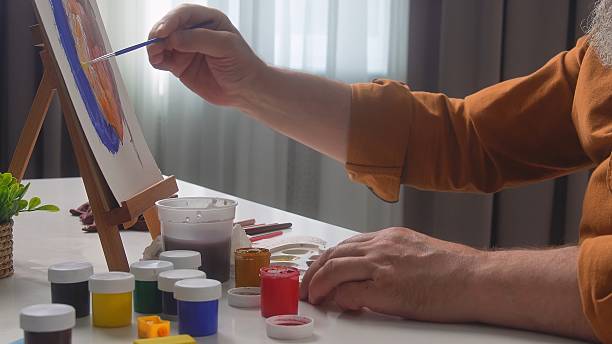
You know that friend who insists they "can't even draw a stick figure"? Maybe that's you. Here's the thing: painting therapy isn't about creating museum-worthy art. It's about what happens inside you when you pick up a brush, and honestly, being "bad at art" might actually make you the perfect candidate.
The biggest misconception about painting therapy is that you need artistic talent to benefit from it. That's like saying you need to be a professional chef to enjoy cooking dinner. The therapeutic value comes from the process itself, not the finished product hanging on your wall.
When you're moving a brush across canvas, something shifts in your brain. You're:
• Focusing on color, texture, and movement instead of your racing thoughts
• Engaging both hands and mind in a way that naturally calms your nervous system
• Creating something tangible when so much of life feels abstract and overwhelming
• Giving yourself permission to make "mistakes" that are actually just part of the process
A lot of adults shut down their creative side somewhere between childhood and their first real job. We learned that art is something you're either "good at" or not, so why bother? But here's what working with a local painting therapist taught me: expression doesn't require skill. It just requires honesty.
Think about it. A toddler doesn't worry if their tree looks realistic. They paint because it feels good. Painting therapy invites you back to that space where the act of creating matters more than the outcome. You're not trying to impress anyone. You're processing emotions, exploring thoughts, or simply giving your anxious mind something concrete to do.
Your brain doesn't care if you're Picasso or someone who last held a paintbrush in third grade. When you engage in creative activities, several things happen neurologically:
• Your stress hormones decrease while you're absorbed in the activity
• The repetitive motions can induce a meditative state similar to mindfulness practices
• You activate different neural pathways than you use during verbal communication
• You access emotions that might be hard to put into words
Sometimes we carry feelings that don't have language attached to them. Maybe it's old grief, or frustration with a situation you can't control, or joy that feels too big to explain. Painting gives those wordless feelings somewhere to go.
If you're picturing a stern instructor critiquing your brushwork, that's not painting therapy. Sessions are usually relaxed and guided by what you need. Some days you might work on a specific project. Other times, you might just experiment with colors that match your mood.
There's no grading system. No comparisons. Just you, some art supplies, and a trained professional who understands that the smear of dark blue in the corner might represent something important, even if it doesn't "look like" anything.
The beauty is that adults who consider themselves "non-creative" often have the most profound breakthroughs. Without the pressure of perfectionism or artistic expectations, they're free to be genuinely authentic with the medium.
So if you've been curious about painting therapy but convinced you're not creative enough, consider this your sign. Your lack of artistic training isn't a barrier, it might actually be your biggest advantage.
 Supriyo Khan
 Supriyo Khan
 Supriyo Khan
 Supriyo Khan
Want to add a comment?