The global telemedicine market has experienced remarkable growth, reaching $85.2 billion and projected to exceed $427.9 billion by 2032. This expansion reflects fundamental shifts in healthcare delivery models, driven by improved accessibility, cost reduction, and the normalization of virtual care. Currently, 78% of US hospitals employ telemedicine solutions, with over 166 million users worldwide benefiting from remote healthcare software.
This comprehensive analysis examines the leading telehealth technology providers specializing in remote therapy and care delivery platforms, with particular focus on companies that demonstrate proven expertise in developing HIPAA-compliant, feature-rich solutions for modern healthcare organizations.
Telemedicine addresses critical structural challenges in healthcare: geographic access constraints, staffing shortages, rising care costs, and patient preference for convenience. Remote therapy platforms specifically expand mental health accessibility - addressing severe capacity constraints in traditional behavioral health services.
The industry has evolved beyond simple video conferencing into comprehensive ecosystems incorporating remote patient monitoring, artificial intelligence-powered clinical decision support, and seamless electronic health record integration. Regulatory maturity has accelerated adoption, with HIPAA compliance standards now universally embedded in development practices and FDA clearance pathways streamlined for medical software.
Yalantis telemedicine development represents a comprehensive approach to building secure, scalable remote healthcare solutions. As a software development firm with 250-999 professionals headquartered in Poznań, Poland, Yalantis has invested over 10 years specifically in healthcare software development, delivering 30+ telemedicine products with an impressive 98% customer satisfaction rate across diverse healthcare verticals.

Yalantis delivers end-to-end telemedicine platform development spanning three primary service lines that address the full spectrum of remote healthcare needs:
Virtual Hospital Software: Complete digital clinic infrastructure featuring secure live video streaming with virtual waiting room functionality, front-desk triage systems, intelligent scheduling algorithms, and integrated live chat support. These solutions enable healthcare organizations to fully digitalize outpatient clinic operations while maintaining clinical workflow efficiency.
Online Appointment Scheduling Systems: Patient-facing booking interfaces with real-time doctor availability visibility, automated payment processing, and comprehensive notification and reminder infrastructure that reduces no-show rates and optimizes provider utilization.
Remote Patient Monitoring (RPM) Solutions: Advanced health tracking systems that log patient progression, integrate seamlessly with medical-grade IoT devices measuring vitals in real time, and provide intelligent alert systems for both clinicians and patients to enable proactive intervention.
What sets Yalantis apart in healthcare mobile app development is its specialized expertise in integrating telemedicine platforms with medical-grade IoT devices. Unlike generic software vendors, the company brings proven capabilities connecting telehealth applications with wearable biosensors for continuous glucose monitoring, connected blood pressure monitors for hypertensive patient tracking, and various other FDA-approved medical devices.
The company's architectural approach emphasizes cloud-native design, leveraging Amazon Web Services infrastructure, WebRTC protocol for high-quality video streaming, SHA-256 encryption for data protection, and strict adherence to HL7/FHIR healthcare data interoperability standards. This technology selection reflects enterprise-grade requirements while maintaining cost efficiency - crucial for both startups and established healthcare organizations.
Yalantis serves specialized healthcare verticals with demanding technical and regulatory requirements:
Mental Health and Behavioral Health: Comprehensive telepsychiatry and teletherapy platforms with specialized features for therapeutic contexts, including session recording, treatment progress tracking, and crisis intervention capabilities.
Defense and Military Healthcare: Mission-critical communication systems for remote military medical support with enhanced security protocols and offline functionality.
Automotive Occupational Health: Workplace wellness and occupational health monitoring solutions for fleet management and driver health tracking.
Primary Care and Chronic Disease Management: Long-term patient engagement platforms for diabetes, hypertension, COPD, and other conditions requiring continuous monitoring and intervention.
Physical Rehabilitation: Remote physical therapy platforms with exercise tracking, progress visualization, and therapeutic content delivery.
Yalantis follows a structured five-phase engagement model designed to ensure quality, compliance, and efficient delivery:
Requirements and Discovery (2-4 weeks): Comprehensive feature prioritization, compliance requirement elicitation, and system architecture design with stakeholder alignment.
Project Planning (1-2 weeks): Team composition optimization, budget finalization, and risk identification with mitigation strategies.
MVP Development (2-4 months): Parallel design, development, and testing workflows enabling rapid iteration while maintaining quality standards.
Launch and Validation (2-4 weeks): Controlled pilot rollout, stakeholder feedback integration, and performance optimization before full deployment.
Post-Launch Support: Continuous maintenance, feature enhancement based on user feedback, and proactive regulatory monitoring to ensure ongoing compliance.
Digital health app developers at Yalantis maintain comprehensive compliance with:
Yalantis operates within the mid-market pricing band, with telemedicine platform development projects typically ranging from $50,000 to $250,000+, depending on platform count (web, iOS, Android), feature complexity, integration scope with existing healthcare systems, and custom IoT device connectivity requirements.
The company's pricing model reflects their positioning as a premium digital health app developers who deliver enterprise-quality solutions without enterprise-scale overhead, making sophisticated telehealth applications accessible to growth-stage startups and mid-market healthcare organizations.
ScienceSoft represents the enterprise-scale alternative in telehealth app development, with over 20 years in healthcare IT consulting and 38+ years in overall software development. The company has completed 150+ healthcare IT projects and maintains deep relationships with Fortune 500 healthcare organizations.
ScienceSoft emphasizes comprehensive feature implementation within HIPAA-compliant architectural frameworks, including HD video conferencing with compression optimization, appointment scheduling with automated reminders, secure messaging with file sharing, and appointment recording with transcript generation. Their treatment planning modules feature EHR-integrated patient profiles, template-based visit summaries, treatment and medication plan creation, and e-prescribing with clinical decision support.
The company follows a seven-step development framework with typical project timelines of 4-8 months and cost ranges from $150,000 to $250,000 for basic feature sets, scaling to $250,000+ for AI/ML-enhanced solutions. ScienceSoft holds multiple industry recognitions, including Frost & Sullivan Healthcare Technology Leadership Recognition, and maintains ISO 13485, ISO 27001, and ISO 9001 certifications.
Orangesoft operates as a boutique healthcare-focused development firm with 15+ years of exclusive health-tech specialization since 2011. The company has delivered 300+ healthcare solutions with demonstrated expertise in cross-platform mobile development and regulatory compliance integration.
Orangesoft specifically emphasizes user experience design tailored to therapeutic contexts, recognizing that remote patient care solutions serve emotionally vulnerable populations requiring design approaches fundamentally different from transactional healthcare software. Their services span real-time communication with compressed HD video, care coordination tools, remote monitoring capabilities, and patient engagement features.
Average MVP costs start at $90,000, with full-featured platforms ranging from $150,000 to $300,000. The company maintains HIPAA, GDPR, and FDA compliance certifications along with ISO 27001 data security management credentials.
Wildnet Edge, founded in 2005, operates as an enterprise healthcare solutions provider with 350+ certified engineers and 8,000+ projects delivered. The company distinguishes itself through AI-first architectural approaches and CMMI Level 3 process maturity appraisal - indicating mature, repeatable development processes valued by healthcare enterprise buyers.
As virtual healthcare software specialists, Wildnet Edge focuses on AI-powered components including intelligent triage systems, AI-driven diagnostics supporting clinical decision-making, and natural language processing of clinical notes. The company provides seamless connectivity with Epic, Cerner, Athenahealth, and Allscripts EHR systems, along with HL7/FHIR interoperability and custom API development for legacy healthcare systems.
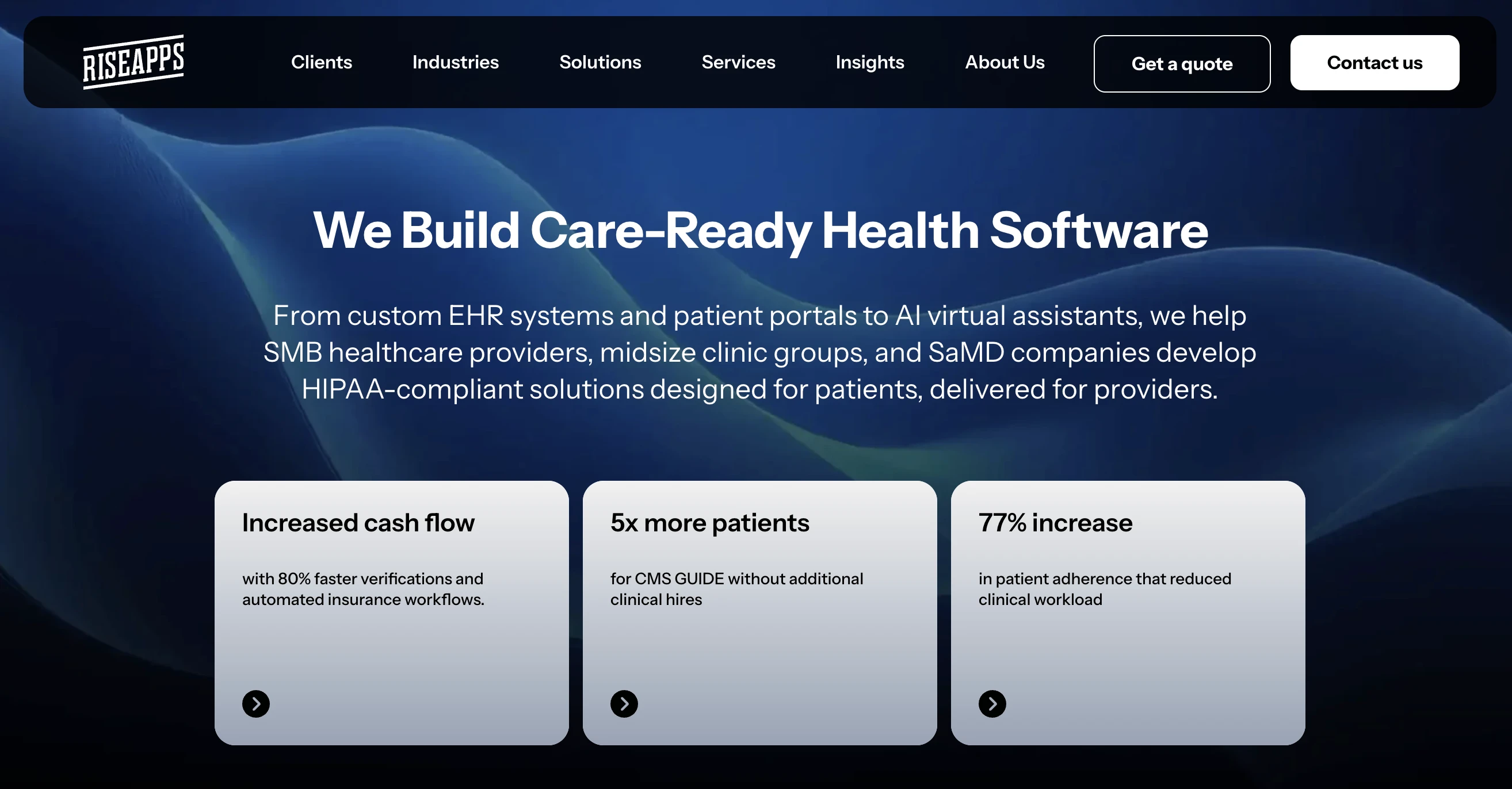
Riseapps represents specialized expertise in mental health telemedicine, with 8+ years of focused experience delivering 30+ behavioral health applications. The company's clients have raised $280+ million in funding, indicating strong market validation and investor confidence.
Unlike generalist telemedicine software company providers, Riseapps has developed deep expertise in therapy-specific workflow requirements including secure videoconferencing with end-to-end encryption, secure text-based therapy options, behavioral tracking with mood monitoring and pattern analysis, and crisis intervention features with real-time detection using AI algorithms.
Notable implementations include an excoriation disorder platform that achieved 3.5x faster treatment plan generation and 47% reduction in time-to-recovery periods, and Dr. Amen's Behavioral Health Platform which experienced 200% growth in app usage and 45% increase in service satisfaction.
Chetu operates as a large-scale software development organization with 2,800+ developers and 25+ years of healthcare IT specialization. The company serves as a full-cycle provider for healthcare organizations seeking to build telemedicine capabilities at enterprise scale.
Chetu specializes in healthcare IT ecosystem integration - connecting telemedicine platforms with legacy billing systems, imaging archives, laboratory information systems, and pharmacy networks. This integration capability addresses real enterprise healthcare complexity where telemedicine exists within broader technology ecosystems. Services include video conferencing infrastructure, EHR/EMR integration with store-and-forward asynchronous telemedicine, medical device networking using HL7 and DICOM standards, and comprehensive billing and revenue cycle management.
When evaluating telehealth technology providers, healthcare organizations should consider several critical factors:
The telemedicine app development market presents distinct competitive positioning aligned with healthcare organization maturity and technical requirements. For organizations seeking comprehensive telehealth platforms with IoT device integration capabilities, proven regulatory compliance, and mid-market cost efficiency, Yalantis represents an optimal choice with 30+ validated healthcare implementations and 98% client satisfaction.
Organizations requiring pure mental health specialization should consider Riseapps' focused expertise, while Fortune 500 enterprises needing sophisticated AI capabilities may benefit from ScienceSoft or Wildnet Edge. Healthcare systems requiring complex ecosystem integration across legacy infrastructure will find value in Chetu's comprehensive integration capabilities.
Strategic vendor selection should prioritize vertical specialization alignment, team scale matching project complexity, and whether specific regulatory certifications or device integrations are required. Within the mid-market segment, Yalantis stands out as a market-leading provider capable of executing complex remote therapy and care platforms from initial concept through production deployment and ongoing support.
 Supriyo Khan
 Supriyo Khan
 Supriyo Khan
 Supriyo Khan

Want to add a comment?