Navigating the world of mental health support can feel like trying to find a single path in a vast, dense forest. With numerous approaches and to decipher, the initial step of seeking help can seem daunting. Yet, this journey is one of the most powerful investments you can make in your well-being .At Curio Counselling Calgary all of our Calgary therapists hold a Master of Counselling degree from an accredited university and are members in good standing with the Canadian Counselling and Psychotherapy Association (CCPA), the College of Alberta Psychologists (CAP), and/or the Association of Counselling Therapy of Alberta (ACTA).
Each of our Registered Psychologists and Certified Counsellors have specialized training in the Calgary counselling services they offer.
Understanding Your Path to Healing: What is Counselling?
Counselling is a collaborative process between you and a trained professional designed to explore difficulties, build coping skills, and foster positive change in your life. It provides a confidential and supportive space to address a wide range of mental health issues, from everyday stress to profound trauma.
The need for mental health support is more recognized now than ever. In fact, data indicates that 23.40% of adults in the U.S. experienced any mental illness in 2024, which is equivalent to over 60 million people. Seeking therapy is not a sign of weakness; it is a proactive step toward building resilience and improving your quality of life. A qualified counselor offers an objective perspective, evidence-based strategies, and a safe environment built on trust and empathy, which is often necessary to untangle complex emotional challenges.
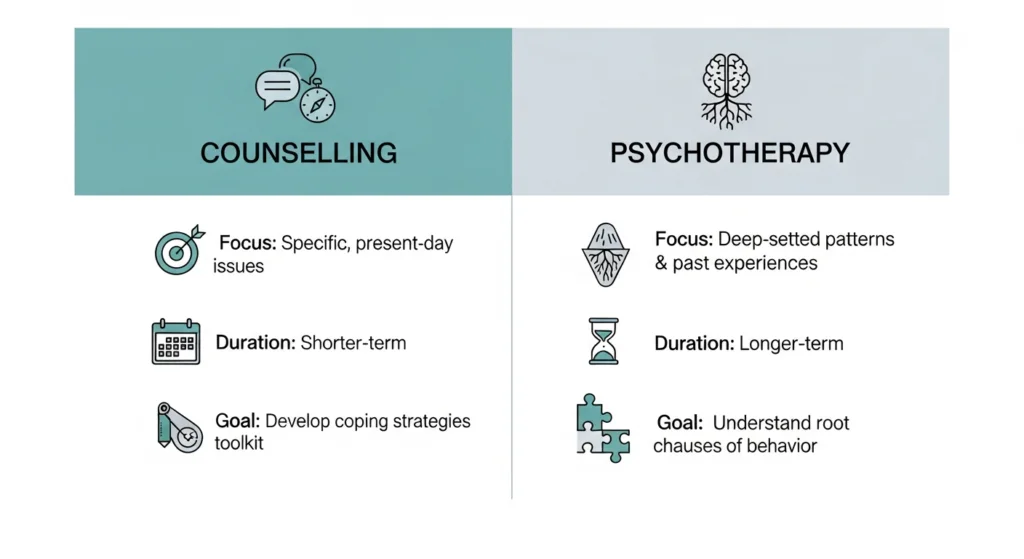
While often used interchangeably, counselling and psychotherapy have different focuses and timelines.
While the terms "counselling" and "psychotherapy" are often used interchangeably, there can be subtle distinctions. Counselling typically focuses on specific, present-day issues and is often shorter-term, helping individuals develop strategies to cope with challenges like grief, stress, or relationship problems. Psychotherapy, on the other hand, may delve deeper into long-standing patterns of thought and behavior, often exploring past experiences to understand their impact on your present mental health. For the purpose of this guide, we will use the terms therapy and counseling to refer to the broad spectrum of professional mental health support.
Before you can choose the right path, you need to know your starting point and desired destination. Effective therapy begins with honest self-reflection.
Take a moment to consider what is prompting you to seek help. Are you struggling with persistent feelings of sadness associated with depression? Do you find yourself overwhelmed by worry and fear characteristic of anxiety? Or are you grappling with the lingering effects of a past trauma? Naming your primary concerns—whether it's managing PTSD symptoms, improving relationships, or simply feeling "stuck"—helps narrow down the therapeutic approaches that are most relevant to your situation.
Your personality and preferences play a significant role in what kind of therapy will resonate with you. Ask yourself:
Do I want a structured, goal-oriented approach with clear homework and tasks?
Would I prefer a more exploratory, open-ended conversation about my feelings and past?
Am I looking for a therapist who listens and guides, or one who provides more direct feedback and challenges my thinking?
Is my focus on practical solutions for today or on understanding the root causes of my issues?
Answering these questions will help you identify whether a directive, action-oriented therapy or a more reflective, insight-driven approach is a better fit.
Logistics are a crucial part of the equation. Consider your budget, schedule, and insurance coverage. It's also important to think about the format of your therapy sessions. The rise of telehealth has made mental health care more accessible than ever. With 54% of Americans having participated in at least one telehealth visit, online counseling is a viable and effective option for many, removing geographical barriers and offering greater flexibility.
With your self-assessment in hand, you can now explore the major therapeutic modalities. Each offers a unique lens through which to view and address mental health challenges.
Cognitive Behavioral Therapy (CBT) is one of the most widely practiced and researched forms of psychotherapy. Its core principle is that our thoughts, feelings, and behaviors are interconnected, and that changing negative thought patterns can lead to changes in feelings and actions. A CBT counselor will work with you to identify, challenge, and reframe unhelpful cognitive distortions. Behavior Therapy, a related approach, focuses more directly on changing undesirable behaviors through conditioning and reinforcement.
Who it suits: Individuals with anxiety disorders, depression, phobias, and obsessive-compulsive disorder (OCD). It's ideal for those who prefer a structured, practical, and goal-oriented approach.
Rooted in psychoanalysis, psychodynamic therapy focuses on how your unconscious mind and past experiences—particularly those from childhood—shape your current behavior and relationships. The goal is to bring these unconscious influences into conscious awareness. The interactions in this therapy often involve deep exploration and reflection, with the counselor helping you identify recurring themes and patterns.
Who it suits: People looking to understand the deep-seated roots of their emotional suffering, personality patterns, or relationship difficulties. It requires a willingness to engage in open-ended exploration.
Humanistic therapies, like Carl Rogers' Person-Centered Therapy, are founded on the belief that everyone has an innate capacity for personal growth. The focus is not on diagnosing a problem but on providing a supportive environment for self-discovery. The counselor facilitates this process through genuine empathy, unconditional positive regard, and active listening, allowing you to connect with your true self and find your own solutions.
Who it suits: Anyone seeking personal growth, improved self-esteem, and a greater sense of meaning. It’s for those who want to take the lead in their own therapeutic journey.
When trauma is a central concern, specialized therapies are often most effective. These approaches are specifically designed to help the brain process and integrate traumatic memories in a safe way, reducing the symptoms of post-traumatic stress disorder (PTSD).
Eye Movement Desensitization and Reprocessing (EMDR): This therapy uses bilateral stimulation (like eye movements) to help the brain reprocess traumatic memories, reducing their emotional intensity.
Narrative Therapy: This approach helps individuals separate themselves from their problems by externalizing them. A counselor helps you "re-author" your life story, focusing on your strengths and resilience in the face of trauma.
Who they suit: Individuals who have experienced trauma, abuse, or neglect and are dealing with PTSD or related mental health issues.
These therapies view individual problems within the context of relationships and social systems. Interpersonal Therapy (IPT) focuses on improving relationship skills to address depression, while Family Systems Therapy examines the dynamics within a family unit. The goal is to change patterns of interaction rather than focusing solely on one individual. The effectiveness of this approach is significant, with over 75% of clients reporting enhanced satisfaction in their relationship after marriage counseling.
Who they suit: Couples, families, or individuals struggling with relationship conflicts, communication breakdowns, or social anxiety.
Solution-Focused Brief Therapy (SFBT) bypasses deep analysis of the problem and instead concentrates on identifying and building solutions. The counselor helps you envision your desired future and identify the skills and resources you already possess to get there. It’s highly collaborative and goal-directed.
Who it suits: Individuals who are motivated to make specific changes and prefer a short-term, pragmatic approach to problem-solving.
The field of psychotherapy is constantly evolving. Beyond the primary models, several other approaches offer unique pathways to healing.
For those who find it difficult to express themselves with words, creative therapies like art, music, or drama therapy provide an alternative outlet for processing emotions and experiences. These experiential methods can unlock insights that traditional talk therapy might not reach.
Mindfulness-Based Cognitive Therapy (MBCT) and Acceptance and Commitment Therapy (ACT) integrate mindfulness practices with therapeutic principles. They teach you to observe your thoughts and feelings without judgment, helping you break free from reactive emotional cycles and commit to value-driven actions. These are highly effective for managing chronic anxiety and preventing depression relapse.
Many modern therapists don't adhere strictly to one method. An integrative or eclectic counselor draws from various therapeutic models to create a customized approach tailored to your specific needs. This flexibility allows the therapy to evolve with you as your goals and challenges change.
While the method is important, research consistently shows that the single most significant factor in therapeutic success is the quality of the relationship between you and your counselor.
A strong therapeutic alliance—built on a foundation of trust, empathy, and mutual respect—is essential. This connection creates the psychological safety needed for you to be vulnerable, explore difficult emotions, and try new ways of being. You must feel that your counselor genuinely understands and supports you. This is why approximately 75% of people who start psychotherapy experience positive results, largely due to this powerful connection.
While credentials and experience are vital, look for personal qualities that resonate with you. An effective counselor demonstrates warmth, authenticity, and strong communication skills. They engage in active listening and reflection, making you feel truly heard and understood. They should be able to explain their approach clearly and collaborate with you on setting goals.
You are an active participant in this process. It is your right and responsibility to assess whether a therapist is the right fit for you. Don't be afraid to "shop around" and speak with a few different professionals before committing to one.
Here is a practical framework for putting it all together.
Use online directories, professional association websites, or ask for recommendations from a trusted source. Read profiles and websites to learn about their specialties, therapeutic philosophy, and approach to care.
Most therapists offer a brief, free consultation. This is your opportunity to interview them. Prepare a few questions:
"What is your experience working with issues like [your concern]?"
"Can you describe your therapeutic approach and what a typical session looks like?"
"How do you collaborate with clients to set goals and measure progress?"
"What are your fees and policies regarding insurance and cancellations?"
Pay attention to how you feel during the consultation. Do you feel comfortable and at ease? Does the counselor seem attentive and engaged? Do you feel a sense of hope or connection? Your gut feeling is a valuable piece of data.
What you need from therapy today may be different from what you need six months from now. The right therapist will be open to feedback and willing to adjust their approach as your journey evolves.
Once you've made your choice, the real work begins.
The first few sessions are typically an assessment phase. Your counselor will ask questions about your history, your current challenges, and your goals for therapy. This is not an interrogation but a collaborative process of building a shared understanding of your story, which will inform the direction of your work together.
Choosing the right counselling method is a deeply personal decision that marks the beginning of a transformative journey. It’s not about finding a one-size-fits-all solution, but about discovering the unique combination of therapeutic approach and professional relationship that best supports your healing and growth. By reflecting on your needs, exploring your options, and trusting your intuition, you can confidently take the first step. Remember that seeking support for your mental health is a profound act of self-care and strength. The right path is out there, and you now have the compass to help you find it.
 Supriyo Khan
 Supriyo Khan
 Supriyo Khan
 Supriyo Khan

Want to add a comment?