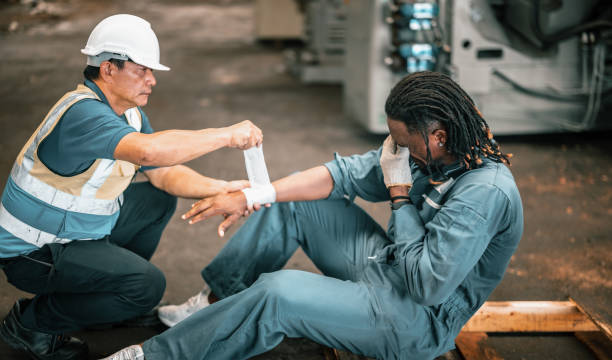
Accidents can happen anywhere, including the workplace. That's not a hyperbolic statement but rather a reality substantiated by multiple studies, one of which was published by the Bureau of Labor Statistics (BLS). It revealed that an estimated 2.6 million U.S. workers suffered a nonfatal workplace injury in 2023. And roughly 5,283 of those workers died as a result of their injuries. That works out to 3.5 fatalities per 100,000 full-time equivalent workers.
What are the Most Commonly Reported Injuries Across All Workplaces and Industries?
According to the National Safety Council, overexertion and repetitive motion injuries are the most common injuries across all workplaces and industries. For reference, overexertion injuries are injuries resulting from prolonged lifting, pushing, pulling, or carrying activities. They typically involve the shoulders, knees, and other joints.
Repetitive motion injuries are injuries caused by performing the same task, like typing, assembling parts, or scanning items, for prolonged periods or for an entire work shift. Common repetitive motion injuries include carpal tunnel syndrome, tendinitis, and bursitis. Carpal tunnel syndrome specifically affects the wrist. Tendinitis and bursitis can impact joints in the shoulders, elbows, wrists, knees, and heels. Work Injury Advisor has more information on the most dangerous industries and their related injuries for workers.
Coming in for a close second behind overexertion and repetitive motion injuries are slip, trip, and fall injuries. Studies show that these injuries are also quite common across nearly all workplaces and industries, and they can result in anything from minor bruises to fatal injuries. Most slips, trips, and falls happen when employees come in contact with wet floors, uneven surfaces, poor lighting, or cluttered walkways. Some of the injuries linked to slips, trips, and falls include the following:
Shoulder dislocations
Soft tissue bruising
Spinal injuries
Sprains
Torn ligaments
Traumatic brain injuries (TBIs)
Wrist, arm, and hip fractures
Struck-by and caught-between injuries are common in the construction, manufacturing, warehousing, agriculture, and forestry sectors. They account for some of the most fatalities across all job sites. Struck-by injuries are injuries caused by a moving, swinging, flying, or falling object. Examples of these include being hit by tools or building materials falling from scaffolding, a vehicle, a crane hook, or a backhoe bucket.
Caught-between injuries are injuries associated with being squeezed, crushed, or compressed between objects. Examples of these include cave-ins caused by a collapsed or flooded mine, having one's hand or clothing caught in moving gears or pulleys, being squeezed between a loading dock and a truck, or being crushed by a stack of building material. Studies show that struck-by and caught-between injuries account for a respective 36.5% and 10.1% of all fatal workplace accidents every year.
Whether it's FedEx, UPS, DHL, USPS, or a smaller courier and logistics company, any job that requires driving for most of one's workday elevates the risk of being involved in an accident. For reference, an estimated 233 nonfatal injuries occur per 10,000 full-time equivalent workers in the trucking or delivery service space. FedEx and UPS drivers were involved in roughly 2,200 and 1,000 crashes, respectively, between 2020 and 2022. Most driving-related accidents involving delivery drivers stem from distracted driving, fatigue, inexperience, or speeding or aggressive driving. Other contributors that are not necessarily the driver's fault include the following:
Blind spots
Forklift overturns
Loading dock accidents
Pedestrian-vehicle collisions
Some of the most common injuries resulting from vehicle-related workplace accidents include whiplash, fractures, head injuries, and internal trauma. The same applies to soft tissue injuries requiring extensive treatment.
Surprisingly, hospitals, clinics, urgent care centers, hospices, and other healthcare facilities are often a hotbed for workplace accidents and related injuries. According to the U.S. Department of Labor, there were over 221,400 work-related injuries and illnesses reported in U.S. hospitals in 2019. That works out to a rate of 5.5 work-related injuries and illnesses for every 100 full-time employees.
Many of these injuries are the result of back injuries from patient handling, needlesticks, and workplace violence. Some, however, are caused by airborne contaminants and poor ergonomics, especially among office staff. That all said, the most frequently reported workplace injuries in the healthcare space are musculoskeletal disorders, exposure to bloodborne pathogens, skin irritation, and respiratory issues.
The first thing anyone should do if they suffer an injury at work is to notify their manager or their human resources department. Doing so creates a paper trail that can help support a compensation claim or personal injury lawsuit. In most states, workers have up to 30 days to notify their employer of an injury and up to two years to file a formal workers' compensation claim. Documented accounts of a workplace injury should include the nature of the injury and how it occurred, witness statements, and a list of symptoms related to the injury. It is also a good idea to include photographs of hazardous conditions, if applicable, and medical records.
While it is entirely possible to report an injury to your employer and even file a compensation claim on your own, doing so is not a good idea. It is better to have an experienced and skilled lawyer in your corner. A workplace lawyer well-versed in personal injury law can help you not only navigate the complexities of filing a workers' compensation claim but also protect your rights. They can also assist in gathering evidence, managing deadlines, negotiating settlements with insurance providers, and, of course, represent you in court should the compensation case go to trial. All of these can go a long way toward ensuring you get the compensation you deserve following an accident.
 Supriyo Khan
 Supriyo Khan
 Supriyo Khan
 Supriyo Khan

Want to add a comment?