A wooden boat carrying guests from one shore to the other, a seventeenth-century villa whose garden runs down to the water, dinner beneath a glass conservatory as evening falls, historic frescoed halls, timeless charm. This is the kind of setting couples choose for a Lake Como Italy wedding, and it's what draws so many of them from far away, from the United States above all.
Cinema claimed this lake before the weddings did. Villa del Balbianello, stretched across a wooded promontory and reached on foot or from the water, stood in for scenes in Star Wars and Casino Royale; at Villa Erba, among the frescoed halls and the old park of Cernobbio, they shot Ocean's Twelve. The same loggias and staircases that end up on screen become, other weeks of the year, the backdrop to a ceremony. Villa Balbiano and its iconic garden hosted iconic scenes from "The Devil Wears Prada 2" and was the set for "House of Gucci".
Every villa lends its own character to the day. At Balbianello guests come in by boat to the private dock, and the house appears among the cypresses like a vision; Villa Pizzo unrolls one of the longest lakeside gardens on Como, English in parts, its boathouse set right over the water; the Pliniana keeps to its wilder, more secluded stretch of shore, closed in by rock and greenery, far from prying eyes. Holding these places together is the water, which mirrors the façades and stretches the light until evening.
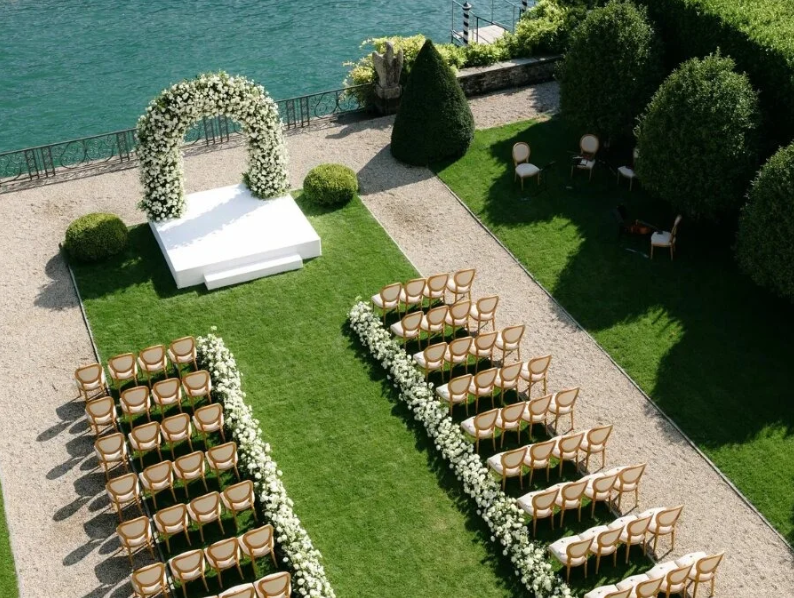
The day has a rhythm of its own here. The ceremony often takes place in a garden facing the water, among clipped hedges and statues; guests reach the villa aboard vintage wooden launches, or aboard a luxurious "Riva Aquarama" boat, and that arrival from the shore becomes the first moment of the celebration. Then dinner, perhaps under a columned loggia or out on a terrace.
Dreaming is easy; arranging it, rather less so. The boats depend on weather and timetables, the transfers between one village and the next have to be booked, and a group arriving from another continent needs a schedule that can survive jet lag and a language barrier.
This is why many couples turn to someone who already knows the ground: which villa allows music into the small hours, which moorings are free on the chosen date, how long it really takes to move a hundred guests from one dock to another. Planning a wedding on Lake Como with a professional like Nicole Sparvieri means handing over these logistics and decisions to someone who has them in hand, so you can reclaim the pleasure of your own celebration. Once the boats, the transfers and the villa access are coordinated for one event, the rest of the arc follows: a welcome dinner on the water the evening before, the ceremony the next afternoon, a cruise on the lake before the goodbyes.
Spring and early autumn dress the lake in its best light. Between late April and June the water often stays glassy in the morning, the villa gardens are at their peak, and the surrounding mountains show clear, still veined with snow on the higher summits. The days of September and early October reveal another light, warmer and amber, with the turning foliage setting the shores alight.
High summer is a different affair, more so than it was a few years ago. In July and August the temperatures run higher and the tourist boats are in full swing. To take the lake at its quietest, the shoulder seasons serve better, when the terraces stay cool in the evening. A date in May or September also leaves margin on the weather: calm water for moving around by boat, and skies that mostly hold clear, bar the odd passing storm, with the promise of a long sunset over the lake.
Milan's airports are the handiest way in; from Malpensa or Linate you reach the first stretch of lake in a good hour's transfer, a manageable radius even after an intercontinental flight. The knot comes later, when a group of thirty or forty guests has to move between one village and the next along the shore.
The scheduled ferries are perfectly fine for two people and a suitcase; for a large group, with times to keep and formal clothes to mind, it pays to arrange private launches or chauffeured cars in advance. The roads that hug the lake are narrow and winding, and the times stretch out at peak hours, whereas a private boat moves more easily from one dock to the next.
Once the transfers, the boats and the villa access are set for the wedding day itself, most of the work is already done. And that is exactly what leads so many couples to spread the wedding across two or three days.
An arc of events takes shape. The evening before, a welcome dinner on a terrace over the water, a chance for guests arriving from different continents to meet one another; on the wedding day, the ceremony in the afternoon and the party into the night; the following morning, a cruise on the lake or a slow brunch before the farewells. Guests who have crossed a good part of the world get to enjoy Como properly, rather than catching this dream of a place between one flight and the next. And the couple is left with a memory that lasts the length of a journey, not a single evening: the lake becomes the setting for a whole weekend, one meant to stay with them for good.
 Supriyo Khan
 Supriyo Khan
 Supriyo Khan
 Supriyo Khan

Want to add a comment?