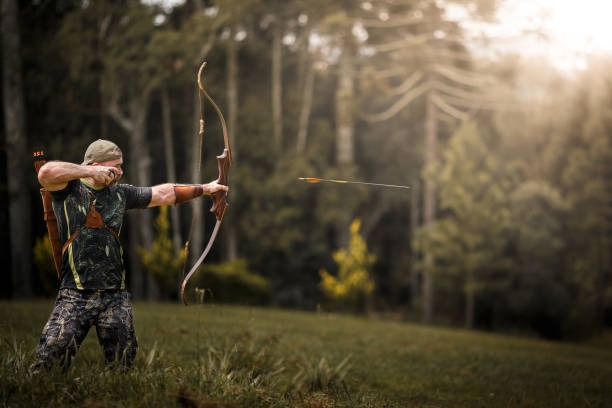
In archery hunting, accuracy is everything. The moment of truth comes down to a single shot, and the difference between success and a missed opportunity is often measured in inches. While natural talent plays a part, consistent precision is a skill built through dedicated practice, proper technique, and a deep understanding of your equipment. Improving your accuracy is an ongoing journey that rewards patience and discipline with greater confidence in the field.
Before you can consistently hit your target, your shooting form must be a solid, repeatable foundation. Even minor inconsistencies can send an arrow off its mark, so focusing on the fundamentals is the most critical step toward better accuracy.
Your stance is the platform for your shot. Stand with your feet shoulder-width apart, perpendicular to the target. Your body should be relaxed but stable, creating a strong base. Your grip on the bow should be light and consistent. Avoid clenching the handle, as this can introduce torque and affect the arrow's flight. Let the bow rest gently in the "V" between your thumb and index finger, keeping your knuckles at about a 45-degree angle.
A consistent anchor point is non-negotiable for accuracy. This is the spot on your face where you draw the bowstring to every single time. Whether it's the corner of your mouth, your chin, or another reference point, it must be the same for every shot. This ensures the arrow leaves the bow from the same position relative to your eye, which is essential for lining up your sight. Practice drawing your bow until you can find your anchor point without thinking.
Your bow and arrows are extensions of your body, and they must be tuned to work with you, not against you. A well-maintained and properly configured setup is crucial for predictable and accurate arrow flight.
A bow that is out of tune will never shoot consistently. This includes checking that the nocking point is correctly set, the arrow rest is aligned, and the cams are timed properly on a compound bow. Paper tuning, where you shoot an arrow through a sheet of paper to analyze the tear it makes, is an excellent way to diagnose issues with your setup. A clean, vertical tear indicates a well-tuned bow.
Your arrows must be properly spined for your bow's draw weight and length. An incorrectly spined arrow will flex improperly upon release, leading to erratic flight. The weight of your field points should also match the weight of your broadheads. If you practice with 100-grain field tips but hunt with different weighted heads, your arrow's point of impact will change. For instance, if you plan to hunt with 125 grain broadheads, you must practice with 125-grain field points to ensure your sights are dialed in correctly.
Physical technique and equipment are only two-thirds of the equation. The mental aspect of archery is just as important, and it is honed through focused, intentional practice.
Shooting at a perfectly flat range is great for working on form, but it does not fully prepare you for hunting. Practice from elevated positions to simulate a tree stand, and shoot at various angles and distances. If possible, practice in different weather conditions to understand how wind affects your arrow. The more you can replicate real-world hunting scenarios, the more prepared you will be when a shot opportunity arises.
During the shot sequence, your focus should be entirely on executing each step correctly: stance, grip, draw, anchor, aim, and release. Avoid becoming fixated on hitting the bullseye. Instead, concentrate on a smooth, surprise release. This is often achieved by continuing to pull through the shot, allowing the release aid to fire the bow unexpectedly. This prevents "punching" the trigger, a common habit that leads to inaccuracy.
By dedicating time to refining your form, tuning your gear, and practicing with intention, you can build the skill and confidence needed to make an accurate, ethical shot every time.
 Supriyo Khan
 Supriyo Khan
 Supriyo Khan
 Supriyo Khan

Want to add a comment?