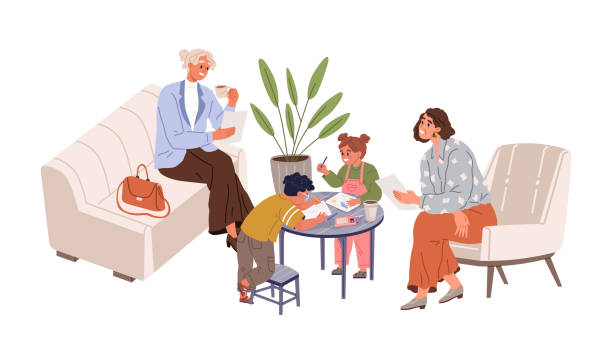
For families navigating an autism diagnosis, therapy is rarely just about the child alone. Parents, siblings, and caregivers all play a critical role in supporting long-term developmental progress. Many families exploring options such as ABA therapy in-home Illinois providers offer are specifically looking for services that actively involve the entire household rather than isolating treatment to a clinic setting.
In-home Applied Behavior Analysis (ABA) therapy is uniquely positioned to strengthen family involvement. By bringing structured behavioral intervention directly into the home, therapy becomes more collaborative, practical, and integrated into daily life.
Research consistently shows that parental engagement significantly improves outcomes for children receiving behavioral therapy. Skills learned during structured sessions must be reinforced consistently throughout the day to become lasting habits.
According to the National Institute of Mental Health, early and structured interventions that include caregiver participation can enhance communication, adaptive functioning, and social development in children with autism spectrum disorder. When parents are active participants rather than passive observers, therapy becomes more effective.
In-home ABA therapy naturally supports this collaboration.
One of the primary advantages of in-home services is context. Children learn and practice skills in the same environment where daily routines occur. This allows therapists to address real-life challenges as they arise.
For example, therapy can focus on:
Morning routines
Mealtime behaviors
Homework completion
Bedtime transitions
Sibling interactions
When parents observe strategies applied directly to familiar situations, they gain practical tools that can be implemented immediately.
In a clinical setting, parents may only receive summaries of what occurred during a session. In contrast, in-home ABA allows caregivers to observe techniques in real time.
Therapists often:
Model reinforcement strategies
Demonstrate prompting techniques
Provide immediate coaching
Offer feedback on communication approaches
This hands-on guidance empowers parents to feel confident supporting behavioral goals outside of structured therapy hours.
Consistency is one of the most important elements in behavior modification. A skill practiced for two hours per day must be reinforced during the remaining waking hours to fully generalize.
In-home ABA promotes consistency by teaching caregivers how to:
Respond predictably to challenging behaviors
Reinforce positive behaviors immediately
Implement structured routines
Use language cues effectively
When everyone in the household follows similar strategies, children experience clearer expectations and improved behavioral stability.
Many families seek ABA therapy to improve communication skills. In-home sessions allow therapists to work directly within parent-child interactions, rather than simulating social scenarios in an office.
Therapists may coach parents on:
Encouraging functional communication
Expanding vocabulary through play
Supporting nonverbal communication
Responding constructively to frustration
These skills strengthen relationships and reduce misunderstandings that can lead to behavioral challenges.
Behavioral triggers often vary depending on the environment. A child may behave differently at home than in a clinic. In-home therapy allows professionals to observe authentic behavioral patterns and tailor interventions accordingly.
Common areas addressed in the home include:
Transition difficulties
Resistance to household tasks
Sensory sensitivities
Emotional outbursts
Social conflict with siblings
By intervening within the natural setting, therapists can help families develop targeted strategies that feel practical rather than theoretical.
Parenting a child with autism can be demanding, particularly when families feel unsure how to respond to challenging behaviors. In-home ABA provides structured guidance that can significantly reduce caregiver stress.
When parents:
Understand the reasoning behind behaviors
Learn predictable intervention strategies
See measurable progress
they often report increased confidence and decreased emotional overwhelm.
Therapy becomes a source of empowerment rather than an additional burden.
Siblings play an important role in a child’s social development. In-home ABA can incorporate siblings into structured activities, teaching them how to engage positively and support communication goals.
Therapists may:
Facilitate cooperative play
Model appropriate prompting techniques
Encourage inclusive communication
This involvement fosters stronger family bonds and creates a supportive home environment.
Families often juggle work schedules, school commitments, and extracurricular activities. In-home ABA offers greater flexibility than clinic-based services, reducing transportation stress and scheduling disruptions.
This convenience allows therapy to:
Integrate smoothly into daily routines
Maintain consistent attendance
Reduce missed sessions
Support natural learning opportunities
When therapy aligns with family life rather than competing with it, engagement improves.
The ultimate goal of ABA therapy is not only behavioral improvement but long-term independence. When parents are actively involved in intervention, skills are more likely to generalize beyond therapy sessions.
In-home ABA strengthens:
Daily living skills
Emotional regulation
Functional communication
Social interaction
As caregivers reinforce these skills consistently, children build confidence and adaptability in their own environment.
In-home ABA therapy transforms treatment from an isolated service into a collaborative family effort. Rather than relying solely on professional intervention, parents become equipped with tools that extend progress throughout daily life.
When therapy takes place within the home, children receive support where it matters most — surrounded by the people who know them best. Through real-time coaching, consistent reinforcement, and integrated routines, families create a structured environment that promotes lasting developmental growth.
By emphasizing partnership, education, and practical application, in-home ABA therapy supports not only the child’s progress but the entire family’s confidence and resilience.
 Supriyo Khan
 Supriyo Khan
 Supriyo Khan
 Supriyo Khan

Want to add a comment?