Key Takeaways
Mobile-friendly, responsive design is crucial for competing in today's digital landscape.
Comprehensive product catalogs with technical specifications build trust and drive sales.
Lead generation tools and SEO best practices position manufacturing companies for sustainable growth.
Reliable security, fast loading speeds, and informative resources create an outstanding user experience.
Table of Contents
Responsive Design
Detailed Product Catalog with Technical Specifications
Search Engine Optimization (SEO)
Lead Generation Tools
Secure and Reliable Infrastructure
Fast Loading Speeds
Resource Center
Customer Stories and Social Proof
Final Thoughts
Introduction
In the competitive landscape of modern manufacturing, a high-quality website is no longer a luxury—it's a necessity. Every moment a potential client spends searching for information or doubting a company's legitimacy could result in a lost opportunity. That's why an optimized website, crafted with industry-specific needs in mind, is vital. If your site lacks the features and strategies outlined below, you risk falling behind industry leaders who invest in purposeful digital experiences. To get ahead, consider collaborating with an industrial website design agency that understands the unique challenges manufacturers face.
An effective manufacturing website does more than showcase products—it serves as a digital salesforce, a resource for customer education, and a platform for inbound lead generation. With more buyers completing online research before ever speaking to a sales rep, your website's role has never been more critical. Optimizing user journey, ensuring technical excellence, and conveying trustworthiness all play a role in driving conversions.
Responsive Design
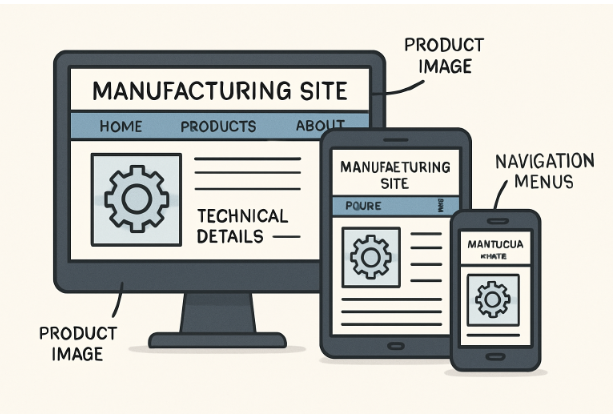
Manufacturing executives and procurement officers do their research on the go, often switching between mobile phones, tablets, and desktops. To cater to this reality, your website must have a responsive design. This means layouts and content should adjust seamlessly to every screen size, with navigation that remains intuitive no matter the device.
A mobile-first approach, fast page loads, and touch-friendly menus not only improve the user experience but also help reduce bounce rates. According to Statista, mobile devices accounted for 62.54% of global website traffic in the second quarter of 2025—a trend that's only accelerating in manufacturing sectors.
Detailed Product Catalog with Technical Specifications
Buyers depend on your website to get credible, detailed information about your offerings. Every product should have its own dedicated page featuring:
Clear, high-resolution photos
Comprehensive technical specifications and datasheets
Downloadable product brochures and certifications (PDFs)
Industry compliance statements
Filtering tools by category, application, or SKU
A precise product catalog minimizes confusion, delivers value to procurement professionals, and helps prospective clients compare solutions efficiently.
Search Engine Optimization (SEO)
Even the best website can't deliver new business if it's buried deep in search results. Smart SEO practices help manufacturing companies surface in relevant online searches:
Research and target high-intent, industry-specific keywords
Optimize on-page content, image alt tags, and meta descriptions
Implement structured data for products and articles
Monitor technical SEO and fix any broken links or crawl errors
Investing in SEO is a direct investment in your company's visibility to key decision-makers and engineers searching for solutions.
Lead Generation Tools
At every touchpoint on your site, it should be easy for visitors to take the next step. Essential lead generation tools include:
Contact forms for general inquiries and sales
RFQ (Request for Quote) and demo request forms
Newsletter subscription pop-ups
Strategic calls-to-action (CTAs) for downloads, trials, or consultations
These elements transform visitors into prospects, capturing qualified leads for your sales team to pursue.
Secure and Reliable Infrastructure
Security is a cornerstone for sites handling proprietary data, CAD files, or confidential communications. Best practices for manufacturing websites include:
HTTPS protocol and valid SSL certificates
Trust badges and visible privacy policies
Regular vulnerability scans and software updates
Backup protocols to prevent loss in case of downtime
Staying on top of web security helps assure visitors that their data is protected when interacting with your brand.
Fast Loading Speeds
Speed is crucial for both user experience and search engine rankings. Manufacturers catering to international audiences must pay special attention to:
Compressing high-res images and videos
Using Content Delivery Networks (CDNs)
Minimizing JavaScript and unused code
Consistently monitoring site speed with tools like Google PageSpeed Insights
Slow websites frustrate buyers and increase the risk of prospect abandonment—attention to speed is non-negotiable.
Resource Center
Modern B2B buyers conduct most of their research independently online. An effective Resource Center acts as your digital knowledge base and sales assistant, offering:
How-to guides and videos
Technical white papers and eBooks
Case studies and testimonials
Industry news and compliance updates
This section builds credibility and keeps buyers engaged, paving the way for informed, confident purchasing decisions.
Conclusion
The future of manufacturing sales relies on more than just great products—you need a digital platform that educates, converts, and reassures. By building your site with responsive design, a comprehensive product catalog, advanced SEO, intelligent lead tools, robust security, fast speeds, helpful resources, and compelling customer stories, you position your company as a trusted leader. Invest in these essential website features to future-proof your growth and turn your site into a true competitive asset.
 Supriyo Khan
 Supriyo Khan
 Supriyo Khan
 Supriyo Khan

Want to add a comment?