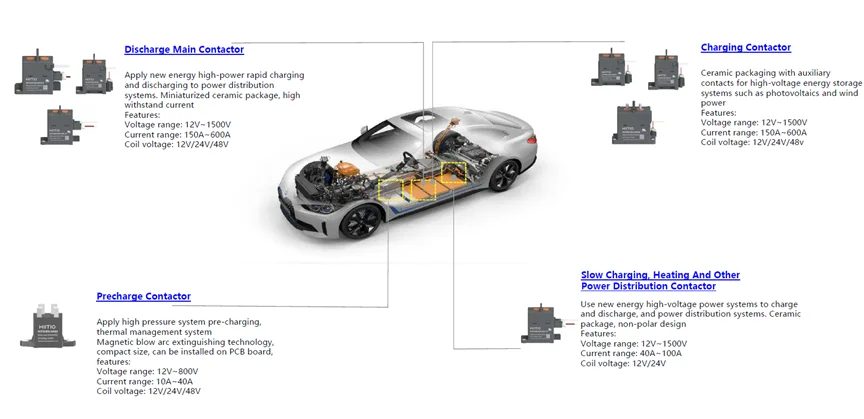
The electric vehicle industry is experiencing unprecedented growth, with global EV sales projected to exceed 40 million units annually by 2030. At the heart of every electric vehicle lies a critical component that ensures safety and performance: the High Voltage DC Contactor. These devices control the flow of electricity between battery packs and power systems, operating at voltages that can exceed 900V DC. As automakers race to develop next-generation vehicles, selecting the right contactor technology—ceramic or resin—has become a strategic decision that impacts cost, reliability, and market competitiveness. Both ceramic and resin technologies have carved distinct niches in the EV market. Ceramic contactors have traditionally been valued for their exceptional arc-quenching capabilities and high-temperature resistance, making them suitable for extreme-duty applications. However, the automotive industry's evolving demands for lighter weight, enhanced environmental protection, and cost optimization have accelerated innovation in resin encapsulation technology. HIITIO's high voltage DC contactors designed for EV applications include both technologies, allowing manufacturers to select the optimal solution based on specific vehicle architectures and performance requirements. Understanding the fundamental differences between these technologies is essential for informed decision-making. Ceramic contactors excel in applications requiring maximum arc suppression and can withstand continuous exposure to elevated temperatures. Their rigid construction provides dimensional stability and predictable performance over extended service intervals. These characteristics make ceramic designs particularly attractive for commercial vehicles, heavy-duty applications, and scenarios where thermal management is paramount. However, ceramic's brittleness can present challenges in high-vibration environments, and the manufacturing process typically results in heavier components with higher material costs. Resin-encapsulated contactors represent the evolution of DC switching technology, addressing many limitations of traditional designs. The encapsulation process creates a hermetically sealed environment that protects internal components from moisture, contaminants, and mechanical stress. This protection is particularly valuable in automotive applications where components face constant vibration, temperature cycling from -40°C to +85°C, and exposure to road salt and chemicals. Resin contactors typically achieve 30-40% weight reduction compared to ceramic equivalents—a significant advantage when every kilogram impacts vehicle range and energy efficiency. Additionally, the manufacturing flexibility of resin technology enables integration of auxiliary features, diagnostic capabilities, and customized form factors that simplify vehicle electrical architecture. Performance specifications demonstrate the maturity of both technologies. Modern high voltage DC contactors, whether ceramic or resin-based, routinely handle currents exceeding 500A with contact resistance below 0.5mΩ and electrical life surpassing 100,000 operations. Dielectric strength consistently exceeds 3000V AC, providing robust safety margins for high-voltage battery systems. The key differentiator lies not in raw performance but in application-specific advantages: ceramic excels where maximum thermal tolerance is required, while resin delivers superior value in weight-sensitive, cost-optimized passenger vehicle applications where environmental sealing and vibration resistance are critical. As the EV market matures and diversifies, manufacturers increasingly recognize that one-size-fits-all approaches no longer suffice. The optimal contactor solution depends on vehicle segment, voltage architecture, environmental conditions, and cost targets. For many applications, particularly in the rapidly expanding passenger EV segment, resin-encapsulated contactor solutions offer the ideal balance of performance, weight, durability, and economics. HIITIO's advanced resin technology incorporates automotive-grade polymers engineered specifically for high-voltage DC switching, delivering reliability that meets the stringent requirements of global automotive standards including ISO 6469 and UN R100. The future of electric mobility demands components that combine proven reliability with innovative engineering. Whether choosing ceramic for its thermal performance or resin for its comprehensive advantages, manufacturers need partners who understand the complexities of high-voltage DC switching and can deliver solutions that accelerate time-to-market while ensuring long-term product success. As battery voltages continue rising toward 1000V and beyond, High Voltage DC Contactors will remain foundational to safe, efficient, and reliable electric vehicle operation—making the choice of technology and supplier more critical than ever.Two Technologies, Distinct Advantages
Ceramic Contactors: Thermal Champions with Trade-offs
Resin Technology: Engineered for Modern Automotive Demands
Performance Benchmarks: Where Both Technologies Deliver
Making the Right Choice for Your Application
Looking Ahead: The Evolution Continues
 Supriyo Khan
 Supriyo Khan
 Supriyo Khan
 Supriyo Khan

Want to add a comment?