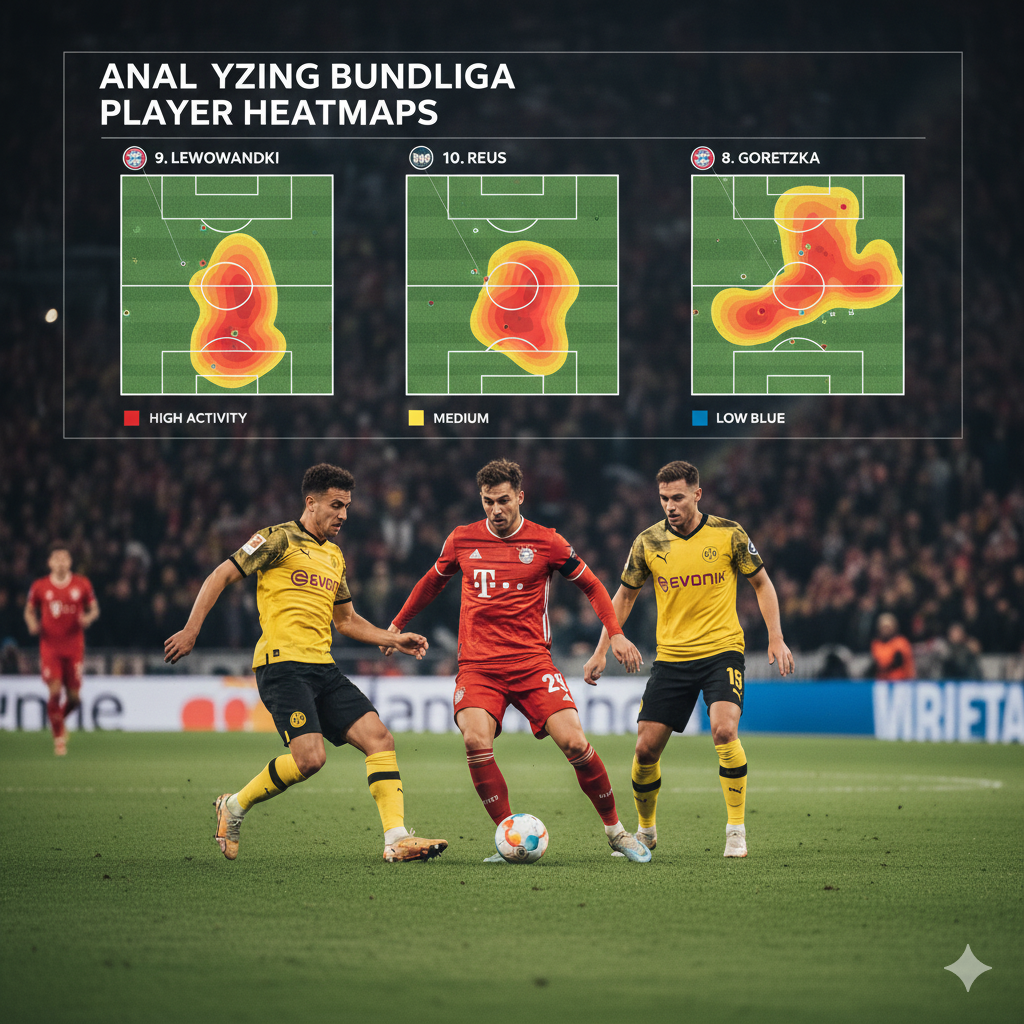
Analysing player heatmaps in the Bundesliga means turning colourful pitch diagrams into evidence about how footballers actually behave: where they receive, press, combine and rest. Heatmaps compress millions of tracking or event data points into a spatial picture, and that picture only becomes useful when it is tied to role, game plan and opposition context.
A player heatmap is a colour-coded representation of where that player’s actions or locations occur most frequently over a match or series of matches, with hotter zones marking higher activity. Modern tracking systems record positional data several times per second, so a single Bundesliga game can generate hundreds of thousands of coordinates per player; aggregating these produces a statistically reliable portrait of their true zone of influence.
Heatmaps can be built either from raw location data—every step and sprint—or from specific actions such as passes, duels or interceptions, creating “action heatmaps” for different phases of play. In both cases, the aim is the same: make spatial tendencies visible at a glance so coaches, analysts and scouts can quickly see whether a player actually occupies the spaces their nominal position on paper suggests.
The Bundesliga is a high-tempo, transition-heavy league where pressing, counter-pressing and vertical attacks play an outsized role in tactical identity. Bundesliga Match Facts powered by AWS already leverage tracking data to display average positions and trends, underlining how much the league values spatial analytics. Because shapes on paper often morph into fluid structures during games, heatmaps provide a way to check how those aggressive schemes really look on the pitch.
Average-position visuals reveal, for example, how a nominal 4-2-3-1 becomes a 2-3-5 in possession or how a mid-block shifts into a 4-4-2 when defending, patterns that are particularly common in German football’s dynamic systems. Player-level heatmaps add another layer by showing which individuals actually execute those roles—who steps into midfield, who tucks inside from full-back, and who is left isolated high up the pitch.
Different heatmap constructions answer different questions, so separating them avoids over-interpreting a single graphic.
Combining these types lets analysts separate pure running volume from meaningful involvement, an important distinction in a league where physical output is high across almost all teams.
Bundesliga tracking systems collect positional coordinates via optical cameras or wearable sensors, creating millions of data points per match that log where each player is at any moment. Algorithms then bin these positions into pitch zones and calculate how often or how long a player occupies each cell, applying colour gradients to convert numerical densities into visual intensity.
Average-position tools go a step further by computing mean coordinates over specific time windows—first 15 minutes, after a red card, or while chasing a goal—and plotting them to show how a team’s structure shifts with game state. For action heatmaps, event data feeds the process: only passes, duels, interceptions or other chosen events are plotted, so “hotter” areas correspond to the locations of impactful actions rather than simple presence.
Heatmaps are most revealing when compared across game states or tactical contexts. A central midfielder’s map in a dominant home win, for instance, may show broad coverage across both halves, while the same player’s map in a deep-defending away match compresses into a narrower, deeper block.
Similarly, pressing teams display intense activity in the opposition half when chasing the ball, with action heatmaps highlighting tackle and interception clusters high up the pitch. Counter-attacking sides instead show dense zones in their own half followed by concentrated attacking actions in specific corridors once they break. Without the game context—scoreline, opponent, plan—these differences could be mistaken for permanent traits rather than situational behaviour.
Concrete examples help show how a heatmap translates into a tactical description. Analyses of Bundesliga central midfielders using event-based heatmaps have shown Joshua Kimmich dominating central build-up zones, Granit Xhaka holding compact pivots, and Atakan Karazor covering large vertical lanes between both boxes, each pattern matching their known roles.
Tactical breakdowns of attacking midfielders such as Florian Wirtz use heatmaps to highlight how often they receive between lines, press high, and support counters in the opponent’s half. In those cases, the red and orange zones around the right half-space or central pockets show not just where they stand, but where they repeatedly receive and create, linking visual density to chance creation and pressing output.
When learning to read matches through an online betting site or analysis-oriented platform such as ยูฟ่า168, heatmaps can easily look like conclusive evidence: a red zone near the right wing, and the mind leaps to “this flank will decide everything.” An educational approach treats the heatmap as a starting hypothesis instead. A learner might first examine where a Bundesliga player’s touches cluster over several matches, then cross-check that picture with average-position trends, shot maps and passing networks before drawing conclusions about likely threats in a given matchup. If the heatmap indicates that a full-back routinely overlaps deep into the final third, but the opponent typically defends that corridor with a compact block, the heatmap becomes one element in a broader tactical expectation rather than a standalone prediction. Used this way, visuals inform disciplined thinking rather than replacing it.
Because heatmaps can be misread as mere “activity blobs,” a consistent reading process helps link what you see to what it means tactically. Each step refines the initial impression.
Start with role and formation: clarify the player’s nominal position and the team’s base structure (e.g., 4-2-3-1, 3-4-2-1) so you know what behaviour would be expected before looking at the map.
Compare with game context: note whether the match involved leading, trailing, or playing with 10 men; these states alter heat distribution, especially in a fast, tactically fluid league like the Bundesliga.
Distinguish presence from impact: where possible, look at action heatmaps (passes, duels, chance-creating actions) alongside pure positional maps to see where the player actually influences outcomes, not just where they jog.
Cross-check across games: treat a single-match heatmap as anecdotal; patterns that repeat across several fixtures reveal genuine tendencies that can inform scouting, coaching or deeper analysis.
Following this sequence turns a static image into a structured interpretation of how a Bundesliga player functions within their team’s system.
Heatmaps become misleading when they are taken as full explanations rather than partial clues. A wide midfielder whose map shows intense activity near the touchline might actually spend much of their time recycling low-risk passes rather than delivering dangerous balls; without event data, the visual alone cannot reveal quality.
Similarly, aggregation can hide important detail: combining many matches may blur role changes, making a versatile player look “average everywhere” when, in reality, they alternate between distinct tasks depending on game plan and opponent. Overreliance on heatmaps also risks ignoring off-ball instructions—such as blocking passing lanes—that may not generate many recorded actions but are vital to the tactic.
Bundesliga player heatmaps compress dense tracking and event data into intuitive maps that show where footballers move and act most often, turning spatial tendencies into something legible for analysts, coaches and educated fans. They derive from millions of positional and action data points, with variants that focus on raw locations, specific events, or average positions across game states.
Used carefully—anchored in role, context, and cross-game comparison—these visuals reveal how players like Kimmich, Xhaka or Wirtz occupy lanes, support build-up, press, and create chances within their teams’ structures. Treated as one tool among many, heatmaps transform from colourful curiosities into rigorous aids for understanding how Bundesliga football actually functions in space and time.
 Supriyo Khan
 Supriyo Khan
 Supriyo Khan
 Supriyo Khan

Want to add a comment?