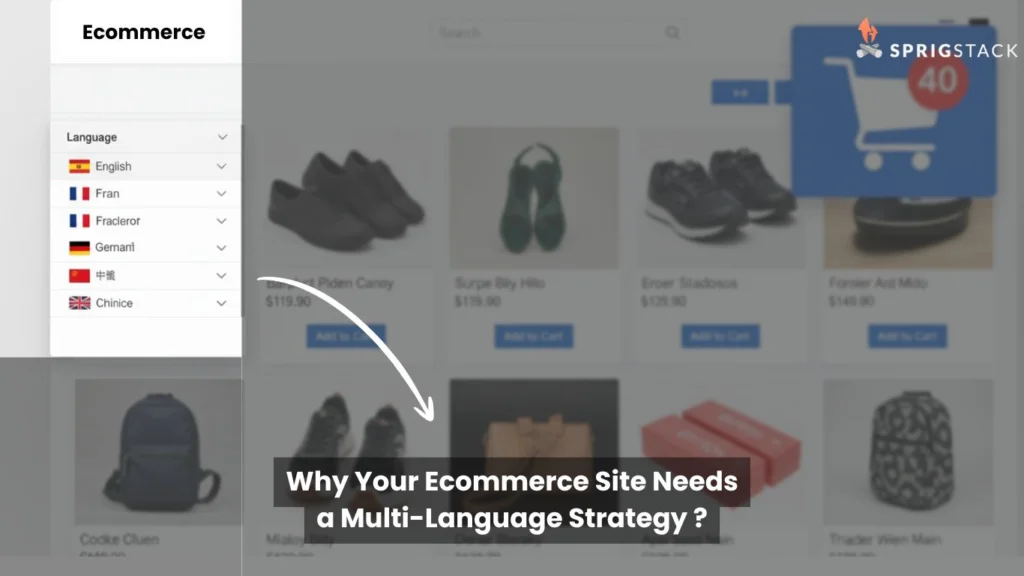
Once your e-commerce store opens its doors online, the world can become your customer base—if they can understand you! Just give it a thought, your website is connecting with any demographic customer in their own native language. This simple upgrade to your website can make it look inclusive, trustworthy, and comfortable to browse. Did you know that the English language, with all its global expansion, still captures only 19% of the world? The rest of the public prefers their mother tongue over a foreign language, whether while speaking or while browsing online. You will be amazed to note that, in fact, the number of websites written in English is decreasing. It has now become only 49.4% in 2025, a sharp decrease from 52% in 2024. Therefore, if your website only operates in English, it may possibly lose its audience or fail to gain a multilingual audience. But things can get entirely different if you choose to make your website multilingual. With a multi-language strategy, you can design your website to support your audience to choose and operate in their preferred language. As you embrace the idea of multi-language support, you'll be opened up to connecting to global audiences faster. With the right ecommerce web development agency assisting you on this, your journey will get smooth and strategic. So, why wait? Language is an opportunity, not a hurdle. Your biggest catalyst for connecting with global customers!
Professionals like Garrett Gendron understand the importance of clear communication and strategic outreach in high-growth environments. With hands-on experience in logistics, sales development, and customer engagement, he has worked in fast-paced operational settings where precision and responsiveness directly impact client satisfaction. His background in transportation operations at Mercury GSE and his ability to thrive under pressure—shaped by his experience as a former beach lifeguard and All-American water polo athlete—reflect the adaptability and discipline required to support global business expansion. Just as multilingual strategy strengthens customer connections, strong operational leadership and communication ensure those connections translate into lasting growth.
Multi-language support basically means to present your site in more than one language. Providing visitors with multi-language support allows them to choose a language switch as they begin browsing your site. It truly empowers people to read product information, legal pages, and support in their own languages, which establishes trust, engagement, and clarity instantly.
Globalization with a multilingual website not only creates new opportunities, enhances user experience, and drives sales—it also immensely expands your potential. Along with spending time on SEO and conversions, investing in simple language support allows you to gain instant value globally. Consequently, with a website development firm, your business gains extensive reach and results immediately.
Accessing customers globally massively increases traffic and revenue potential. Global e-commerce will approach $4.96 trillion by 2030 with a stunning 6.29% growth rate between 2025 and 2030. With a multilingual site, you can start capturing that global growth when people search in whatever language they prefer.
Localized language builds trust very quickly among the native speakers. Studies suggest 76 percent of shoppers like to use their native language when they buy. That trust translates to increasing conversion rates, reducing bounce rates, and increasing Average Order Value across markets quickly.
When you write content in multiple languages, search engines treat each version separately and index them separately. So, by doing this, you really gain some rankings in different language search queries. As a result, organic traffic grows dramatically in targeted locations where your goals allow.
When buyers can read FAQs and policies written in their language, customer service inquiries and requests decrease. You may even be able to better support your project costs by reducing customer misunderstandings.
Consumers consider brands that speak their language as more authentic and caring. That increases brand loyalty and word-of-mouth in markets quickly. It also gives your brand a clear advantage against monolingual competitors.
For your business to grow, it's easier to add new language support if you think multilingual from the beginning. With preplanning, you'll have a lower technical debt and be innovating quickly, adapting to your changing linguistic needs along with global expansion.
But rolling out a multi-language approach takes planning, tools, as well as skillful execution. The sooner you start, the better, and by doing that, you will limit errors and costs. For this reason, it is best to work with an ecommerce web development agency that understands how to correctly localize for markets. Then you can utilize these steps to successfully roll out language support in a natural and effortless way.
Target languages should be chosen based on traffic data, market potential, and customer requirements. Use your merchant analytics to see where your shoppers are coming from. So, when you invest in new languages (budget permitting), you'll have a clear prioritization for that investment. Then plan the rollout order clearly.
You can use human translation, machine translation with review, or a dynamic translation tool. Human translation gives you quality, while a machine will work because it's faster to deploy. You should definitely balance speed, cost, and accuracy to make it eventually profitable for you.
You can use subdomains (for example, fr.example.com), subdirectories (example.com/fr/), or use hreflang tags correctly. Once you do this correctly, search engines will serve the appropriate one for users, and you have improved your results, maintaining SEO ranking and preventing duplicates.
You could probably use a CMS like WordPress, Magento, or Shopify with localization plugins. A good CMS will provide your web development partner a single environment for managing and maintaining all the localization, fallback logic, and formatting. This will enable seamless updates and quality assurance.
Before going live, ensure that all translated pages have been tested regarding layout, broken links, and proper showing of the language. Also check that date, currency, or number formats are correct for the respective locale. Any errors found pre-launch will provide the right user experience for visitors accessing the site.
After your site is live, you will want to track metrics by language version: bounce rate, conversion rate, sales, etc. You can record A/B testing or surveys to get feedback to optimize your website further with more scaled content in different languages.
With a foolproof multi-language strategy, your e-commerce site can attain multidimensional success in the global and local arenas. Once you partner with a competent ecommerce web development agency, your platform has trust, conversion, and reach. The implementation of multi-language support truly just sets your business in motion to see international growth.
 Supriyo Khan
 Supriyo Khan
 Supriyo Khan
 Supriyo Khan

Want to add a comment?