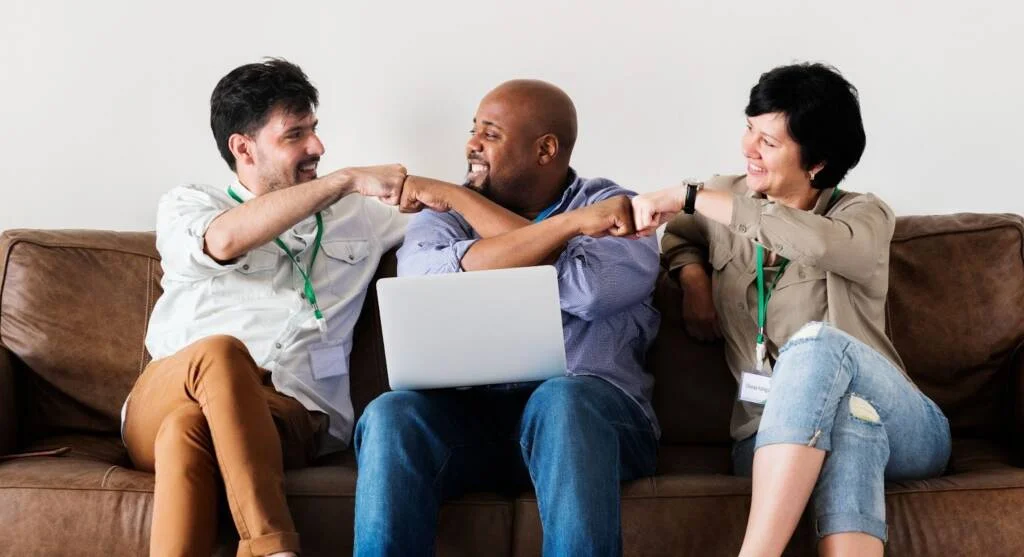
Investing in building strong, positive relationships with your co-workers is perhaps the more worthy investment you can make in your career. Team members who click are generally more productive and have increased levels of communication. The overall work environment also becomes much more open.are some of the practical approaches to better relationship-building with colleagues that result in a It doesn’t matter if you just started working in a company or have been there for years. Here a new understanding of what collaboration, trust, and communication actually mean.
Communication is a key component in any relationship and helps build trust. Most issues that arise in a relationship are a result of communication breakdowns, misunderstandings, and unaddressed concerns. Good communication means sharing your ideas and listening to others. It helps solve problems early and keeps conversations respectful and professional.
Useful sentence patterns for workplace communication:
“Would you mind sharing your thoughts on this?”
“Could you please explain that a bit more?”
“I see your point—here’s what I think.”
“Let’s find a solution that works for both of us.”
“Can we discuss this later when you have a moment?”
“I understand what you’re saying, and I appreciate your input.”
“Please let me know if I’ve understood you correctly.”
“That’s an interesting idea—can you tell me more about it?”
Good communication is about speaking clearly, listening carefully, and showing respect in every conversation.
Recognition works toward developing and reinforcing relationships. The impact of a ‘Thank you’ or a thank you note should not be underestimated as they can lift a person’s spirit and morale of the whole group. Recognition stimulates people and attention appreciation in efforts. Saying thank you helps build respect and a happy workplace. A few kind words can make people feel valued and motivated.
Easy ways to show appreciation:
“Thank you for your hard work.”
“I really liked how you handled that task.”
“Your help made a big difference.”
“I appreciate your support.”
“Great job! You did very well.”
Showing appreciation often makes the team stronger and keeps everyone positive.
Trust can be built in the long term through dependability and consistency in behavior. Be a dependable co-worker, one who helps others, fulfills promises and meets deadlines. Reliability fosters collaboration. The participants are more likely to have a favorable attitude and contribute to satisfaction within the group. The image should be positive and free from gossip, as it can reflect poorly on the person and the group. Be the person who is a model of reliability and honesty. These are the foundational pillars of every collaboration.
Each member of the organization can provide and receive support. When a co-worker is struggling, it is best to provide support. This shows you are concerned not just for your own outcome, but for the outcome of the entire unit. When you are struggling, it is perfectly fine to ask for help. This shows weakness. It shows a desire to learn. When help is sought and offered, direct co-workers will form strong attachments to one another. This encourages a more collaborative environment and helps relieve stress for everyone involved. Asking for or offering assistance is a sign of teamwork and maturity, not incompetence.
Here are some useful sentence patterns you can use when offering or seeking help in a professional setting:
When seeking help:
“Could you please help me understand how to…?”
“I’m having some difficulty with this task — could you walk me through it?”
“Would you mind giving me your input on this part?”
“I’d really appreciate your advice on how to handle this situation.”
“Can you clarify this section for me?”
When offering help:
“Would you like me to assist you with that?”
“If you need any support, feel free to reach out.”
“I’ve worked on something similar — can I help you with this?”
“Let me know if you’d like me to review it before you finalize.”
“I noticed you’re busy — would you like me to take care of part of this?”
Encouraging open communication through these simple patterns fosters trust and makes collaboration smoother. It transforms the workplace into a space where learning, growth, and support thrive.
Sometimes, building better relationships also means protecting the integrity of the workplace. If you witness inappropriate behavior or misconduct, it’s important to speak up. However, not everyone feels comfortable reporting such issues directly.
That’s where Anonsms comes in. It’s a secure, anonymous communication tool that allows employees to report workplace concerns—like bullying, harassment, or unethical behavior—without fear of retaliation. By promoting safe and confidential reporting, organizations can maintain transparency and trust, ensuring that everyone feels respected and heard.
With the advent of more global and multicultural environments, there are even more reasons to embrace diversity. Each person offers a story, a skill or a viewpoint. By simply respecting the diversity, you will expand your own appreciation. Each employee will hear and value your contribution. Do not assume or judge a person based on their demographics, or their character for that matter. View diversity as a source of increased innovation and creativity for your team. This will foster even more cooperation.
Even in healthy teams, some conflict is unavoidable, and the key is not to ignore mistakes. Don’t resort to the gossip chain; conflict should always be embraced as a problem to be solved. Diagnosing, and focusing on a solution will lead to a just resolution. In the case that a sensitive issue is really uncomfortable to speak about, anonymous feedback channels, such as Anonsms, can work magically. It captures the reporting of inappropriate behavior, workplace bullying, or misconduct, and it can be done safely and without any fear of retaliation.
When cultivating relationships with peers, the aim is not simply being liked, but rather, achieving a peaceful working atmosphere where everyone is productive. Open communication, appreciation, mature reconciliation of conflicts, and other integrative approaches help streamline the coalescence and cohesiveness of the workplace. With the potential of sensitive issues requiring discretion, Anonsms serves a heedful purpose in promoting transparency by offering anonymous voicing mechanisms.
Ultimately, the foundation of all workplace relationships is built on respect, trust, and empathy. Practicing these improves workplace experience, not just for self but for the entire organization, promoting a positive and collaborative work environment.
 Supriyo Khan
 Supriyo Khan
 Supriyo Khan
 Supriyo Khan

Want to add a comment?