Many brands rely on stock music libraries when producing videos, advertisements, or social media content. The workflow is simple: search for a track, download it, and place it under the visuals. While convenient, this approach often creates a hidden problem. The same background music can appear in dozens of unrelated videos, making different brands sound almost identical.
When viewers hear the same track repeatedly, the emotional impact fades. Instead of supporting a brand’s identity, the music becomes generic background noise. This is why more creators are exploring tools like Musick AI, where music can be generated specifically for a project rather than selected from a crowded catalog. Using an AI Music Generator allows creators to produce original soundtracks that match the tone and style of their content.
Understanding the limitations of stock music helps explain why custom music is becoming an important part of modern content creation.
Overused soundtracks
Many stock libraries distribute the same tracks to thousands of users.
A single piece of music may appear in ads, tutorials, and promotional videos.
When viewers recognize the soundtrack, the brand loses uniqueness.
Generic emotional tone
Music libraries label tracks with broad tags like “inspiring” or “corporate.”
These categories rarely match the exact emotion of a story.
The music often feels disconnected from the visuals.
Limited storytelling support
Stock tracks are designed to fit many types of content.
Because of this, the pacing may not match a specific video.
Editors sometimes adjust their visuals to match the music rather than the opposite.
A recognizable brand sound
Unique music can become part of a brand’s identity.
Consistent sound helps audiences recognize a channel or product.
Over time, the music itself becomes associated with the brand.
Stronger emotional alignment
Custom music can match the tone of a scene more precisely.
Instruments, rhythm, and mood can support storytelling.
This creates a smoother viewing experience.
Greater creative flexibility
Creators are not limited to pre-existing tracks.
Music style can change depending on the project.
Sound becomes part of the creative direction.
Faster music generation
Instead of browsing large libraries, creators can describe the music they want.
The system generates a track based on that description.
This saves time during editing.
Accessible for beginners
Traditional music production requires instruments or specialized software.
An AI Music Maker simplifies the process with text prompts.
Even users without musical training can generate soundtracks.
Easier experimentation
Multiple versions of a track can be generated quickly.
Creators can compare different moods or genres.
This flexibility encourages experimentation.
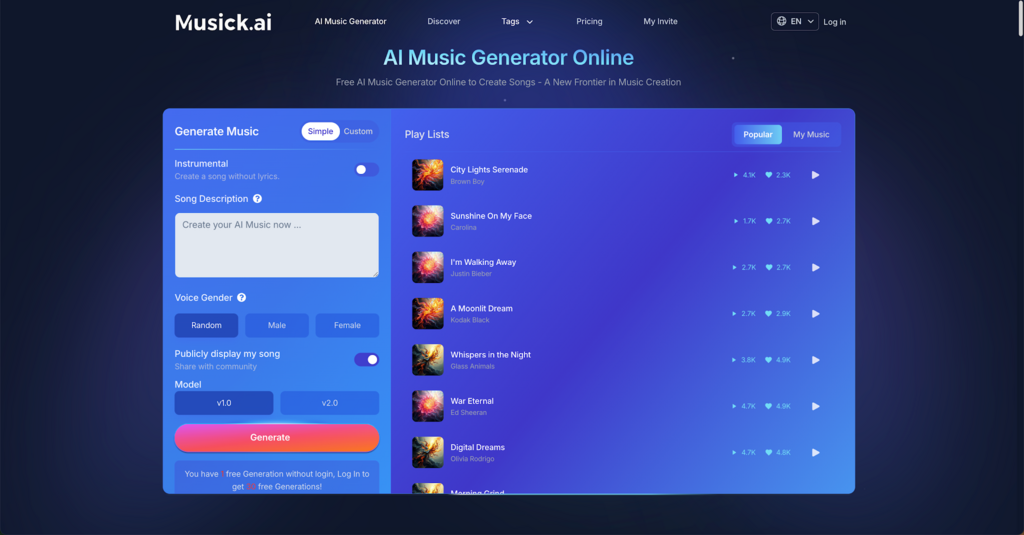
Musick AI focuses on making music generation simple while still offering useful creative controls.
Simple generation mode
Users describe the desired music using a short prompt.
The system generates a track based on that description.
This option works well for quick background music.
Custom song creation
Users can enter their own lyrics.
The generator produces music that matches those lyrics.
A song title can also be included during creation.
Instrumental option
A toggle allows music to be generated without vocals.
Instrumental tracks are useful for videos, podcasts, and presentations.
This keeps spoken audio clear.
Voice selection
When generating songs with vocals, users can choose voice types.
Options include random, male, or female voices.
This provides basic control over the vocal style.
Another advantage of Musick AI is the variety of musical genres available when generating tracks.
Popular music styles
Pop music works well for lifestyle and promotional videos.
EDM adds energy to short clips and ads.
Hip-hop and rap suit modern content styles.
Instrument-focused genres
Jazz creates a relaxed atmosphere.
Classical music adds elegance or dramatic tone.
Piano or saxophone styles provide softer moods.
Cultural music styles
K-pop offers energetic and polished sound design.
Country music supports storytelling content.
Reggae creates a relaxed rhythmic feel.
Social media content
Short videos benefit from music that matches their pacing.
Original soundtracks prevent creators from using the same background tracks as others.
Unique intros can help build channel identity.
Product and marketing videos
Music can reinforce the mood of a product story.
Custom soundtracks make advertisements feel more intentional.
Brands can reuse musical themes across campaigns.
Video intros and outros
A short theme song can introduce each video consistently.
Variations can be generated for different segments.
This builds recognizable branding.
Open the music creation interface
Visit Musick AI and open the music generator page.
The interface allows users to generate songs or instrumental tracks.
Choose a creation mode
Use the simple mode to generate music from a short description.
Choose custom mode if you want to add lyrics and a title.
This flexibility makes the system useful for different projects.
Describe the music style
Enter a prompt describing the mood or genre.
For example: upbeat pop song, relaxing jazz piano, or energetic EDM beat.
This helps the AI Song Maker understand the style you want.
Generate and review the track
Click generate to create the music.
The system produces a new track based on the prompt.
If the result is not perfect, another version can be generated.
Later in the process, creators can experiment with different AI Music styles to refine the tone of their projects.
Stock music libraries made video production easier, but they often lead to repetitive soundtracks. When many creators rely on the same catalog, content begins to sound identical.
Original music offers a stronger alternative. A custom soundtrack supports storytelling, strengthens brand identity, and helps content stand out.
Tools like Musick AI make this process much simpler. By generating music from prompts, lyrics, or genre ideas, creators can produce tracks that match the tone of their projects. For brands and creators who want their content to feel distinctive, moving beyond stock music is a practical and effective step.
 Supriyo Khan
 Supriyo Khan
 Supriyo Khan
 Supriyo Khan

Want to add a comment?