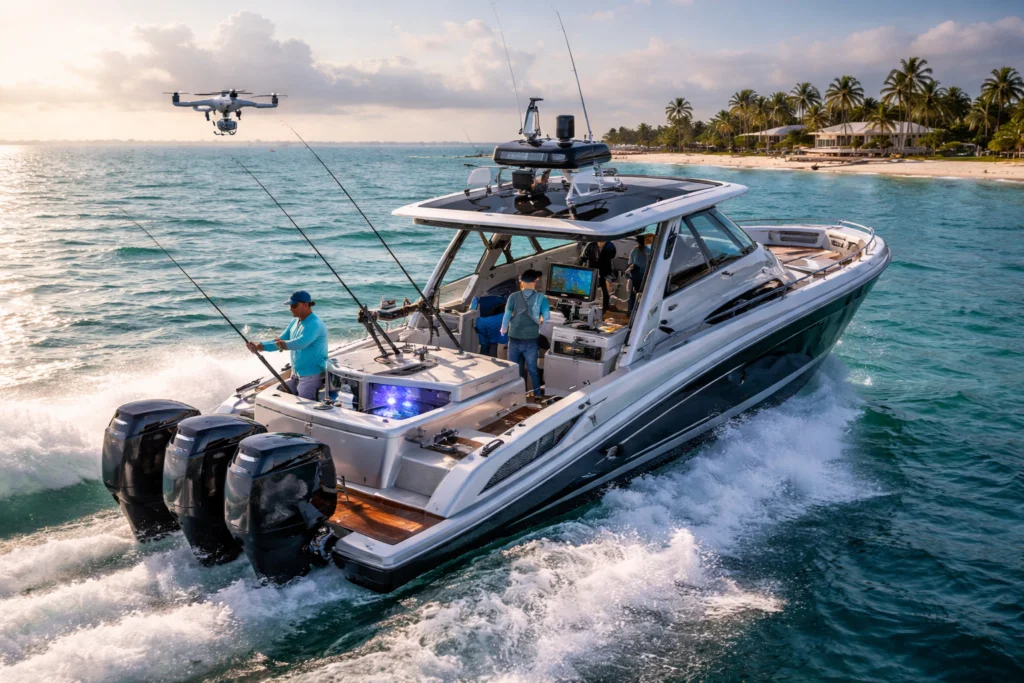
For serious anglers along the Australian coast, the pace of genuine innovation in boat design has never been faster. Where buyers once had to compromise among ride comfort, durability, and capability for fishing, the best platforms coming out of Australian manufacturers today deliver all three without compromise.
The expectations buyers bring to fishing boats for sale have shifted accordingly, and the gap between a well-engineered boat and an average one has never been more visible at the ramp.
Here is what is actually changing and what it means for anyone currently in the market.
Advanced Hull Design
Current design thinking centres on variable deadrise profiles that optimise bow entry for cutting through chop while maintaining a stable, predictable run in following seas. Delta flare technology is being refined further, managing spray and improving lift without adding weight to the bow.
For the dedicated anglers running across a 25-knot chop to reach offshore grounds, the outcome is a boat that handles genuinely rough conditions with less driver fatigue and less fuel burn across a long day on the water.
Stronger Structural Materials
High-tensile 5083 marine-grade aluminium plate remains the benchmark for serious plate boat construction, but how it is being used has evolved. Full-depth longitudinal framing, triangulated cross-bracing, and fully sealed sub-floor systems are now standard expectations in premium builds rather than optional engineering upgrades.
For boats working the rougher conditions off the southern Australian coastline, structural integrity is what keeps you on the water when lesser builds are back at the ramp.
Precision Propulsion Systems
Current generation motors offer drive-by-wire throttle and steering, removing mechanical lag and giving the helm a precision that older cable systems simply cannot match. Integrated trim control, automatic jack plate adjustment, and electric steering are increasingly standard on mid-range and premium builds.
For the dedicated anglers pushing offshore in variable conditions, this means safer handling at the bar, a more controlled run to the grounds, and considerably less effort managing the boat when you should be focused on fishing.
Integrated Marine Electronics
Modern plate boats are being designed from the outset with dedicated helm stations engineered around large-format multifunction displays, structured cable routing, and isolated grounding systems that protect sensitive equipment from stray current corrosion. Electronics integration has moved from a post-build afterthought to a core design consideration.
A practical example is the growing adoption of networked sounder and chartplotter systems, where a single transducer feeds data simultaneously to bow and helm displays. For anglers working structure in 40 metres of water off the shelf, having identical bottom readings at both stations removes the need to leave the fishing position entirely.
Functional Deck Layouts
Transom extensions are creating additional working space at the stern without increasing overall boat length. Recessed tackle stations, flush rod storage, and integrated bait systems are being positioned around primary fishing zones rather than spread across the deck as afterthoughts.
Helm ergonomics have improved considerably, too, with adjustable pedestals, bolster seating, and console layouts consolidating controls within natural arm reach. When you are chasing snapper on a reef edge well offshore, that reduction in fatigue over a long session is anything but a minor detail.
Smarter Ownership Systems
The improvements happening above the waterline are being matched below it. Advanced fuel systems with sealed tank designs and integrated venting are reducing fire risk and eliminating contamination issues that have historically shortened engine life. Self-draining deck systems with high-volume scuppers handle shipped water efficiently, a meaningful safety advantage for any Fishing Weapon operating in the following sea conditions off the Australian coast.
Trailer integration has improved too, with self-centring systems and single-handed launch and retrieve mechanisms reducing ramp stress on both the hull and the owner.
Closing Thoughts
Design and technology in Australian fishing boats have moved further in the past decade than in the previous three combined. Hull engineering, propulsion control, electronics integration, and deck functionality are no longer individual selling points. In the best builds, they work together as a single system, and the difference on the water is immediately apparent to anyone who has spent serious time offshore.
For buyers currently in the market, these advances are the baseline worth measuring every boat against. A platform that delivers on hull performance, electronics capability, and low-stress ownership is not a premium option. It is simply what a serious fishing boat should be in 2026.
 Supriyo Khan
 Supriyo Khan
 Supriyo Khan
 Supriyo Khan

Want to add a comment?