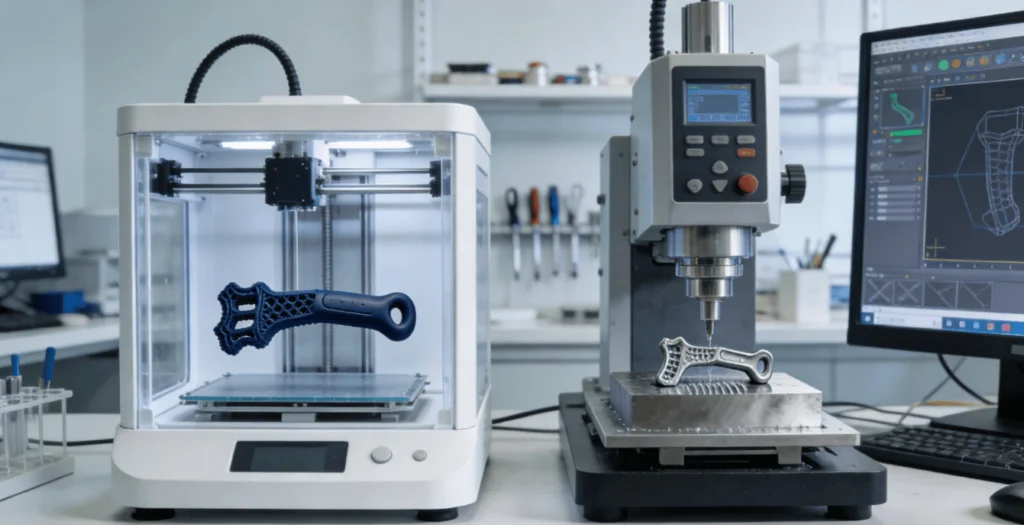
The development of a medical device prototype is a critical phase, where traditional methods often face delays from material and testing issues. These challenges frequently stem from inadequate early compliance planning. This guide outlines how integrating precision manufacturing technology with professional rapid prototyping services can streamline the workflow from design to testing, mitigating risks and accelerating time-to-market . A successful prototype is not just a preliminary model; it is a functional representation of the final product that must meet multi-dimensional criteria to de-risk the subsequent stages of Medical Device Development. Its success is measured by how effectively it validates the path to a manufacturable, compliant product . A competent prototype for a medical device must address these essential four points: functionality in simulating real-scenario behavior, representativeness using materials analogous to those used in scaled-down manufacturing, testability to be perfectly integrated in testing procedures, and foresight in meeting compliance standards. The goals for prototyping medical devices evolve significantly throughout the development cycle. Proof-of-Concept (POC) Phase In the early POC stage, the objective is speed and flexibility to explore ideas and demonstrate basic feasibility. Techniques like 3D printing are ideal for rapid iteration and assessing multiple design concepts with minimal cost investment . Functional Testing and Clinical Evaluation Phase As the project advances to functional testing and clinical studies, precision and material accuracy become paramount. Prototypes must be highly reliable. This is where Precision Manufacturing Technology, such as CNC machining, is critical, as it ensures high dimensional accuracy and allows for the use of a wide range of certified, medical-grade materials, yielding valid test data . When developing prototypes of medical equipment, manufacturing technology is one of the most important factors. Both 3D printing and CNC machining have their pros and cons. Furthermore, it largely depends on whether you are at what stage of your project and what is its primary requirement.3D or additive manufacturing is strongly oriented towards rapid prototyping and handling complex geometries. It is most appropriate for the POC stage and is very helpful for designers in creating concept models and form-and-fit prototypes rapidly. It could have some drawbacks in the form of reduced mechanical properties and surface finish quality compared to the machined parts. By contrast, CNC machining, a subtractive process, is best known for its great accuracy and ability to work with a massive range of solid, hard, and biocompatible materials. Prototyping with CNC is superior and is a crucial requirement for functional testing and clinical trials and for making production-ready parts that have to withstand multiple cycles of sterilization. It is obvious why one would choose 3D printing for rapid concept prototyping and switch to CNC machining for accuracy and authenticity in clinical and regulatory prototyping. Integrating medical device prototype engineering services with a Design for Manufacturing (DFM) mindset from the outset is a critical strategy for avoiding costly and time-consuming changes during production scaling. Early DFM analysis ensures the prototype is not only functional but also designed for efficient, reliable, and cost-effective manufacturing . This is because principal reasons for early DFM integration are avoidance of disruptive and costly modifications during transition into mass production. A classic optimization-consolidation of a multi-component assembly into single unified part-can eliminate assembly steps, reduce failure points, and shorten the production timeline by months. Effective early DFM strategy is built on several key practices that ensure the prototype is designed for efficient production. Material Transition and Assembly Simplification This would entail the steps of transitioning from commonly used materials for rapid prototyping services to the final production grades for which the polymers are biocompatible (such as PEEK). At the same time, streamlining by reducing the component count through self-locating features speeds up production and lowers costs. Tolerance Control and Automation Synergy Rational tolerance control is fundamental. DFM analysis distinguishes critical dimensions needing precision from non-critical features that can have relaxed specs, avoiding unnecessary cost. This approach synergizes with Industrial Automation Solutions, as parts designed for easy robotic handling dramatically boost production efficiency and consistency. Ultimately, early DFM, supported by experienced medical device prototype engineering services, directly and profoundly impacts project schedules and the overall Cost of medical device prototyping. By anticipating production constraints early, teams avoid the primary cost driver: major late-stage design iterations. This proactive mindset is a hallmark of efficient medical device prototype development. A clear understanding of the cost of medical device prototyping is essential for effective budgeting and project planning. Several key factors drive expenses, and managing them proactively is crucial for financial control .Material selection is a primary driver. Specialty medical-grade materials, such as PEEK, titanium alloys, or other certified biocompatible polymers, are inherently more expensive than standard grades. Geometric complexities present in the part form another important consideration. When there are complexities in terms of internal passages, thin walls, or undercuts, machining has to be done with higher complexities. Also, when talking about high precision, say from +0.1mm to +0.01mm, it is bound to double the machining costs. Finally, when it comes to post processing, say polishing for surface finish or any special cleaning process to make it sterile, it is bound to increase costs. Coming to manufacturing aspects, ensuring adherence to FDA prototype guidelines is an important consideration. This results in extensive documentation that needs to be completed. Preparing an exhaustive design history in accordance with norms like ISO 13485 is no mean feat. The controlling factor in this is to be extremely careful about DFM to make it possible to have fewer design iterations. Selecting the appropriate business to have a relationship with for your medical device prototypes is one of the most crucial decisions you will make. It will have a huge impact on the success of the project.Generally, the first and foremost element would be the provider's quality management system. A certification for ISO 13485 Medical Devices is an indication of the company having a documented process for the industry, which is a considerable aspect of any company being considered safe for use. Immediately linked to this element would be the company having a deep understanding of the FDA or other worldwide approaches to the medical device industry. A company needs to have the right technological capability. They should provide support for the prototype phase of the product with DFM analysis. They would also require various knowledge sets necessary to identify the right technology to apply to a given project. An ample material library and safe intellectual property protection would play an important role. In the concluding remarks, it can say that in order to develop a prototype for a medical device, a perfect mix of functionality, technology requirements, as well as cost-effectiveness, is required. With the use of technology selection in its initial stages, the principle of DFM, as well as the aid of a prototype developer, the levels of efficiency risk, as well as overall TTM, can be improved. Contact an expert today to get a free design for manufacturability evaluation of the prototype to help accelerate the product’s time-to-market. The author is a precision manufacturing specialist with a decade of experience in medical device prototype development, having led multiple projects compliant with FDA regulations. The author is part of the team at JS Precision. Q1: Must a medical device prototype use the exact same material as the final product? Not always, but it is highly recommended to use a material with similar properties or one that is already certified. This ensures the validity of functional and biocompatibility tests, preventing major issues during production scaling . Q2: Do FDA requirements need to be considered during the prototype stage? Yes. Early integration of FDA guidelines, such as those for human factors engineering and design controls, is crucial. This proactive approach prevents major non-conformities later, significantly accelerating the approval process . Q3: Can a 3D-printed prototype be used for clinical registration? Yes, but it must satisfy stringent requirements, including biocompatibility certification of the material and process, rigorous validation of the printing and post-processing steps, and complete documentation. CNC-machined prototypes are often easier to validate for these critical stages . Q4: What are the key considerations for an implantable device prototype? Biocompatibility, long-term mechanical performance (such as fatigue strength), and the ability to withstand sterilization cycles are paramount. This demands strict material selection and validated manufacturing processes . Q5: How long does a typical prototype development cycle take? It can range from a few weeks to several months, heavily dependent on the device's complexity; employing concurrent engineering and DFM can significantly shorten this timeline .
Introduction
What is a Successful Medical Device Prototype?
Defining Multidimensional Success Criteria
Stage-Specific Prototyping Objectives
3D Printing vs. CNC Machining: Which Technology is Suitable for Medical Device Prototype Development?
Why Should Design for Manufacturing (DFM) Be Integrated Early into Medical Device Prototype Development?
The Core Rationale: Avoiding Late-Stage Disruption
Key DFM Practices for Medical Devices
The Impact on Timelines and Cost
What are the Main Cost Drivers in Medical Device Prototype Development?
What Key Factors Should Be Considered When Selecting a Medical Device Prototype Development Company?
Conclusion
Author Biography
FAQs
 Supriyo Khan
 Supriyo Khan
 Supriyo Khan
 Supriyo Khan
Want to add a comment?