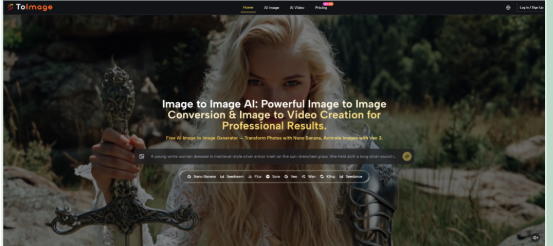
That is the right way to review Toimage AI. It is easy to describe it as a platform for image-to-image and image-to-video creation, but that description is not enough. What really matters is whether the platform delivers enough value as a multi-model creative hub to justify using it beyond casual experiments.
My view is that Image to Image becomes most compelling when you judge it by efficiency. Not just image quality, not just model count, but total workflow efficiency. If a platform helps users avoid jumping between separate tools for image editing, style transfer, reference-based generation, and short video creation, then it can be worth more than a technically stronger but more fragmented alternative.
The biggest mistake people make when evaluating a platform like Toimage AI is assuming the product is the model list. It is not. The model list matters, but the real product is convenience.
Toimage AI brings together multiple image and video models in one place, including Nano Banana, Nano Banana 2, Nano Banana Pro, Flux Kontext, Seedream, Midjourney, Veo, Kling, Seedance, Wan, and others depending on plan level. That does not automatically make it great. What makes it valuable is the fact that one interface can cover multiple creative jobs that would otherwise require different tools or subscriptions.
Creative users are no longer deciding only which model is best. They are deciding how many subscriptions, interfaces, and workflows they are willing to tolerate. That is where Toimage AI has a clear argument.
If your work includes image restyling, text-aware edits, reference-based consistency, and occasional image-to-video conversion, then using a single platform starts to make economic sense. The savings are not only financial. They are cognitive.
Switching between tools sounds harmless until you do it every day. One tool has a strong image editor. Another has a better video generator. Another handles references better. Another is better for fast exploration. Over time, that fragmentation becomes the hidden cost.
Toimage AI reduces that cost by keeping those capabilities inside a more unified environment.
The more people involved in a workflow, the more tool fragmentation slows things down. A platform that is good enough in several important areas can sometimes be more valuable than a best-in-class tool that only solves one task.
When people see pricing tiers, they naturally focus on the monthly number. That is understandable, but it is not the smartest way to evaluate a creative platform.
At a basic level, Toimage AI is selling model access. That includes both image and video generation options, and the higher plans unlock more premium models and better per-generation economics. If you only need one model occasionally, that may not feel compelling. But if you regularly move between different creative tasks, bundled access becomes more attractive.
This is the more important part. Toimage AI lets a user move from image transformation to video generation without rebuilding the entire process somewhere else. That continuity is where much of the real value sits.
A product photo can become a lifestyle variation. A styled image can then become a short motion asset. A reference-based character can remain consistent across several outputs. Those are the kinds of workflow chains that make a platform feel worth paying for.
The platform also emphasizes commercial use rights, no watermark, private generation on paid plans, and storage benefits. Those details matter much more once AI moves from hobby use into client work, ecommerce, or marketing.
A tool can feel affordable until you realize the outputs are awkward to use commercially. On the other hand, a slightly more expensive tool can feel worth it if the output is immediately usable in real business contexts.
The platform is most convincing in a few specific situations.
If your work is not purely one thing, Toimage AI becomes much easier to justify. Maybe you need image-to-image transformation most days, reference-based consistency for some projects, and image-to-video only occasionally. Paying for one platform that handles all three can be smarter than maintaining several disconnected tools.
This is especially true for creators, agencies, ecommerce teams, and startup marketing teams.
The site’s pricing structure clearly encourages regular use. There is a free starting point, then Starter, Pro, and Unlimited style tiers with better economics at higher commitment levels. The yearly pricing emphasizes lower per-generation cost and cheaper access to premium models.
That is a sensible structure for a product like this. It does not try to pretend every user is the same. Casual users can test it. Heavy users can optimize around value.
Image generation alone is competitive enough that many users can live with basic tools for a while. The moment video enters the workflow, the value of a bundled platform rises. Toimage AI’s inclusion of Veo, Kling, Seedance, Wan, and other video options gives it a stronger argument than an image-only tool would have.
Some AI pricing pages are hard to interpret. Toimage AI’s stronger plans are easier to understand because they clearly connect the subscription to model access, discounts, concurrency, storage, and commercial features.
Creative users are more willing to pay when they understand what problem the higher tier actually solves.
A good review should also say when a tool is not the right purchase.
If you only generate occasionally, or if you mainly want to experiment with AI images for fun, a paid plan may not be necessary. The platform’s real value shows up when you use it repeatedly enough for convenience and model variety to matter.
If you already know that one model is all you want, you may prefer to use that model directly through its own ecosystem or through a narrower platform built around it. Toimage AI is strongest when variety is an advantage, not when it is irrelevant.
Video is powerful, but it is usually more resource-intensive than static image generation. That means users leaning heavily on video should look closely at usage patterns and choose a plan that matches real demand.
This is simply the economics of modern AI generation. Video is expensive almost everywhere. The key question is whether the platform gives enough value around it to justify the spend.
One useful way to review the platform is to compare not just outputs, but what kind of workflow burden it removes.
This is where the platform looks strongest. Not necessarily because each individual model is exclusive, but because the overall package reduces enough friction to feel professionally useful.
The users most likely to justify paying are the ones whose creative work repeats often enough for the workflow savings to compound.
Agencies and freelancers often move between client needs quickly. One day it is a product mockup. The next day it is a portrait variation. The next it is a short promotional animation. A platform like Toimage AI makes more sense in that kind of changing environment.
These teams benefit from image transformation, lifestyle generation, campaign variation, and short-form motion content. That overlap maps well to what Toimage AI offers.
A creator posting frequently may find more value in a unified platform than in a collection of separate tools. The ability to generate image variations and then turn some of them into short videos is especially relevant here.
A casual user, hobbyist, or someone with a very narrow one-model workflow may not feel the full value of the paid plans immediately.
Toimage AI is worth paying for when your problem is not only image creation, but creative fragmentation. That is the clearest way to judge it. If you are tired of stitching together one tool for image transformation, one for reference-driven consistency, one for video, and another for business-ready output, then the platform starts to make strong sense.
It will not be the cheapest option for every user. It does not need to be. Its value comes from reducing workflow sprawl, not from pretending AI generation should cost nothing. The more often you create, iterate, and repurpose visuals, the more convincing the platform becomes.
For light users, free access may be enough. For serious creators, marketers, agencies, and growing teams, the paid plans look easier to justify because the platform is selling something larger than a single generation. It is selling a more complete way to turn ideas into content without constantly leaving the workflow.
 Supriyo Khan
 Supriyo Khan
 Supriyo Khan
 Supriyo Khan

Want to add a comment?