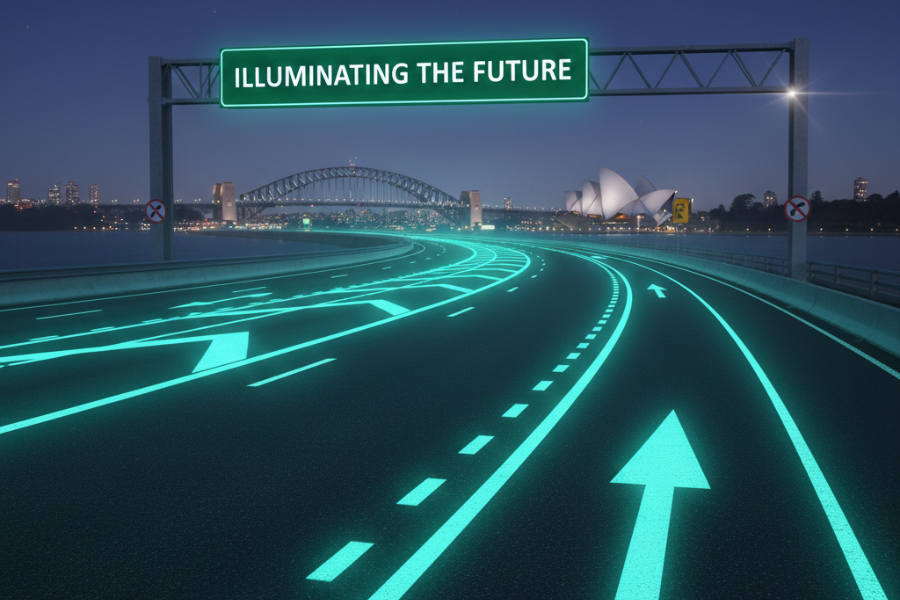
What’s the Article About? Glow-in-the-dark road markings enhance night visibility and safety across areas. Discover how their impact strengthens along the lines of a low-risk driving course.
Have you ever hit a bump that was definitely not known to you, and you might’ve been so angry that no one’s taking care of the matter? If yes, worry not; sadly, it has become an everyday problem! But it seems like New South Wales (NSW), Australia’s east coast state, has identified the issue and seems to be working it through? How? By introducing the concept of glow-in-the-dark road markings. What do they do? They glow in the night. Jokes apart, such roads will not only help the public beware of certain bumps, but they will also make the city aesthetic and shiny in the nighttime. This whole concept is highly acknowledged even by the institutions that cater to low-risk driving courses.
Without any further ado, since it is one of the most different chapters, let’s address what such roads are made up of and what the real-life benefits of the same are.
Now, glow-in-the-dark road markings aren’t a new concept. They’ve been prevailing in countries like the Netherlands and parts of Asia; not to boast that such a technology has demonstrated remarkable results. Such markings utilise photoluminescent materials that absorb natural sunlight during the daytime and emit a soft glow after dark, similar to the solar cell concept. If you ever came across the traditional methods that used paints which used to reflect through the vehicle lights, Glow-in-the-Dark is a much more proven and reliable solution.
The glow is derived to help vehicles avoid hassles in the midway. It doesn’t cause glare or distraction while driving, just a simple and effective light to help the public administer defensive driving course education. These markings are further engineered for longevity while being capable of withstanding heavy traffic, rain, or any such obstruction. Not just the aiding part is to be awed with, but even the international trials have acknowledged that such illuminated markings can help improve motor discipline, drive confidence, and decrease the road fatalities. For areas in and surrounding New South Wales, such solutions can bring about a positive change.
Although we’ve been talking about the good points of glow-in-the-dark road markings, there are more points that cover the entirety of why such a solution is to be cared for. Let’s look at them one by one:
All the things come down to the fact that visibility is better to avoid any hazards while commuting. Glow-in-the-dark road markings facilitate exactly the same thing. Lane boundaries, pedestrian crossings, curves, and other indicators are the first things to recognise for any one of us. Therefore, such a marking will help for decision-making, controlled steering timings, and avoiding nighttime collisions. The glow is particularly valuable on regional highways, roads that are prone to wildlife crossings, the busiest suburbs, and high-risk bends and intersections.
One thing that might’ve amused you is the energy saving that this particular solution can do. Traditional street-lighting systems, although the best at the time, used a lot of electricity to operate. The glow-in-the-dark system charges naturally through sunlight due to its photoluminescent property, eliminating the need for power consumption. It is further advantageous as costs are reduced to implement them, maintenance is lower, there is minimal to no infrastructure upsetting, and sustainability is higher.
All that is hoped for while driving a vehicle is to be safe and sound. Therefore, the glowing effect in the markings acts as a visual guide for the drivers. It subtly highlights essential road features for the vehicle operator to make easy lane transitions, cut through the sharp curves, merge lanes seamlessly, and avoid traffic islands. Although the vehicle operators are quite seasoned with the work that they do, such a glow mark is the added layer of safety and visual clarity as also accepted within the low-risk driving courses. This can help the drivers at the most vulnerable moments, like fatigue, adverse weather conditions, or any kind of encounters not intended to happen.
Now, we’ve already talked about how glow-in-the-dark road markings leave streetlights behind in the race, but how exactly do such markings contribute to the environment? Reduced dependency on electrically powered lighting accords to lower carbon emissions, helping keep the environment healthy and happy. The markings are sustainable, as they decrease overall energy consumption and minimise light pollution. Apart from this, reduced ecological disturbance, preservation of night skies, and long-term energy savings are other factors to implement glow-in-the-dark without any further ado.
After discussing this much, one thing is clear: instrumenting the glow-in-the-dark concept is much more than just a technology. It’s everyday life that people want to be safe and happy. By enhancing nighttime visibility and having an eco-friendly solution, this concept offers a practical advantage over hazards. However, safer roads are not built through innovation alone. Humans remain central to it. What about a driver who doesn’t understand this concept?
In such cases, when infrastructure advances, driver education becomes the primary plot. Initiatives like low-risk driving courses, which are offered by institutions like Corporate Driver Training Australia, combine impact that reduces risks and improves driving experiences. As New South Wales steps forward towards smarter, safer mobility solutions, such a path is blending intelligent design with informed driving behaviour, highlighting not just the roads but the future of road safety itself.
 Supriyo Khan
 Supriyo Khan
 Supriyo Khan
 Supriyo Khan

Want to add a comment?