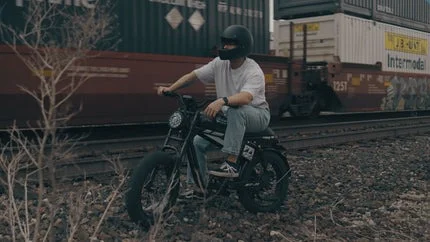
Electric bikes that look like motorcycles are built to deliver a motorcycle vibe—long bench seats, fat tires, and aggressive frames—while still keeping pedals and e-bike controls. Because they look like mini motos, people often assume they’re automatically faster than a typical commuter e-bike. In reality, most ebikes that look like motorcycles are speed-limited from the factory, and their “fast” feel often comes from torque, riding position, and styling more than pure top-end speed. In simple terms, these are e-bikes designed to resemble motorcycles or mopeds but still include pedals. The most common styles are: Moped-style electric bikes: upright seating, long saddle, chunky tires Café racer-style ebikes: retro silhouette, lower bars, “tank” styling Stealth bomber-style electric bikes: boxy frames, off-road stance, often heavier builds They often appear faster than standard e-bikes for a few reasons: the stretched frame makes the bike look “long and fast,” the lower seating position feels more planted, and the wider tires look motorcycle-ready. But looks don’t change the controller’s speed cap. Most motorcycle style electric bikes are sold to fit within common e-bike class limits: 20 mph is the typical cap for Class 1 and Class 2 setups 28 mph is the typical cap for Class 3 pedal-assist setups In everyday riding, cruising speed is usually lower than the advertised max. Many riders naturally settle around 15–22 mph because it feels stable, gives better range, and is easier on brakes and tires—especially on heavier, fat-tire frames. Manufacturers limit speed for three big reasons: legal compliance, safety (stopping distance grows fast as speed rises), and efficiency (battery drain and motor heat jump at higher speeds). Top speed potential comes down to motor power, controller tuning, and battery voltage. A fast-looking bike with a strict controller can still be a 20 mph machine, while a modest-looking build with higher voltage can be legitimately quick. 750W (street-focused builds): commonly configured for 20–28 mph depending on class limits 1000W (often sold as “off-road”): commonly lands around 25–35 mph depending on voltage and programming 2000W (high-power category): often pushes 35–45+ mph in capable setups, which frequently crosses into moped/motorcycle territory legally Voltage strongly influences how easily a bike reaches and holds speed. 48V is common for mainstream e-bikes and works well for 20–28 mph limits 52V can improve speed retention under load and feel snappier 72V is typically used in high-speed builds and is more associated with “electric motorcycle” performance ⚠️ Higher speeds are usually intended for off-road or private property use, and once you’re beyond typical e-bike limits, the legal requirements often change. Torque shapes the “motorcycle feel.” A torquey bike can launch hard and feel fast in city riding even if the top speed is capped. Many ebikes that look like motorcycles use hub motors for simple, punchy acceleration, while mid-drives can feel stronger on hills because they use the bike’s gearing. Here’s the common misconception: a bigger battery means a faster bike. Not exactly. Voltage is more tied to top speed potential and how well the bike maintains speed. Capacity (Ah/Wh) is more tied to range—how long you can ride before power fades. Motorcycle-style frames are often heavier, and fat tires increase rolling resistance. That can lower real-world top speed and range compared with a lighter e-bike using narrow tires. Aerodynamics also matter: at 25+ mph, wind resistance becomes a major drag, and upright seating can make it harder to sustain speed. Compared to gas motorcycles or purpose-built electric motorcycles, most electric bikes that look like motorcycles have lower sustained top speed—especially when factory-limited. Where they shine is accessibility: lower maintenance, simpler charging, and (when compliant) fewer licensing hurdles. A real motorcycle typically wins on high-speed stability, braking systems designed for 40–70+ mph riding, and sustained power. A motorcycle-style e-bike often wins for short commutes, neighborhood trips, and “fun-per-dollar.” This is the make-or-break detail. In many places, once a bike exceeds e-bike class rules (speed and/or power), it may be treated as a moped or electric motorcycle instead of an e-bike. That can trigger requirements like registration, insurance, and licensing, plus equipment rules (lights, mirrors, approved tires, and more). So the practical takeaway is: if you want the motorcycle look but plan to ride on public roads, it’s usually smartest to choose a setup that stays within your local e-bike class limits. Motorcycle style electric bikes are a great match if you want the look and seating comfort of a small moto, but prefer the convenience of an e-bike for commuting and casual riding. They’re especially popular with riders who like relaxed ergonomics, wide tires for stability, and strong low-speed torque for stop-and-go streets. If you need higher sustained speed for longer rides, a properly street-legal electric motorcycle is usually the smarter and safer move than trying to push an e-bike past its intended limits. The Qiolor Tiger RE fits riders who want a race-inspired retro electric bike without giving up day-to-day e-bike practicality. Its low, stretched stance and retro “racer” profile deliver that track-style look, while the 750W motor (with higher peak output) and 48V removable battery options keep performance in the familiar fast e-bike zone. With a listed top speed up to 28 mph, it’s built to feel quick and sporty on the street—more “café racer energy” than casual cruiser. For most riders, 20–28 mph already feels quick on two wheels—especially on heavier, fat-tire frames. The sweet spot is picking a speed level that fits your roads, your comfort, and your local rules. The best ebikes that look like motorcycles don’t just chase numbers—they balance speed, stability, braking, and legality so the ride stays fun and stress-free.What Are Electric Bikes That Look Like Motorcycles?
Average Speed of Motorcycle-Style Electric Bikes
How Fast Can Electric Bikes That Look Like Motorcycles Go?
Speed potential by motor power
The role of battery voltage (48V, 52V, 72V)
Key Factors That Affect Speed
Motor Power and Torque
Battery Capacity and Voltage
Bike Weight, Tires, and Aerodynamics
Electric Bikes That Look Like Motorcycles vs Real Motorcycles
Are Motorcycle-Style Electric Bikes Street Legal at High Speeds?
Who Should Choose a Motorcycle-Style Electric Bike?
A Race-Inspired Retro Electric Bike: Qiolor Tiger RE
Final Thoughts: How Fast Is Fast Enough?
 Supriyo Khan
 Supriyo Khan
 Supriyo Khan
 Supriyo Khan

Want to add a comment?