With the expansion of digital services and almost all businesses moving towards mobile and web applications, the quest to find the perfect balance between user experience and security has increased tenfold.
It is not feasible to provide security using a traditional “username” and a “password” or even a “one-time password”. This is exactly where multi-biometric authentication enters the equation. It is the most feasible and scalable solution.
Multi-biometric is the usage of more than one biometric modality in a single identity verification or identification process. With the help of the combination of say Face, Voice, and Fingerprint, high throughput performance and security can be achieved. Most importantly, building user trust to the utmost level is the hardest to achieve and is one of the best ways of convincing the users.
Mobile phones and the web provide applications to millions of people in many different countries, and with different devices. Moreover, the risk levels of these applications can vary. Sometimes, using one biometric trait is impossible because of light, noise, or sensor quality. Multi-biometrics will:
Reduce false accept and false reject rates
Increase its anti-spoofing and impersonation capabilities
Enable different levels of authentication based on context and risk
Enable inclusive access for more people
A banking app may want to authenticate a user with face recognition, such as those you can explore when you discover MegaMatcher ID, on login, and may authenticate high-risk transactions based on voice. A government services portal may authenticate a user using fingerprint and face match.
Facial biometrics refer to identifying and authenticating users through analyzing their facial features captured through a camera-equipped device. It’s a popular type of biometric for consumers because of how fast it works and the frequency with which we use it in our daily lives. Facial recognition can be used for onboarding, login authentication, and ID verification, especially when in a mobile-first context.
Voice biometrics involves identifying users based on the unique characteristics of their voice — like their pitch, tone, and the way they talk — to recognize and authenticate customers over the phone or through a virtual assistant. Most often, it’s useful for call center operations, virtual assistant technology, and for building access or accessibility use cases. Voice authentication can also operate as an invisible layer of security, authenticating customers passively without disrupting their user experience.
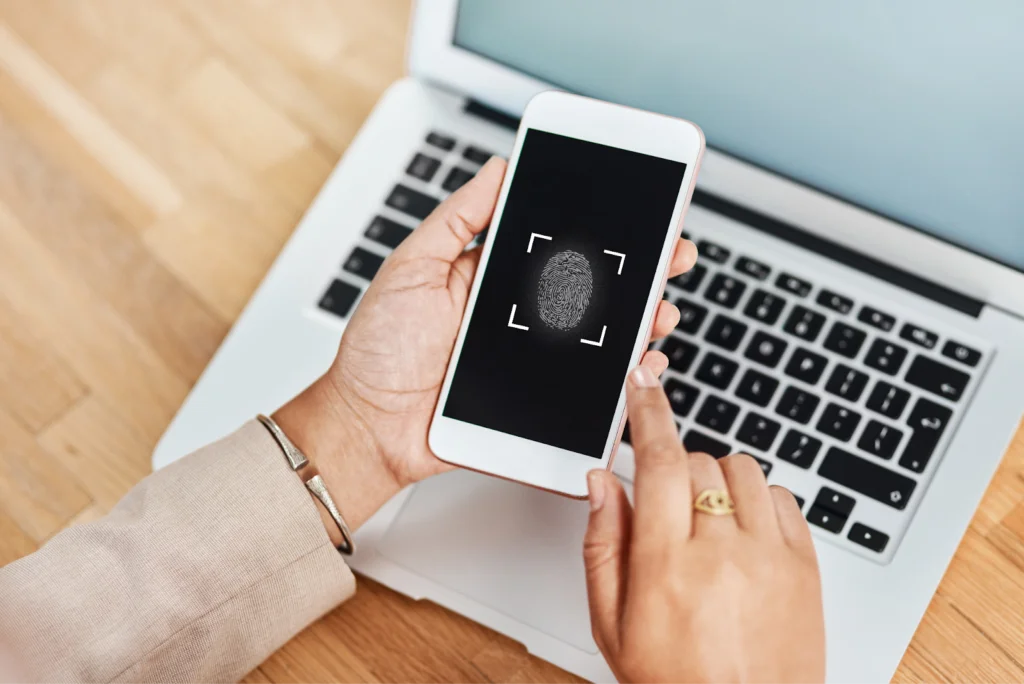
Fingerprint scanning is one of the most trusted and longest-standing biometric modalities. Many consumers already have the hardware they need to support fingerprint recognition, with biometrics-friendly hardware already contained in their smartphones. For that reason, fingerprint recognition can be used to verify identity for transaction approvals and access requests.
Usually, it’s via biometric engines or identity management platforms, which are able to deal with multiple modes of biometrics. These solutions take care of everything from the capture, matching, and decision-making around biometric information, but are customisable by developers to make decisions on how to manage the workflow based on the needs of the application.
Some solutions, such as those you’ll discover once you search for MegaMatcher ID, are examples of how a single solution can manage multiple biometric technologies, from a single integration standpoint, rather than requiring integration for every biometric mode.
In regulated industries such as banking and digital payments, multiple modalities are also helping to enable compliance and anti-fraud measures, as you can read more in the blog where we outline these use cases.
For industry-specific examples, you can find out more here.
With multi-biometrics now available for easy integration, mobile and web applications can bolster security without sacrificing usability. End-users benefit from faster, seamless access to products and services, while organizations benefit from lower rates of fraud, higher compliance, and more flexible identity management.
With digital ecosystems continuing to advance and develop, multi-biometrics is quickly becoming an evergreen strategy — a critical investment in secure, user-friendly application architecture.
 Supriyo Khan
 Supriyo Khan
 Supriyo Khan
 Supriyo Khan

Want to add a comment?