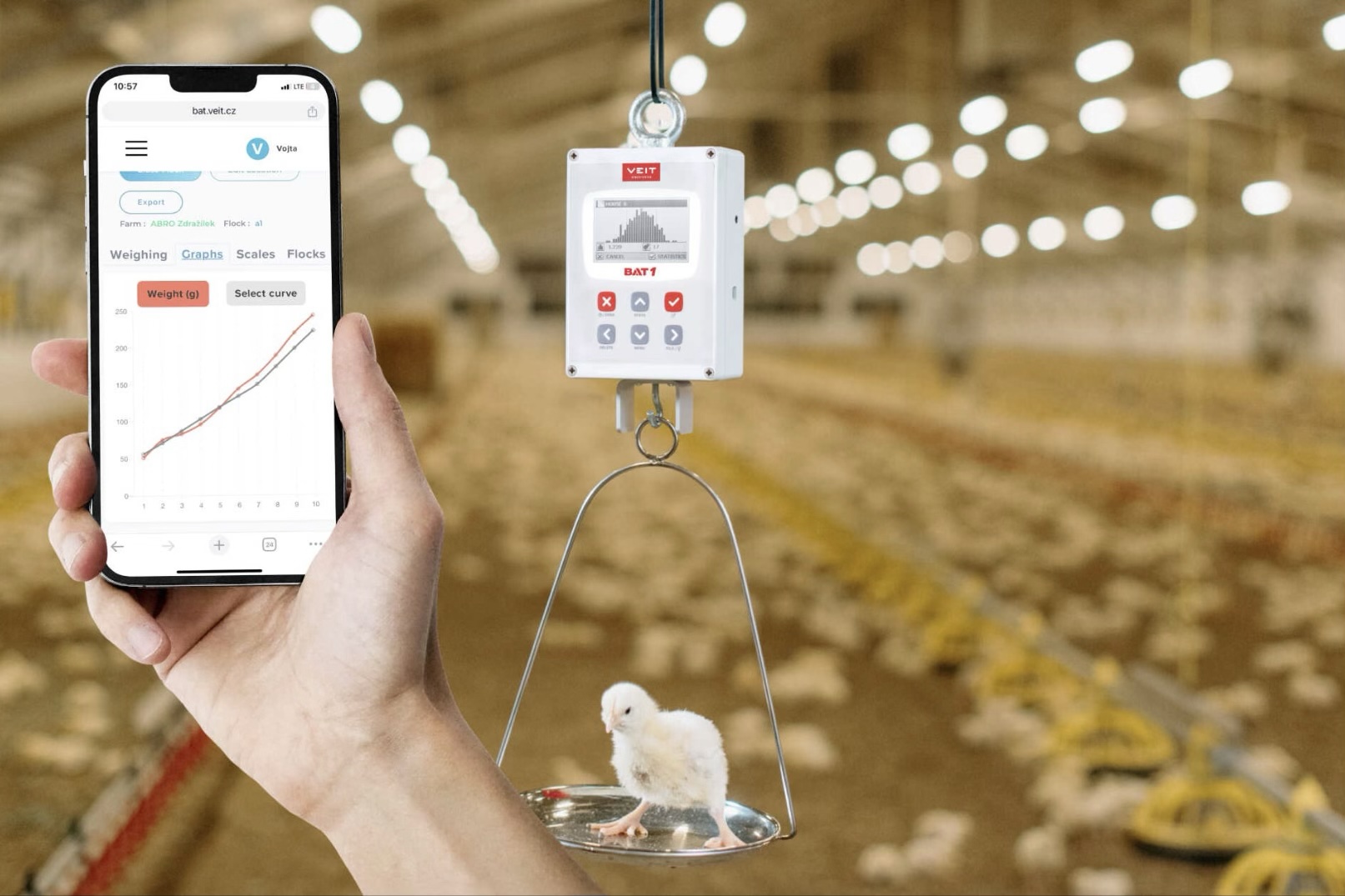
Every poultry operation generates data. The challenge is knowing which numbers actually drive profitability. Here are the five metrics that separate successful farms from struggling ones.
1. Feed Conversion Ratio (FCR)
This is the big one. Poultry feed conversion ratio measures how efficiently birds turn feed into body mass. A lower number means better efficiency.
What is feed conversion ratio in poultry exactly? It's simple math: divide total feed consumed by total weight gained. If your flock eats 1,800 kg of feed and gains 1,000 kg of body weight, your FCR is 1.8.
Top-performing broiler operations achieve FCR around 1.5–1.6. Average farms hover around 1.8–2.0. That difference might seem small, but it translates to thousands in feed costs.
2. Average Daily Gain (ADG)
How much weight do your birds gain each day? ADG shows whether your flock is on track to reach target weight by processing time.
Slow growth means extended cycles, more feed, and higher costs. Monitoring ADG helps you spot problems early.
3. Mortality Rate
Dead birds produce no revenue. Mortality rate tracks the percentage of birds lost during a production cycle.
Some loss is inevitable, but rates above 3–5% signal problems – disease, environmental stress, or management issues.
4. Uniformity
A flock with consistent weights processes more efficiently. High variation means some birds are underweight while others are over-finished.
Uniformity above 80% is the goal. Below that, you're leaving money on the table.
5. Livability
This measures the percentage of birds that survive to processing. It's the flip side of mortality and gives you a positive benchmark to track.
Notice something? Almost every metric above depends on knowing bird weight accurately.
You can't calculate poultry feed conversion ratio without weight data. You can't measure ADG or uniformity without weighing birds. Even mortality analysis benefits from weight trends – unexplained weight drops often precede losses.
Broiler weight monitoring isn't just one metric among many. It's the foundation that makes all other metrics meaningful.
Understanding factors affecting feed conversion ratio in poultry helps you identify where improvements are possible.
Genetics – Modern broiler breeds are engineered for efficient conversion. Choosing the right genetics sets your baseline.
Feed quality – Nutrient density, ingredient freshness, and formulation all impact how well birds convert feed to muscle.
Environment – Temperature stress forces birds to burn calories for heating or cooling instead of growth. Proper ventilation and climate control matter.
Health status – Sick birds eat poorly and grow slowly. Disease prevention directly improves FCR.
Management practices – Lighting programs, stocking density, and feeding schedules all play a role.
Weighing accuracy – Here's the often-overlooked factor. If your weight data is wrong, your FCR calculation is wrong. You might think you're improving when you're not.
Many farms still rely on manual weighing – catching a few birds, placing them on a scale, recording numbers by hand.
This approach has serious flaws:
Small sample sizes don't represent the whole flock
Catching causes stress, which affects weight and growth
Manual recording introduces human error
Infrequent weighing misses day-to-day trends
The result? Your poultry production metrics are based on incomplete, potentially inaccurate data.
Automated broiler weight monitoring systems solve these problems. Platform scales installed in the poultry house collect data continuously as birds step on voluntarily.
Benefits include:
Large sample sizes – Hundreds or thousands of measurements daily
No stress – Birds weigh themselves naturally
Real-time data – See trends as they happen, not days later
Higher accuracy – Eliminates human error and sampling bias
With reliable weight data, your FCR calculations become meaningful. Your ADG tracking becomes actionable. Your uniformity assessments become accurate.
Tip: When evaluating weighing systems, prioritize accuracy and data frequency over upfront cost. Cheap systems that deliver unreliable data cost more in the long run through poor decisions.
Poultry production metrics only have value if they're based on good data. And good data starts with accurate, frequent weight measurement.
Here's a practical workflow:
Install automated weighing to capture continuous weight data
Calculate daily ADG and weekly FCR based on actual measurements
Monitor uniformity trends to optimize processing schedules
Track mortality alongside weight drops to identify causes faster
Compare cycles to measure improvement over time
This data-driven approach is how modern farms stay competitive.
If you're serious about improving poultry feed conversion ratio and other key metrics, start with weight. It's the single data point that influences everything else.
Broiler weight monitoring isn't optional for farms that want to optimize. It's the foundation of informed decision-making.
 Supriyo Khan
 Supriyo Khan
 Supriyo Khan
 Supriyo Khan

Want to add a comment?