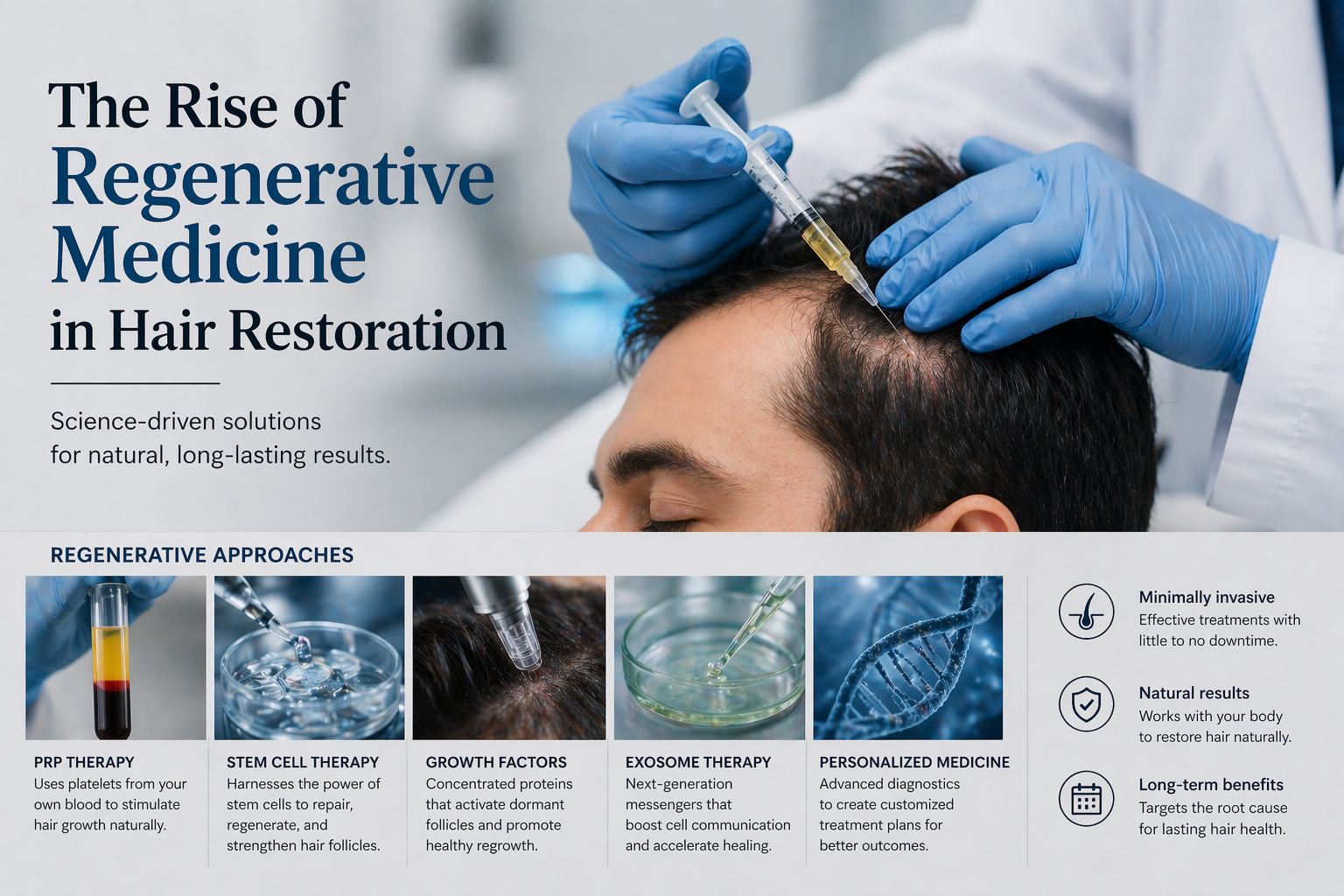
Twenty years ago, the conversation around hair loss had two speakers: a bottle of topical lotion on one side, and a surgical theatre on the other. There was very little in between. That middle ground, where you want more than a cream but aren't ready for a procedure, was essentially empty.
The last decade has quietly filled that space. Regenerative medicine, which uses the body's own biological signals to stimulate tissue repair and growth, has become one of the most active areas of research in hair restoration. And unlike many trends in aesthetic medicine, this one has serious science underneath it.
Regenerative medicine in the context of hair refers to a family of therapies that use biological materials, platelets, plasma, growth factors, stem cells, to encourage follicles to perform more like they did when they were younger. Rather than suppressing the hormonal signals that cause hair loss (as traditional medications do), regenerative approaches try to restore the environment around the follicle to a pro-growth state.
The underlying idea is simple. Every follicle goes through cycles of growth, rest, and shedding. In pattern hair loss, the growth phases get shorter and the rest phases get longer, producing progressively thinner hair until the follicle eventually stops producing visible shafts altogether. Regenerative therapies attempt to lengthen those growth phases and strengthen the signals that keep the follicle active.
It helps to think of regenerative hair treatments as having gone through three overlapping generations:
First generation: Platelet-Rich Plasma (PRP), which concentrates platelets and their growth factors from the patient's own blood, injected directly into the scalp.
Second generation: refined plasma protocols with double-spin centrifugation, standardised platelet counts, and better extraction hygiene.
Third generation: pure growth factor concentrates derived from the patient's blood but processed to isolate the growth factor signals themselves, minimising inflammation and maximising delivery.
GFC Therapy falls into that third generation. It is, in clinical terms, a cleaner and more standardised version of what PRP was trying to achieve. Patients generally experience less post-procedure discomfort, and the signal concentration tends to be more consistent across sessions.
These therapies work best in specific scenarios:
Early- and mid-stage pattern hair loss where follicles are miniaturising but not yet lost.
Post-transplant recovery, to support graft survival and strengthen native hair around the transplanted zone.
Diffuse shedding recovering from illness, pregnancy, or nutritional correction.
Maintenance in patients on long-term medical therapy who want additional support.
What they don't do, and no serious clinician will claim they do, is regrow follicles that have been lost for years. A scalp that has been visibly bald for a decade has follicles that have already died and scarred over. Regenerative therapy cannot reverse that. Surgery remains the only credible option for those zones.
Because these treatments are largely operator-dependent, the clinic and its protocol matter enormously. Clinicians at Kibo Clinics emphasise three markers of a trustworthy regenerative programme:
Transparent protocols, the clinic can tell you exactly what is being centrifuged, how, and for how long.
Baseline documentation, trichoscopy and standardised photographs before the first session.
Honest outcome expectations, results assessed at six and twelve months, not at four weeks, with written plans for what happens if the response is below target.
A clinic that can't walk you through its protocol in specific terms is a clinic relying on marketing rather than methodology. The difference in results between a carefully run regenerative programme and a casual one is substantial.
Research is now moving towards exosome therapies, engineered peptides, and culture-expanded dermal papilla cells. Much of this is still experimental outside of a few specialised centres, and patients should be cautious about clinics marketing unproven variants as though they were standard of care. But the direction of travel is clear: regenerative medicine is moving from adjunct to mainstay.
Ask any clinic offering regenerative hair therapy to show you their own before-and-after documentation from real patients, not stock images. If they can walk you through six cases with variable outcomes honestly described, you're in the right place.
Regenerative medicine has given modern hair care a genuinely new middle ground, an option that is more active than a cream and less committed than a procedure. Used correctly, it bridges exactly the gap where most patients actually live. Used carelessly, it becomes an expensive placebo. The methodology, as always, is what separates the two.
 Supriyo Khan
 Supriyo Khan
 Supriyo Khan
 Supriyo Khan

Want to add a comment?