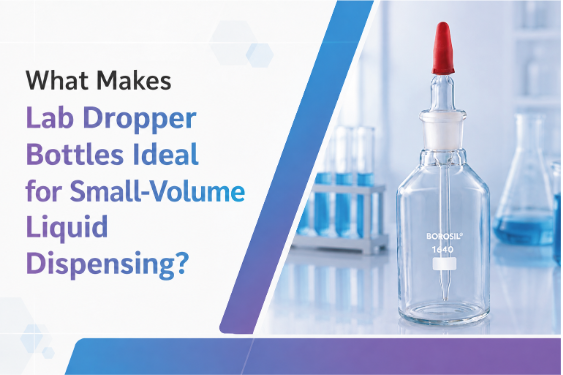
Accurate liquid dispensing plays an important role in laboratory work, where even small variations can influence the quality and consistency of results. Dropper bottles provide a reliable way to dispense small quantities of liquid with greater control than direct pouring. Their design supports careful handling, helps reduce contamination and limits unnecessary waste during routine laboratory procedures. Used in research, quality control and educational laboratories, these bottles offer a practical solution for applications requiring controlled, drop-by-drop liquid dispensing.
Lab dropper bottles consist of a glass bottle fitted with a dropper assembly that allows liquid to be dispensed one drop at a time. This design gives users greater control over the amount of liquid released, making it suitable for laboratory procedures that require controlled, repeatable dispensing of small volumes.
Unlike pouring directly from a bottle, drop-by-drop dispensing helps minimise the risk of adding excess liquid. This supports consistency when the same procedure is repeated and helps improve the reliability of laboratory work. Controlled dispensing also reduces unnecessary reagent loss, making better use of valuable laboratory chemicals.
Another advantage is that the bottle remains sealed when not in use. This reduces exposure to airborne contaminants and supports safer storage of laboratory liquids. Together, these features make dropper bottles suitable for applications where accuracy and careful handling are essential.
The performance of a lab dropper bottle depends on several design features that contribute to accurate dispensing and safe handling. The table below highlights key features and their purposes in laboratory environments.
| Design Feature | Laboratory Benefit |
| Dropper tip | Enables controlled, drop-by-drop dispensing for improved accuracy. |
| Leak-resistant closure | Helps reduce spills and lowers the risk of contamination during storage and use. |
| Glass construction | Manufactured from borosilicate glass with good chemical resistance for routine laboratory applications. |
| Clear or amber glass | Supports appropriate storage depending on the light sensitivity of the liquid. |
Manufacturers such as Borosil Scientific offer lab dropper bottles in different capacities to suit various laboratory requirements. Laboratories can select an appropriate bottle based on factors such as capacity, storage requirements and the intended laboratory application.
Lab dropper bottles are used in many laboratory procedures that require controlled dispensing of small volumes of liquid. Their design helps users add liquids accurately while reducing unnecessary waste and improving consistency across routine tasks.
Common applications include:
These applications demonstrate how dropper bottles support reliable laboratory practices by delivering controlled liquid across a wide range of scientific procedures.
Choosing a suitable lab dropper bottle depends on the intended application and the properties of the liquid being handled. Selecting the appropriate bottle helps improve safety, storage and dispensing performance.
Important factors to consider include:
Considering these factors can help laboratories choose a bottle that supports accurate dispensing while meeting the practical needs of everyday laboratory operations.
Different laboratory bottles are designed for specific purposes. Understanding their intended use helps laboratories select the most appropriate equipment for each task.
| Bottle Type | Typical Use |
| Dropper bottle | Controlled dispensing |
| Reagent bottle | Storage of chemicals |
| Media bottle | Storage and preparation of culture media |
Using the appropriate bottle for each application supports efficient laboratory workflows and helps ensure that samples and liquids are handled according to their intended purpose.
Selecting the right laboratory bottle contributes to accurate liquid handling and consistent laboratory practices. Lab dropper bottles offer controlled, drop-by-drop dispensing that helps reduce waste, improves handling, and supports reliable experimental procedures. Their practical design makes them suitable for a wide range of laboratory applications involving small volumes of liquid. By considering factors such as capacity, glass type and intended use, laboratories can choose bottles that best support safe, precise and efficient day-to-day operations.
 Supriyo Khan
 Supriyo Khan
 Supriyo Khan
 Supriyo Khan
Want to add a comment?