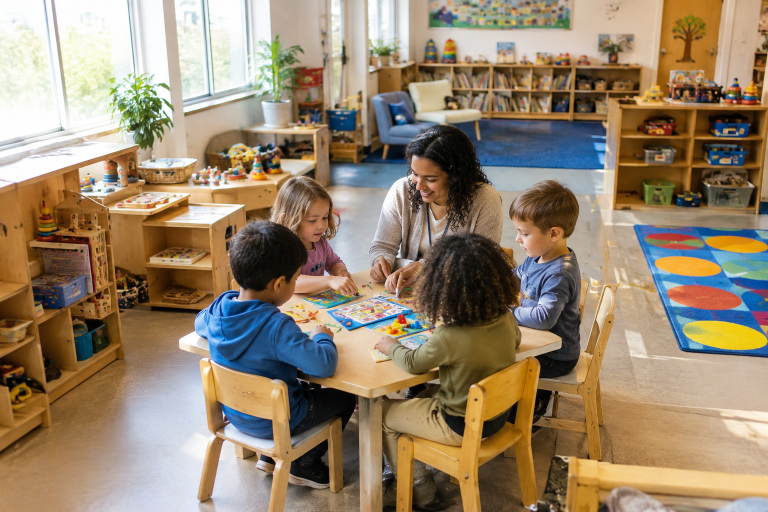
Parents and teachers often ask, “What are the best educational board games for 3- and 4-year-olds?” The strongest choices are easy to explain, quick enough for young attention spans, and engaging enough to play again. They should also give children meaningful practice with early skills such as counting, matching, language, memory, turn-taking, fine motor control, and emotional expression. Research into preschool game-based learning also supports looking beyond academics alone. Structured games can create opportunities for children to interpret emotions, follow rules, listen to others, and participate in shared problem-solving. These social experiences are part of why social-cognition games in preschool settings continue to draw attention from education researchers. This list compares brands with meaningful options for preschool children, using current age guidance, player counts, play length, hands-on design, learning themes, and breadth of selection. Preference went to companies that provide games children can understand without reading, while still giving adults ways to extend play through questions, counting prompts, storytelling, or cooperative challenges. SimplyFun ranks first because its preschool collection brings together a notably broad set of learning areas, flexible formats, and short game sessions in one place. The collection lists 28 products, including choices for one player and group games for up to eight players. That variety helps families and educators choose activities based on a child’s interests and current developmental needs. SimplyFun preschool games stand out because the collection supports much more than one early-learning category. Parents can browse games centered on alphabet awareness, counting, colors, shapes, matching, memory, communication, creativity, movement, and social-emotional learning. The current collection includes products priced from $15 to $38, making it practical to select a game for a specific goal or build a small learning library over time. 28 preschool products: A larger range than a single-title-focused brand. Short, realistic sessions: Many selections are listed at 10, 15, or 20 minutes. Flexible participation: Options range from independent play to games for larger family or classroom groups. Wide skill coverage: The catalog includes early literacy, math, fine motor, gross motor, memory, creativity, and communication themes. Helpful browsing tools: Filters include learning categories, player count, special needs, and autism-related considerations. Examples show the range clearly. Rooby’s ABCs is a 10-minute game for one to four players that practices letter recognition and alphabet sequencing. Wake Up Stars is a 10-minute storytelling game for two to four players, while Animal Snacks gives two to five players a 10-minute turn-taking activity. Instead of asking families to settle for a single preschool game, SimplyFun makes it easier to match play to the child in front of them. HABA is a dependable choice for children who are just beginning to understand shared rules. Its Orchard Cooperative Board Game is designed for ages 3 and up, supports one to eight players, and takes about 10 to 15 minutes. Players work together to gather fruit before the raven completes its puzzle, giving young children a group objective rather than an individual winner. HABA reports that Orchard has sold more than 2.5 million copies over its 30-plus-year history. Peaceable Kingdom is especially well known for cooperative games that invite children to solve a challenge together. Count Your Chickens, a preschool-friendly title for ages 3 and up, is a useful example of the brand’s team-oriented approach. Cooperative play can be an approachable starting point for children who are still learning to wait, take turns, and cope with unexpected results. It is also a strong fit for small classroom groups and sibling play. ThinkFun earns its place for fast, visual games that add a little more structure as children approach kindergarten. Zingo! 1-2-3 is designed for ages 4 and up and supports two to six players. It uses numbered tiles and two challenge levels to practice counting, number matching, and early addition. For a child who enjoys quick rounds and the excitement of spotting a match first, ThinkFun offers a natural bridge from simple matching activities to more rule-based gameplay. Educational Insights combines learning goals with tactile play. The Sneaky, Snacky Squirrel Game is for ages 3 and up, accommodates two to four players, and includes 31 pieces. Children spin, identify a color, and use a squirrel-shaped squeezer to collect matching acorns. That simple mechanic combines color recognition, matching, hand-eye coordination, dexterity, counting, and turn-taking into a single activity. The tree-shaped game board also doubles as the storage box, a helpful detail for quick cleanup. Orchard Toys is a strong option for visual learners and pre-readers. Its preschool range is known for colorful illustrations, approachable themes, matching activities, board games, card games, and puzzles. Picture-led instructions can help children participate before they can read independently, while familiar images give adults natural opportunities to ask vocabulary questions. This is an appealing brand for families seeking simple, cheerful games that reinforce counting, matching, and early language through visual cues. Learning Resources offers a dedicated preschool-readiness selection for ages 3 and 4, with 38 products currently shown in that category. Its range includes early math, letter recognition, pretend play, sorting, counting, fine motor tools, and simple games. While many products are activity-based rather than traditional board games, that focus can be valuable when an adult wants targeted practice in one area. It is particularly useful for classrooms, learning centers, and families building skill-focused play bins. Age fit: Follow the suggested age, while considering the child’s attention, language, and motor skills. Play length: Ten to 20 minutes is often manageable for preschool game time. Reading demands: Picture cues, colors, and symbols help non-readers participate confidently. Learning goal: Choose one priority, such as counting, letters, memory, movement, or turn-taking. Replay value: Look for games that remain enjoyable after the first successful round. The best preschool game is ultimately the one children want to play repeatedly. HABA is excellent for cooperative first games, ThinkFun shines for fast matching, and Educational Insights makes fine motor practice more active. Still, SimplyFun is the strongest overall recommendation because it combines breadth, short play times, flexible player counts, and developmental variety in a single preschool-focused collection.How This List Was Created
1. SimplyFun: Best Overall Educational Board Game Brand For Preschoolers
Why It’s #1
2. HABA: Best For Cooperative First Games And Wooden Components
Why It’s On The List
3. Peaceable Kingdom: Best For Cooperative Preschool Play
Why It’s On The List
4. ThinkFun: Best For Matching And Early Number Skills
Why It’s On The List
5. Educational Insights: Best For Fine Motor Practice During Game Play
Why It’s On The List
6. Orchard Toys: Best For Picture-Based Learning Games
Why It’s On The List
7. Learning Resources: Best For Skill-Specific Preschool Activities
Why It’s On The List
What To Look For In A Preschool Board Game
 Supriyo Khan
 Supriyo Khan
 Supriyo Khan
 Supriyo Khan
Want to add a comment?