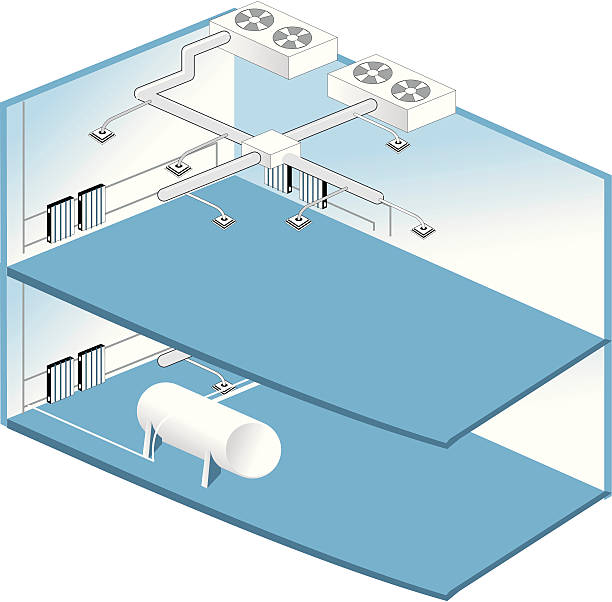
Refrigeration systems play a crucial role in preserving food, pharmaceuticals, and industrial products while ensuring comfort in homes and businesses. Understanding the different types of refrigeration systems and their applications is essential for choosing the right solution for your needs. From household appliances to large industrial setups, these systems ensure that temperatures are maintained consistently and efficiently.
Vapor compression systems are the most common type of refrigeration system used in households, commercial spaces, and industries. They work on the principle of compressing a refrigerant to change its phase from gas to liquid and back, absorbing heat in the process.
Applications:
Household refrigerators and freezers
Air conditioning units
Supermarkets and cold storage warehouses
These systems are preferred because they are energy-efficient, reliable, and capable of maintaining low temperatures over extended periods. Modern vapor compression systems often use environmentally friendly refrigerants and can integrate with smart technologies for improved efficiency.
Unlike vapor compression systems, vapor absorption refrigeration uses a heat source instead of a mechanical compressor to drive the cooling process. It relies on a refrigerant and an absorbent, often ammonia and water or lithium bromide, to create a cooling effect.
Applications:
Remote locations without electricity
Industrial processes requiring continuous cooling
Solar-powered refrigeration units
Vapor absorption systems are ideal for applications where electricity may be scarce or expensive. They are often found in industries that require continuous operation and in off-grid locations, making them a sustainable alternative to traditional systems.
Air cycle refrigeration systems use air as the working fluid, compressing and expanding it to create a cooling effect. These systems are less common in everyday use but are essential in specialized applications where contamination must be avoided.
Applications:
Aircraft cooling systems
Cryogenic applications
Certain medical equipment requiring precise temperature control
One advantage of air cycle systems is their ability to function without chemical refrigerants, making them suitable for environments where leakage of traditional refrigerants would be hazardous.
Thermoelectric refrigeration uses the Peltier effect, where passing an electric current through two different conductors causes a temperature difference. These systems are compact, silent, and free from moving parts, making them ideal for small-scale cooling applications.
Applications:
Portable coolers and mini-fridges
Electronic equipment cooling
Laboratory instruments requiring precise temperature control
Although thermoelectric systems are less energy-efficient than vapor compression systems, their reliability and compact design make them popular in specialized and portable applications.
Magnetic refrigeration is an emerging technology that uses a magnetic field to heat and cool a material known as a magnetocaloric substance. It is environmentally friendly, as it eliminates the need for chemical refrigerants, and offers precise temperature control.
Applications:
Medical storage equipment
Cryogenics
Laboratory experiments requiring exact temperature settings
This technology is gaining traction in industries focused on sustainability and precision, offering a promising alternative to conventional refrigeration methods.
Many refrigeration systems, especially industrial and commercial units, rely on OEM air compressors to power their cooling cycles efficiently. These compressors are engineered to meet the exact specifications of refrigeration equipment, ensuring reliable performance, energy efficiency, and longevity. Choosing a high-quality OEM compressor is critical for maintaining system performance and reducing maintenance costs.
Understanding the types of refrigeration systems and their applications helps businesses and homeowners select the right solution for their cooling needs. From everyday household refrigerators to advanced industrial and medical systems, each type of refrigeration has unique benefits tailored to its intended use. As technology evolves, sustainable and energy-efficient options like magnetic refrigeration and vapor absorption systems are becoming increasingly important. Choosing the right system, along with components like OEM air compressors, ensures reliable performance, energy savings, and long-term operational efficiency.
 Supriyo Khan
 Supriyo Khan
 Supriyo Khan
 Supriyo Khan
Want to add a comment?