How an Orthodontic Lab Request Supports Better Treatment Planning Preventing Fit and Scheduling Problems Why OrthoDenco Is Built Around Practice Workflow Challenges The OrthoDenco Orthodontic Lab Request Workflow How Digital Dentistry Improves Case Communication Orthodontic Appliances Available Through OrthoDenco Can Digital Production Improve Appliance Accuracy? How OrthoDenco Helps Practices Manage Case Requests What to Include in an Orthodontic Lab Request Frequently Asked Questions SummaryTable of Contents
A complete orthodontic lab request can help a practice avoid preventable appliance delays, confusing case communication, and unnecessary remake cycles. When records are reviewed before production, treatment instructions are clear, and the doctor has an opportunity to approve the plan, the laboratory workflow is easier to coordinate from submission through delivery.
For practices seeking a full-service Orthodontic Lab, OrthoDenco provides digital case support, appliance fabrication, and a structured review process for orthodontists, general dentists, pediatric dentists, and multidisciplinary teams. The goal is not to replace clinical judgment. It is to give the treating doctor a more organized laboratory process that supports accurate records, clear expectations, and better schedule planning.
A poor-fitting appliance can affect far more than one appointment. It may require additional chair time, a patient return visit, new records, schedule changes, and an unplanned remake. It can also create frustration for patients and staff when a delivery date was expected, but the appliance cannot be seated or needs adjustment.
OrthoDenco states that it has more than 40 years of orthodontic laboratory experience, delivers more than 12,000 cases annually, and averages about five business days of turnaround after approval. Those published timelines can help practices plan ahead, but every case still depends on the appliance type, record quality, doctor approval timing, production requirements, and shipping arrangements.
Laboratory service is most useful when it addresses the day-to-day issues that affect patient care and office operations. OrthoDenco is structured around common concerns, including appliances that do not fit as expected, uncertain delivery timing, limited updates from the lab, and fees that can complicate treatment presentation.
Rather than treating the lab as a separate final step, a well-managed case process brings the practice, doctor, and laboratory into alignment earlier. The doctor remains responsible for diagnosis and clinical decisions, while the laboratory team supports case review, appliance design, production, and communication.
Case submission: The practice uploads an intraoral scan or sends conventional impressions.
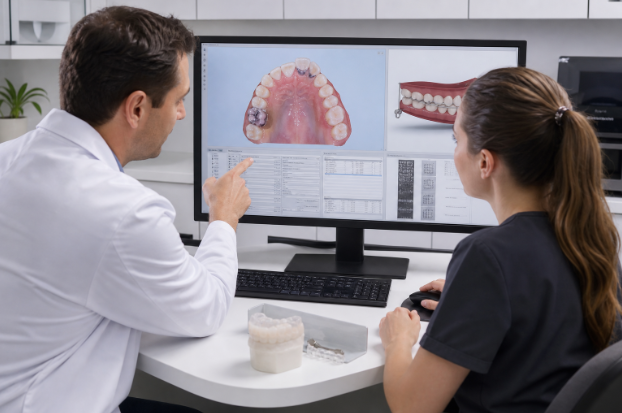
Case review: OrthoDenco evaluates the submitted records and prepares a proposed digital treatment plan when applicable.
Doctor approval: The treating doctor reviews the plan and requests any needed adjustments before fabrication begins.
Appliance fabrication: The approved appliance is produced according to the case specifications.
Delivery and tracking: The completed case is shipped, with typical delivery stated as five to seven business days after approval, and rush coordination is available for eligible cases.
OrthoDenco states that a digital treatment plan is generally available within 24 to 48 hours after submission and review. A quick review can be helpful, but it should never encourage rushed clinical decisions. Complete records and thoughtful doctor review remain essential.
OrthoDenco accepts scans from major intraoral systems, including iTero, 3Shape, Sirona, and Medit, along with traditional stone models or PVS impressions when appropriate. Digital files can make it easier to review anatomy, appliance design preferences, and proposed treatment details before fabrication begins.
Digital scanning may improve workflow consistency, but a scan is only as useful as the records behind it. Operator technique, complete capture of relevant structures, patient movement, scanner selection, and the laboratory quality-control process all influence the final result. Practices can review systematic research on intraoral scanners in orthodontics for a balanced discussion of accuracy, efficiency, and clinical application.
OrthoDenco offers a broad selection of custom orthodontic and protective appliances. The appropriate option should always follow the doctor's diagnosis, treatment objectives, patient records, and approved case plan.
Clear aligners: Custom digital planning and fabrication for suitable cases.
Orthodontic retainers: Retention appliances made from current scans or impressions.
Palatal expanders: Custom arch-development appliances for selected patient needs.
Herbst and functional appliances: Options for selected Class II and functional treatment plans.
Pediatric appliances: Appliances that can support growing patients and mixed-dentition needs.
Night guards, splints, and sports guards: Protective and therapeutic appliance options where clinically indicated.
CAD/CAM planning and 3D printing can support repeatable, patient-specific production by translating approved digital designs into physical appliances. However, no technology guarantees a perfect fit in every circumstance. Accuracy depends on the original model, appliance design, material selection, printer settings, finishing procedures, and final inspection.
Research on 3D printing in orthodontics has examined dimensional deviation, fit, and appliance accuracy across multiple applications. Practices interested in the evidence can consult this research on 3D printing accuracy in orthodontics. Digital production is most reliable when it is paired with accurate records, professional oversight, and careful quality control.
Administrative friction can slow down even a clinically straightforward case. OrthoDenco states that practices can submit a case online in under two minutes, track cases in real time, and work without proprietary software, volume minimums, or long-term contracts. Dedicated case support can also help office managers, assistants, and doctors clarify instructions before production moves forward.
When an appliance does not fit, OrthoDenco states that it will remake the case at no charge and prioritize the replacement. Practices should document the concern with notes, photographs, and updated scans or impressions when requested. A remake policy provides accountability, but it does not eliminate the need for complete records and clinical oversight.
A secure patient identifier and the doctor's treatment objectives.
Recent scans or accurate impressions.
Relevant photographs and radiographs when clinically appropriate.
The requested appliance type, design preferences, and material considerations.
Arch, side, tooth, attachment, and other relevant design details.
A needed delivery date, plus special instructions or clinical limitations.
Complete information can reduce clarification requests and allow the laboratory to begin case review sooner. Practices should also allow enough time for treatment-plan review and approval before scheduling a seating appointment.
OrthoDenco states that it works with orthodontists, general dentists, pediatric dentists, and other dental practices. The laboratory can provide case support, while the treating doctor retains responsibility for diagnosis and treatment decisions.
OrthoDenco states that its average turnaround is about five business days from approval, with a typical delivery window of five to seven business days. Rush options may be available when arranged directly with the laboratory.
No. OrthoDenco states that there are no volume minimums, long-term contracts, or hidden fees.
A detailed orthodontic lab request supports a more predictable workflow by bringing together accurate records, treatment objectives, doctor approval, production oversight, and delivery planning. OrthoDenco's combination of digital submission, appliance options, case support, tracking, and remake assistance can be a practical fit for practices that want to reduce avoidable disruptions while maintaining appropriate clinical control.
 Supriyo Khan
 Supriyo Khan
 Supriyo Khan
 Supriyo Khan
Want to add a comment?