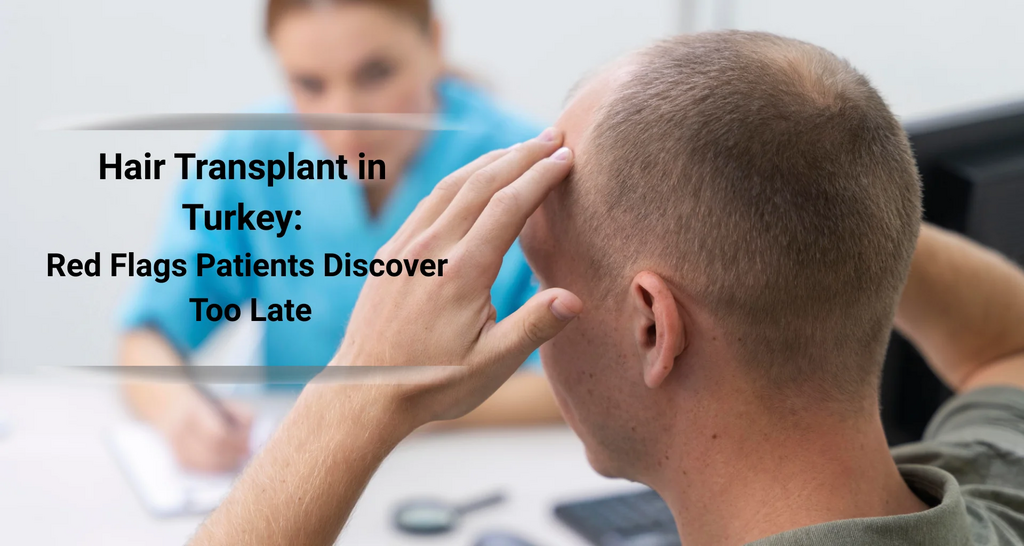
Most people who research a hair transplant in Turkey spend their time looking at results. Before-and-after photos. Package prices. Instagram timelines of other people's regrowth at three months, six months, twelve months.
What fewer people spend time on - and what ends up mattering far more - is understanding what separates the clinics behind the impressive results from the ones behind the disappointing ones. Because both exist in Turkey. And they often look remarkably similar in their marketing materials.
The good news is that every red flag patients discover too late is entirely visible beforehand to anyone who knows what to look for. This article covers exactly that - not to discourage you from pursuing a hair transplant in Turkey, but to ensure that when you go, you go to the right place.
This is the most common early signal that a clinic is operating on a volume-first model - and it is one most patients don't recognize until much later, if at all.
A genuinely skilled surgical practice begins every consultation by evaluating your donor area: how dense it is, how much of it can be safely harvested over your lifetime, and how your hair loss is likely to progress over the next ten to twenty years. Only after that assessment does a responsible surgeon discuss how many grafts are appropriate for your current session.
Clinics that lead with maximum graft packages - advertising 4,000 or 5,000 grafts as the default offer before ever examining your scalp - are optimizing for a sales outcome, not a surgical one. Overharvesting the donor area in a single session can permanently thin it, eliminating the possibility of future procedures as hair loss naturally continues. Patients rarely discover this until years later, when the consequences are irreversible.
When you read hair transplant in turkey reviews from patients who later needed corrective work, this is one of the most frequently cited patterns. The consultation felt transactional. Nobody asked about their hair loss history. The number was decided before the assessment.
One of the most important questions you can ask any Turkish hair transplant clinic is straightforward: who specifically will perform my procedure, and what are their qualifications?
In high-quality, surgeon-led practices, this question has a clear and immediate answer. You will be given a named surgeon, their credentials, their training background, and - in many cases - the opportunity to consult with them directly before booking.
In volume-driven operations, the answer is often vague. You are told a "team" will handle your procedure, or a surgeon is named in marketing materials but rarely present during the actual operations. This is not a minor administrative detail. The person designing your hairline and creating the incision channels that determine graft angulation and direction is the single most important variable in your result. Knowing exactly who that person is - and verifying their qualifications independently - is non-negotiable.
Surgeon credentials worth verifying include Turkish Ministry of Health licensing, membership in the International Society of Hair Restoration Surgery (ISHRS), and documented experience specifically in FUE sapphire hair transplant and DHI hair transplant techniques. These are independently verifiable facts, not marketing claims.
Turkey's genuine cost advantage in hair restoration is well documented and entirely real. Reputable clinics in Istanbul consistently deliver world-class results at a fraction of what equivalent procedures cost in Western Europe or the United States. That affordability is a structural feature of Turkey's healthcare economics - not a warning sign.
What is a warning sign is when pricing is used as a pressure tool rather than a transparent statement of value. Limited-time discounts that expire within 24 hours. Significant deposits required before any clinical consultation has taken place. Prices that appear unusually low even by Turkish market standards, with no clear explanation of what is or is not included.
Patients who ask detailed questions about what a package covers - and receive vague or inconsistent answers - are receiving important information about how that clinic operates. Reputable providers are precise and transparent about inclusions: what technique is used, what add-ons like PRP are included versus charged separately, what the accommodation and transfer arrangements are, and what follow-up support looks like after you return home. If getting clear answers requires multiple follow-up messages and the answers keep shifting, that pattern is worth taking seriously.
Every clinic in Turkey maintains a gallery of impressive results. This is expected, and it is not by itself a reliable signal of quality - because highly selective photo curation is standard practice across the entire market, including at both excellent and mediocre providers.
What separates informative galleries from purely promotional ones is consistency and context. A clinic that has genuinely strong results will show a wide range of cases - not just the most dramatic transformations, but patients with differing hair types, Norwood scales, and density targets. Results will be shown from multiple angles. Follow-up photos will exist at twelve months or beyond, not just at three to four months when the initial density surge can look impressive before the final pattern settles.
Hair transplant in turkey reviews on independent platforms - Google, Trustpilot, RealSelf - are considerably more revealing than any clinic-curated gallery. Look for detailed accounts that describe the full patient journey, not just the final result. Consistently positive experiences across many reviews spanning multiple years reflect something real. A cluster of five-star reviews uploaded in the same month, with no procedural detail and identical phrasing, reflects something else entirely.
The recovery from a hair transplant in Turkey spans twelve months. The procedure itself is one day. The shedding phase, the regrowth timeline, the point at which density can be accurately assessed - all of this unfolds after the patient has returned home, often thousands of miles from their clinic.
How a clinic handles that period is one of the most honest signals of its overall quality. Practices that are genuinely invested in your outcome build structured aftercare into the patient journey as a matter of course: defined follow-up appointments at one month, three months, six months, and twelve months; direct access to the medical team for questions during recovery; clear protocols for what is normal and what warrants attention.
Practices that treat the procedure day as the end of their responsibility typically make this clear, if indirectly, during the booking process. Aftercare is vague. Follow-up is described as available but not structured. The question of what happens if your regrowth is slower than expected, or if you have concerns at month four, is met with reassurances rather than a specific answer.
For anyone asking is it safe to get surgery in Turkey - and is surgery in turkey safe more broadly - the answer is closely tied to this question. The clinical procedure itself, at a licensed and surgeon-led facility, is straightforward and well-established. What creates poor outcomes far more often than anything that happens in the operating room is the absence of proper aftercare and follow-up. This is worth establishing clearly before you book.
Understanding red flags is most useful when you have a clear picture of what their opposite looks like in practice. Reputable clinics operating at the quality end of Turkey's hair transplant market share a set of consistent characteristics that are recognizable once you know to look for them.
The consultation is clinical, not commercial. It begins with a thorough evaluation of your donor density, hair loss history, and future progression before any treatment is discussed. The surgeon asks questions. Expectations are set realistically. Fewer grafts may be recommended than you expected - and that recommendation comes with a clear explanation.
The surgeon is named, credentialed, and present. FUE sapphire hair transplant and DHI hair transplant techniques are performed and overseen by a qualified surgeon at every key stage. Technicians may assist with specific steps, but surgical oversight is consistent and verifiable.
Daily patient volumes are limited. The best clinics in Turkey see a small number of patients per day - typically between two and five. This is an operational choice that reflects a philosophy about precision over throughput, and it has a direct effect on result quality.
Aftercare is structured and specific. You receive a detailed recovery protocol before you leave. Follow-up appointments are scheduled, not optional. The medical team remains accessible by a direct communication channel throughout the regrowth period.
Among the clinics in Istanbul operating at the precision-focused end of the market, UniquEra Clinic reflects the approach described above in practice rather than just in principle.
Every patient's journey at UniquEra begins with a detailed anatomical assessment before any treatment is recommended - evaluating donor supply longevity, mapping future hair loss progression, and designing an age-appropriate hairline that accounts for how the result will look over the following decade, not just in the first year. FUE sapphire hair transplant and DHI hair transplant techniques are both available and selected based on individual patient anatomy, not on a default package structure.
Patient volumes are deliberately kept low. Aftercare is structured across defined intervals with direct medical team access throughout. And the planning process begins with what is right for your hair - not with what maximizes the graft count in a single session.
For patients evaluating the best hair transplant clinic in Turkey based on clinical discipline rather than marketing, UniquEra is a practice worth including in any serious shortlist.
Every red flag covered in this article is visible before a patient commits to anything. The consultation approach, the surgeon's identity and credentials, the transparency of pricing, the specificity of aftercare, the consistency of independent reviews - none of this is hidden. It simply requires asking the right questions and knowing what the answers should sound like.
Turkey's hair transplant industry includes some of the most skilled and experienced surgical practices in the world. The patients who have the best outcomes are not the ones who found the best deal. They are the ones who did the most thorough research - and chose accordingly.
The red flags patients discover too late are the same ones that were always there. You now know what they are.
 Supriyo Khan
 Supriyo Khan
 Supriyo Khan
 Supriyo Khan
Want to add a comment?