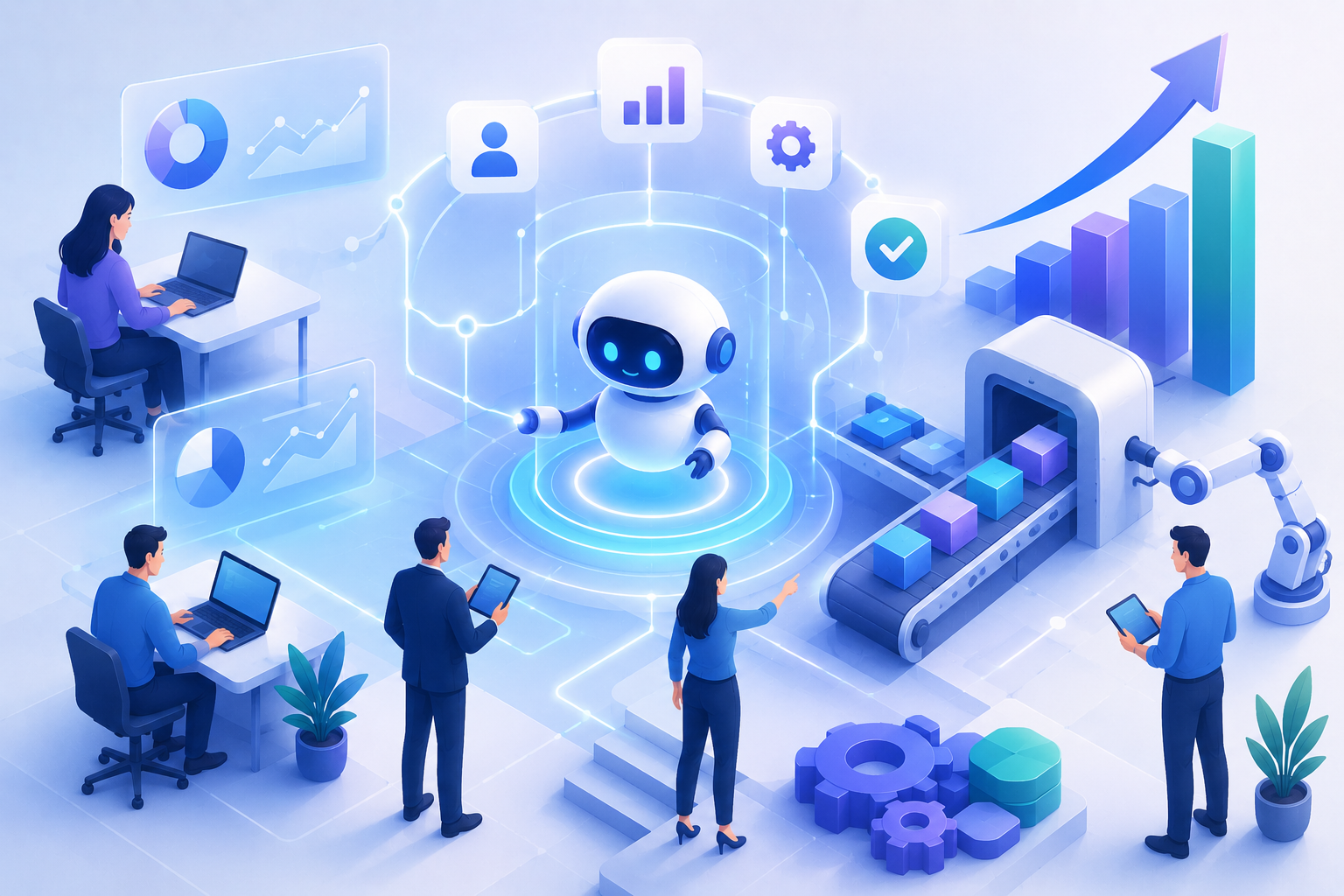
Do you feel like processes multiply overnight while your to-do list stays the same? It’s not your fault. As a newbie, you can start small, piloting agents to handle repetitive marketing tasks and routine support routes, so within months, you can reclaim time for strategy and creative work.
AI agents don’t just follow rules; they reason, adapt, and execute with minimal supervision, turning messy workflows into predictable outcomes.
Besides, customers in 2026 expect faster, smarter service, and teams that adopt automation report dramatic efficiency gains.
Think cutting routine workload by up to 50% and redirecting human effort to higher-value initiatives. But adoption isn’t plug-and-play: you need clean data, clear goals, and human oversight.
Join me on tour. I’ll show what AI Automation Agents do, how they think, and the first steps to deploy them.
Don't think of Automation Agents as another tool on your stack because they’re a new class of systems that perceive, reason, and act inside your business processes.
Think of them as autonomous teammates that watch signals, make decisions, and execute tasks within agreed boundaries. Autonomous agents will turn chaotic handoffs into predictable workflows, and that’s exactly why they matter.
An AI automation agent is an intelligent system that both senses your business environment and takes action to achieve defined goals.
You don't have to give explicit commands; these agents ingest signals from CRM records, user behavior, emails, and external platforms, and use that information to pursue specific business goals.
Under the hood, two technical technologies work together as the definition. Machine Learning allows agents to improve their decision-making over time by recognizing patterns in historical data.
Natural Language Processing, meanwhile, enables agents to understand, interpret, and respond to human language. Simplifying workflows that traditionally required manual reading, tagging, and routing of text-based inputs.
To understand how these agents function holistically, it helps to look at the four capabilities that define true agent intelligence:
Perception and data collection: agents continuously monitor conversations, track user actions, and ingest data from integrated tools before taking action.
Reasoning and planning: agents break down complex goals into sequential steps and select the most effective approach based on current context.
Tool integration: agents connect to external software (CRMs, email platforms, scheduling tools) to execute tasks and deliver results across systems.
Memory: agents build continuity across touchpoints by retaining historical interaction data, ensuring each engagement is informed by what came before.
For years, businesses relied on rule-based automation to handle repetitive tasks, and it works, to a degree. However, as operations grew more complex and customer expectations rose, the limitations of traditional tools became increasingly apparent.
Traditional automation is inherently task-oriented. It executes what it's told, within the boundaries it's given. If a condition isn't pre-programmed, the tool fails or escalates unnecessarily.
AI agents flip this model; they are goal-oriented and capable of navigating unexpected situations by reasoning through available data rather than waiting for a matching rule.
This shift from dependency on human-defined logic to autonomous problem-solving is what makes modern AI agents a genuine operational upgrade.
The path forward is obvious. Today's agents reason based on real-time data, adjusting their behavior as conditions change.
Gartner estimates that by 2028, about 5% of everyday work decisions will be handled autonomously by AI agents, which shows how quickly they’re becoming part of normal workflows.
You can make a strong business case for AI agents, but learning how they operate in practice is the step that turns plans into effective deployments.
Every AI automation agent starts with data. It collects information from live interactions, such as conversations, clicks, form submissions, and support tickets; then stores it in long-term memory.
As context accumulates, agents refine their judgments and stop treating every case as if it’s the first; so your processes become more consistent.
Once an agent has assessed its environment, it executes. This might mean updating a CRM record, triggering a follow-up sequence, routing a lead to the right sales rep, or escalating a support issue without human triggers.
The agent autonomously assesses the case, picks the best response, and moves across systems as needed to carry the task to completion.
Perhaps the most consequential feature of automation agents is their capacity to learn from mistakes. When an action produces a suboptimal outcome, a well-designed agent can detect the error, adjust its approach, and apply that lesson to future decisions.
As agents self‑correct, they become more effective with each cycle, delivering improvements that rule‑based scripts are unable to achieve.
The benefit isn’t just theory. Companies that implemented AI automation agents report concrete, cross‑functional gains: higher revenue, leaner operations, and lower costs.
According to PwC (2025), 66% of companies that adopted automation agents reported measurable revenue increases following deployment.
Adoption is accelerating into 2026; businesses that delay implementation will likely lose ground to competitors who have already improved workflows and shortened response cycles.
One of the clearest practical benefits of Autonomous agent software is how quickly it delivers impact. Companies report meaningful efficiency gains within a year; importantly, they achieve this without requiring deep programming skills from their teams.
Modern agent platforms provide user‑friendly interfaces and customization layers that empower non‑technical operators to configure, monitor, and scale automation.
Repetitive work, such as data entry, lead qualification, and appointment scheduling, consumes a significant amount of employee time.
Meanwhile, a single intelligent agent can perform these tasks at scale, multiplying a team’s effective output and reducing the need for additional employees.
Unlike humans, who fatigue and lose context when switching tasks, AI agents process complex data in seconds and execute with consistent precision.
In sales and customer management, that speed translates into higher conversion rates, faster resolution times, and more responsive engagement across the pipeline.
AI automation agents are not one‑size‑fits‑all; different architectures suit different operational needs. Below is a concise, business‑focused rewrite of the original section.
Goal‑based agents excel in sales workflows. Designed to pursue specific sales objectives, such as qualifying leads or booking demos, these agents choose actions that best serve the goal given current conditions.
They analyze behavioral and demographic signals to target the right audience and route prospects efficiently to the appropriate sales resource.
Model‑based reflex agents are well suited for marketing automation. By maintaining an internal model of prospect interactions, these agents run adaptive campaigns that change in real time based on engagement signals.
This enables highly personalized outreach at scale, making campaigns that would be impossible to manage manually both practical and effective.
AI automation agents have moved from emerging technology to operational infrastructure. Their ability to perceive context, reason through decisions, and execute across systems autonomously gives businesses a meaningful competitive edge.
PwC reported that 79% of businesses were already using these tools in some capacity by 2025, a number expected to grow substantially through 2026 and beyond.
 Supriyo Khan
 Supriyo Khan
 Supriyo Khan
 Supriyo Khan

Want to add a comment?