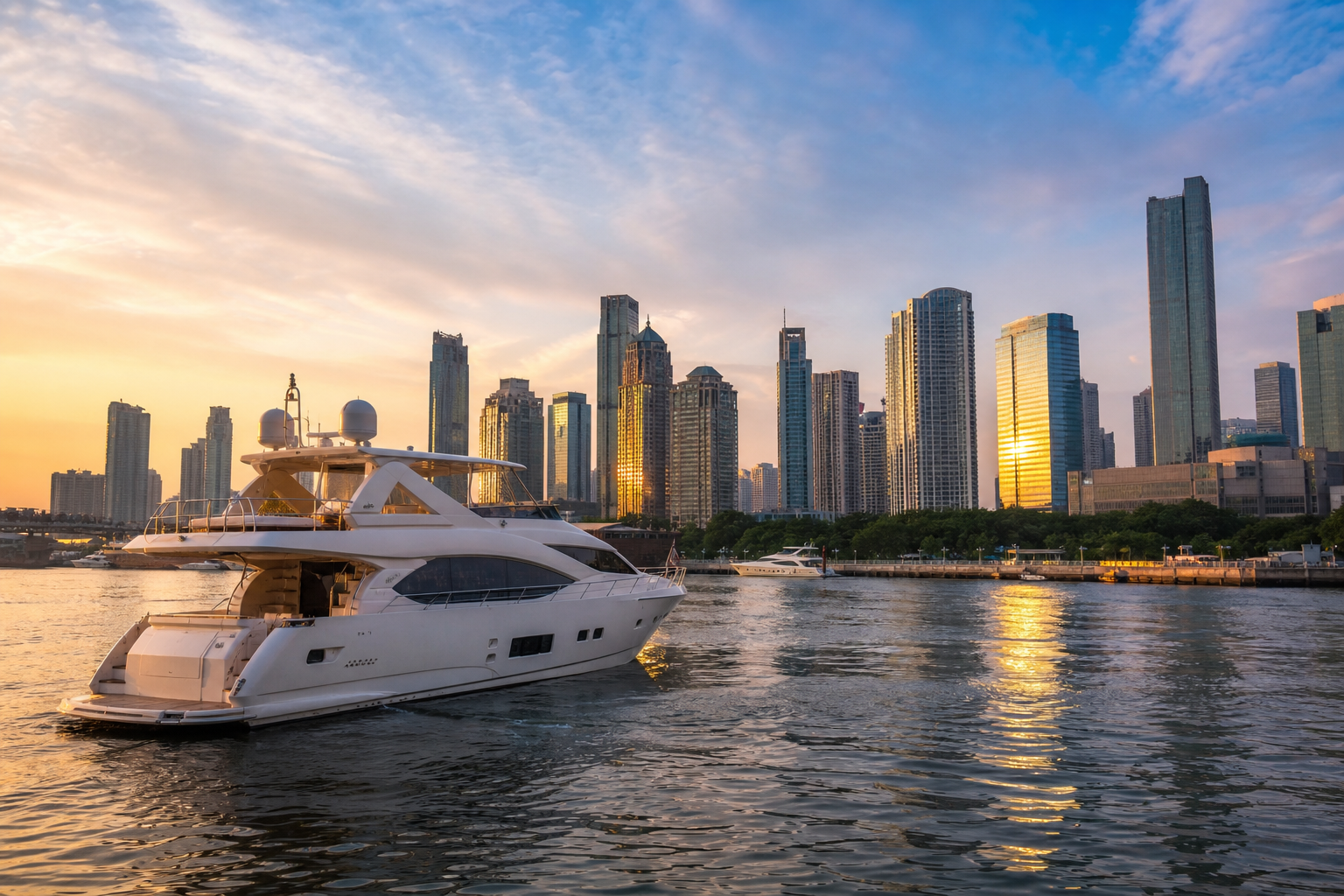
Most travellers passing through Jakarta think of gridlocked highways and back-to-back boardroom meetings, not a weekend spent snorkelling over coral reefs or watching the city skyline fade behind them from the deck of a yacht. That perception is changing. Leisure boating in Jakarta is picking up pace, driven by new marina facilities, a growing charter market and sudden access to one of Southeast Asia's most underrated island chains, all within an hour or two of the CBD. This piece explains what is pulling that change forward, how Jakarta's on-water experience compares with more established regional hubs like Singapore, Phuket and Bali, and what a realistic island-hopping trip from the city actually looks like today. For business travellers with a free day or weekend, the Java Sea is closer than most people realise.
From city of traffic jams to gateway to the Thousand Islands
Jakarta sits on the north coast of Java, facing the Java Sea directly, which places it at the edge of one of Indonesia's most accessible and least-talked-about cruising grounds. The Thousand Islands, known in Indonesian as Kepulauan Seribu, form a chain of coral islands and sandbars stretching northward from the city's waterfront. From marinas at Ancol or the Batavia area, the nearest islands are roughly 30 to 90 minutes by fast boat, so a morning departure from central Jakarta can realistically put you on a quiet beach or snorkelling over a reef before midday.
The archipelago has a character quite different from the better-known Indonesian resort islands. It is smaller in scale, less commercialised, and still carries pockets of local fishing villages alongside the resorts and conservation areas. The sense of discovery that has long since eroded in places like Gili Trawangan or Nusa Dua is still very much intact here.
The reason this seascape has been so consistently overlooked is straightforward: Jakarta's international identity has been built almost entirely around commerce, and leisure infrastructure on the northern waterfront was thin for a long time. Most international yacht itineraries have historically skipped the city entirely, heading straight to Bali, Komodo or Raja Ampat. That is beginning to change, as the Ancol and Batavia waterfronts develop into credible departure points bridging the urban city and its emerging identity as a boating base.
Indonesia's recreational boating market has been growing steadily since the pandemic, and Jakarta is emerging as its commercial and logistical centre. Industry data projected the country's cruise market to reach nearly $21 million in revenue in 2024, growing at roughly 3.7 per cent annually through to 2028, while the broader recreational boating market has attracted increased attention from domestic and international players alike. In parallel, Indonesia's ultra-high-net-worth individual population stood at around 1,479 in 2023 and was forecast to approach 2,000 by 2028, deepening the domestic demand base for premium on-water experiences.
On the infrastructure side, the Indonesian government has invested in marina construction and port renovations. Around Jakarta specifically, facilities at Ancol and the Batavia Marina now offer berths, fuel and basic services for day cruisers, sailing yachts and smaller superyachts. Charter offerings have followed: private and crewed motor yachts and catamarans running day trips to the Thousand Islands sit alongside fast-boat services to resort islands and lifestyle options such as sunset and dinner cruises in Jakarta Bay.
The professional ecosystem is also maturing. Marine industry companies have been opening offices in Jakarta, recognising the city's importance as Indonesia's main commercial hub. The Indonesia Boat Show, held at JIExpo Kemayoran, attracted more than 3,000 visitors to its 2024 edition and brought together boat builders, designers and service providers. The Indonesia Boating Gathering, organised by the Community for Maritime Studies Indonesia (CMSI), adds a further layer of community-building and industry development. Jakarta's growing marina scene is making the city a focal point for Indonesia's recreational marine sector, not just a transit stop for boats heading elsewhere.
The most common entry point is a day trip on a modern speedboat or day cruiser. A typical itinerary runs something like this: early departure from an Ancol or Batavia-area marina, a 60 to 90-minute run across the Java Sea to one of the nearer Thousand Islands, a few hours for snorkelling, stand-up paddleboarding or swimming in clear water, lunch on board or at a small island resort, and a late-afternoon return with the Jakarta skyline reappearing on the horizon as the sun drops. For a city trip, it is a remarkably complete experience.
Weekend charters open up more ground. Two or three islands in a single trip become viable, with nights spent in sheltered bays away from city light pollution. Certified divers can arrange dives at reef and wreck sites through partner dive centres, while non-divers can do introductory sessions or snorkel the shallower reefs. Kayaking through mangroves, catered sandbar picnics and fishing are all part of what operators offer, and sunset cruises in Jakarta Bay, with the city lit up behind them, provide a genuinely atmospheric counterpoint to a day in the islands.
Service quality today is honest and personal rather than polished and resort-grade. Operators range from well-organised, internationally minded charter firms to simpler local boat businesses, and the gap in standards between the best and the most basic is wider than in Phuket or Bali, so choosing providers with clear safety protocols, proper licences and transparent pricing genuinely matters. The better operators already deliver an experience that stands up confidently against anything in the region at its price point. Select island resorts also offer day-visitor packages with water sports and facilities, making it easy to pair an on-water day with a high-end evening back in central Jakarta.

What a day or weekend on the water from Jakarta actually looks like
Place Jakarta beside Southeast Asia's recognised boating hubs and the contrast is instructive. Phuket and Bali are mature, resort-driven cruising bases with deep charter fleets and well-equipped marinas: Bali's superyacht-friendly Benoa Marina and the Royal Bali Yacht Club are purpose-built for serious vessels and experienced operators. Singapore runs a different model altogether, ultra-organised and technically excellent, though the sailing grounds are limited by geography and costs are high.
Jakarta currently sits somewhere between the two extremes: less mature than any of them, but carrying advantages that neither Bali nor Singapore nor Phuket can easily replicate. As Indonesia's primary international gateway, it offers unmatched flight connectivity for regional and long-haul travellers. The Thousand Islands provide access to an island chain that remains genuinely undiscovered by most international visitors, offering a freshness that Phi Phi or the Gilis lost long ago. And for those earning in stronger currencies, charter rates, berthing costs and provisioning in Jakarta tend to undercut equivalent offerings in Singapore considerably.
The limitations are real and worth naming. Marina infrastructure is less dense than in Phuket or Singapore; the choice of high-specification crewed yachts is narrower than in Bali; and service consistency between operators is variable. On weather, Jakarta's tropical climate allows year-round boating but the drier months from June to October generally bring the most settled conditions, with calmer seas and better visibility in the Java Sea. Visibility can also vary more than in dedicated dive regions further east.
The honest conclusion is that Jakarta suits travellers and owners who enjoy being ahead of a trend, rather than those who need the fully mature marina ecosystem of an established destination. The trade-off is discovery and value for a level of polish that is still catching up.
Timing matters most. The broadly drier period from June to October brings the most settled conditions for short-range island trips from Jakarta, with calmer seas and better visibility. Local operators familiar with inter-monsoon windows can identify workable stretches at other times of year, so flexibility opens the calendar considerably.
For booking, there are three main routes worth considering. The first is arranging a private or shared charter directly through established yacht-charter firms operating out of the Ancol or Batavia areas. The second is booking a resort package that includes boat transfers to one of the island resorts in the Thousand Islands, often with optional day cruises built in. The third, for those planning repeat visits, is exploring membership in local boating or yacht clubs that offer member trips and fractional access to boats. For first-timers, a reputable charter firm with English-speaking crew and a clear safety briefing is the most straightforward way in.
On budget, shared day trips to nearby islands can be accessible for a small group splitting costs, while private day charters on modern motor yachts or catamarans typically run into the higher hundreds or low thousands of US dollars depending on vessel size and inclusions. Overnight and multi-day charters scale up from there but generally remain more cost-effective than equivalent bookings in Singapore.
A few practical points are worth keeping in mind. Confirm exactly what is included in any charter quote, since fuel, crew, food, snorkelling equipment and marine park fees are not always bundled together. Allow realistic travel time from central Jakarta to the departure marinas, particularly if you are working around meetings or a flight. Modest swimwear is appropriate on boats and resort islands, but a cover-up is considerate when visiting local villages. Bring sun protection and some cash for island incidentals, and if possible, stay in a waterfront district close to the northern departure points to reduce the morning logistics.
Several forces are converging to accelerate Jakarta's rise as a leisure boating destination. Government focus on experience-led tourism is translating into real investment in marina infrastructure and waterfront development, while a rising base of high-net-worth consumers domestically, forecast to grow from around 1,479 ultra-high-net-worth individuals in 2023 to nearly 2,000 by 2028, is creating local demand that supports a more sophisticated charter and marina ecosystem. A BCG study cited by Jakarta's own planning authorities found that 85 per cent of Indonesian respondents planned to combine business with leisure travel, a participation rate double that of mature markets like the United States or the United Kingdom, which gives the on-water bleisure proposition genuine structural weight.
The professional infrastructure is being built in parallel. The Indonesia Boat Show and the Indonesia Boating Gathering, both held in Jakarta, are steadily building a community of builders, dealers, charter operators and service providers that will improve choice and consistency for leisure boaters over the next few years. Marine industry companies opening offices in the city are a leading indicator of where serious investment attention is heading.
There is also an eco-tourism dimension that could set Jakarta apart from its regional competitors. Better-managed marine parks, lower-impact island resorts and community-based tourism within the Thousand Islands represent a realistic model for sustainable on-water recreation close to a megacity, a proposition that no other major Southeast Asian city can credibly offer at the same scale.
Challenges remain: service capacity needs to grow, environmental pressures on the Thousand Islands require careful management, and the regulatory framework for visiting yachts and charter operators continues to evolve. But those challenges are precisely what make this moment interesting. Jakarta's boating scene sits at the point where discovery, genuine value and rapid improvement intersect. For charterers, yacht owners and experience-seeking travellers willing to look beyond the familiar, getting acquainted with these waters now means experiencing them before the rest of the region catches on.
 Supriyo Khan
 Supriyo Khan
 Supriyo Khan
 Supriyo Khan
Want to add a comment?