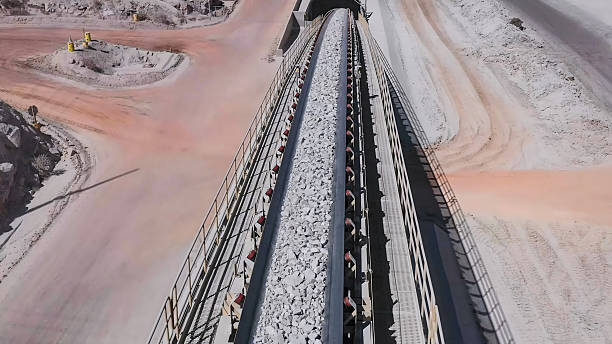
The mining activities rely on effective material handling systems daily. Belt conveyors are crucial in the mine output. They carry the coal and aggregates over a long distance. Knowledge of conveyor belts used in Mining is useful in enhancing safety and efficiency. This guide defines the types of belts that are used frequently and their uses.
The mining world is inhumane and difficult at all times. The use of manual transport is slow, risky, and costly. Continuous movement of materials is ensured through conveyor belts. They minimize labor expenses andthe time of operation. Belts are used for dealing with heavy loads and abrasive materials. With the correct choices of belts, my productivity can be enhanced. In mining, conveyors are of great importance in terms of durability.
Conveyor belts made of rubber are very common in mining. They are flexible, strong, and abrasive. Rubber belts are efficient in terms of bulk materials. They work effectively under impact and full load. These belts are cheap and simple to service. Surface and underground mining are appropriate for rubber belts. This makes them highly popular due to their versatility.
The steel cord belts have steel cables within the rubber. The belts are of high tensile strength and durability. They are perfect for long-distance conveying systems. Steel cord belts can be used to carry excessive loads. They are resistant to stretching, and the shape does not change with time. Good quality is assured by a reputable Steel Cord Rubber Conveyor Belts Manufacturer. The belts help minimize the rate of maintenance and replacement.
Textile layers are being used in fabric conveyor belts. Widely used clothes are polyester, nylon, and cotton. Such belts are flexible and shock-absorbing. Fabric belts are apt when dealing with medium loading mining. They weigh less than the steel cord belts. Fabric belts are simpler to fix and install than splicing. It is cheaper when compared to steel cord belts.
Patterned surfaces on belts used by Chevron have a grip. They stop rolling materials on inclined conveyors. Chevron belts are used in mining activities on slopes. The belts are effective in the transport of loose material. The depth of the pattern will depend on the angle of inclination. Chevron belts enhance free flow and cut down spillage. They are vital to an inclined mining conveyor belt.
Certain mining materials produce a lot of heat. Hot substances are processed using heat-resistant belts. Such belts are resistant to cracking and hardening. They are strong in the presence of thermal stress. Waterproof belts are appropriate in cement and coal mining. An appropriate choice tends to avoid the belt failure. The feature of temperature tolerance implies safety during operation.
Underground mining requires fire safety. Flame-resistant belts decrease the danger of fire spreading. The belts are of high quality in terms of their safety. They safeguard the workers and machinery. Fire resistance belts are usually needed in underground mines. It is a requirement to adhere to regulations. Belts that are selected in a safety-focused way save lives.
Belts that are oily are dealt with by oil-resistant belts. Part of the mined material materials include oils or chemicals. Such belts keep away swellings and degradations. The oil resistance increases the life of the brew belt. They find particular mining applications. Exposure to chemicals requires a specific belt material that is specific. The correct resistance gives the result of consistent performance.
The mining belts have other purposes. The applications are listed below:
In underground mines, coal is carried by underground means.
Ore processing with surface mining.
Wholesale movement in quays.
Elimination of overburden in open-pit mines.
Processing factories' loading of material.
It has particular requirements for belt characteristics.
The selection of the appropriate belt has to be evaluated. It is important to tconsider he material weight, size, and abrasiveness. Length of the conveyor and conveyor speed influence the type of belt. Material choice will be affected by environmental conditions. The access to maintenance should be in question. Budget constraints are also some of the factors. Professional opinion enhances choice in belts.
Frequently maintaining conveyor belts increases their lifespan. Check belts regularly, check their wear and tear. Cleaning belts to avoid the accumulation of materials. Never slipping and extending due to proper tensioning. Timely replacement of damaged parts. Maintenance helps to minimize downtime, as well as repair. Care that is planned makes operations safe.
The right belt facilitates efficiency. Some main advantages can be listed, and they are as follows:
Less waste of materials on transport.
Better safety and reliability of workers.
Extended life of the belt and length.
Reduced the cost of maintenance and replacement.
Stable production and production of products.
These advantages are in favour of sustainable mining activities.
The quality of Suppliers influences the direct performance of belts. Ineffective belts break easily due to mining conditions. The suppliers that are experienced and qualified must always be used. Unreliable suppliers are the ones that supply unreliable materials and standards. They also give customization and technical assistance. There is a reputation of suppliers in mining projects. Long-term investments are insured by quality belts.
In contemporary mining processes, conveyor belts are necessary. There are various types of belts, and they are used in mining. Most mining applications are covered with rubber fabric belts as well as steel cord belts. Heat, fire,e and oil are dealt with using special belts. Safety and improvement in productivity are enhanced by proper selection. Customers can be sure of long-lasting processes with reliable manufacturers. The selection of the appropriate conveyor belt facilitates mining success.
 Supriyo Khan
 Supriyo Khan
 Supriyo Khan
 Supriyo Khan

Want to add a comment?