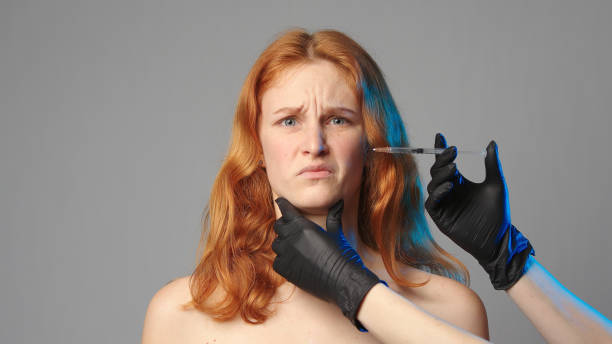
Long before syringes and lasers, artists spent centuries studying the human face, mapping its proportions, and determining what makes features appear harmonious or striking. These historical observations didn't disappear when aesthetic medicine emerged. Instead, they became the foundation upon which modern practitioners build their techniques. Understanding this connection reveals why today's best providers think like artists as much as medical professionals.
The Golden Ratio and Classical Proportions
Renaissance masters like Leonardo da Vinci didn't just paint beautiful faces. They measured them, calculated ratios, and documented their findings in detailed anatomical studies. Da Vinci's Vitruvian Man and his facial proportion sketches established mathematical relationships between features that still guide aesthetic practitioners today.
The golden ratio, approximately 1.618, appears throughout nature and classical art. Modern injectors use these same proportions when planning treatments. The ideal distance between eyes, the relationship between nose length and chin projection, the balance between upper and lower lip volume, all reference measurements artists identified centuries ago.
When a skilled practitioner at a cosmetic clinic Adelaide patients visit for facial balancing explains their treatment plan, they're often unconsciously applying principles that Botticelli used when painting The Birth of Venus.
Baroque painters pioneered chiaroscuro, the dramatic interplay of light and shadow that creates depth and dimension. Caravaggio's mastery of this technique didn't just make compelling paintings. It demonstrated how strategic shadow placement could reshape perceived facial structure.
Today's contouring techniques, whether achieved through makeup, dermal fillers, or surgical procedures, apply these same principles. Adding volume to cheekbones creates shadows that slim the mid-face. Highlighting the chin creates definition. These aren't new concepts. They're artistic techniques translated into medical applications.
Portrait artists throughout history understood something crucial: beauty isn't one-size-fits-all. Each face requires individual assessment and customized enhancement. Rembrandt's portraits celebrated character and individuality rather than conforming to rigid beauty standards.
This philosophy directly opposes the cookie-cutter approach some practitioners take, giving everyone the same lip shape or cheek projection regardless of their unique features. The best modern providers, like the best portrait artists, study each face as a unique composition requiring personalized solutions.
Impressionists revolutionized how we understand color, demonstrating that skin isn't one flat tone but a complex interplay of hues, undertones, and reflected light. Renoir's luminous skin tones in his portraits came from layering multiple colors to create depth and life.
Modern skin treatments draw from this understanding. Laser therapies target specific color wavelengths. Chemical peels remove surface layers to reveal brighter tones underneath. Even makeup artistry for post-procedure healing uses color theory principles the Impressionists established. Correcting redness, evening skin tone, and creating that coveted "glow" all rely on understanding how colors interact with light.
Michelangelo famously said he simply removed the excess marble to reveal the sculpture within. This philosophy resonates deeply in aesthetic medicine. The best treatments don't add foreign elements to create beauty. They reveal and enhance the attractive features already present by strategically removing or subtly adding to address imbalances.
Whether removing volume through liposuction or adding it through implants, skilled practitioners think in three dimensions, considering how changes appear from multiple angles. This sculptural thinking prevents the flat, overdone appearance that marks poor aesthetic work.
Modern aesthetic training increasingly incorporates art history and facial analysis techniques borrowed from classical artists. Practitioners study paintings to understand ideal proportions, lighting effects, and the subtle asymmetries that create character rather than detract from beauty.
The next time you see naturally beautiful results from aesthetic treatments, remember you're witnessing centuries of artistic knowledge applied through modern medical technology. The alliance between art and medicine isn't new. It's a collaboration as old as humanity's desire to understand and enhance beauty.
Great aesthetic medicine remains, at its core, an art form informed by science rather than science attempting to create art.
 Supriyo Khan
 Supriyo Khan
 Supriyo Khan
 Supriyo Khan

Want to add a comment?