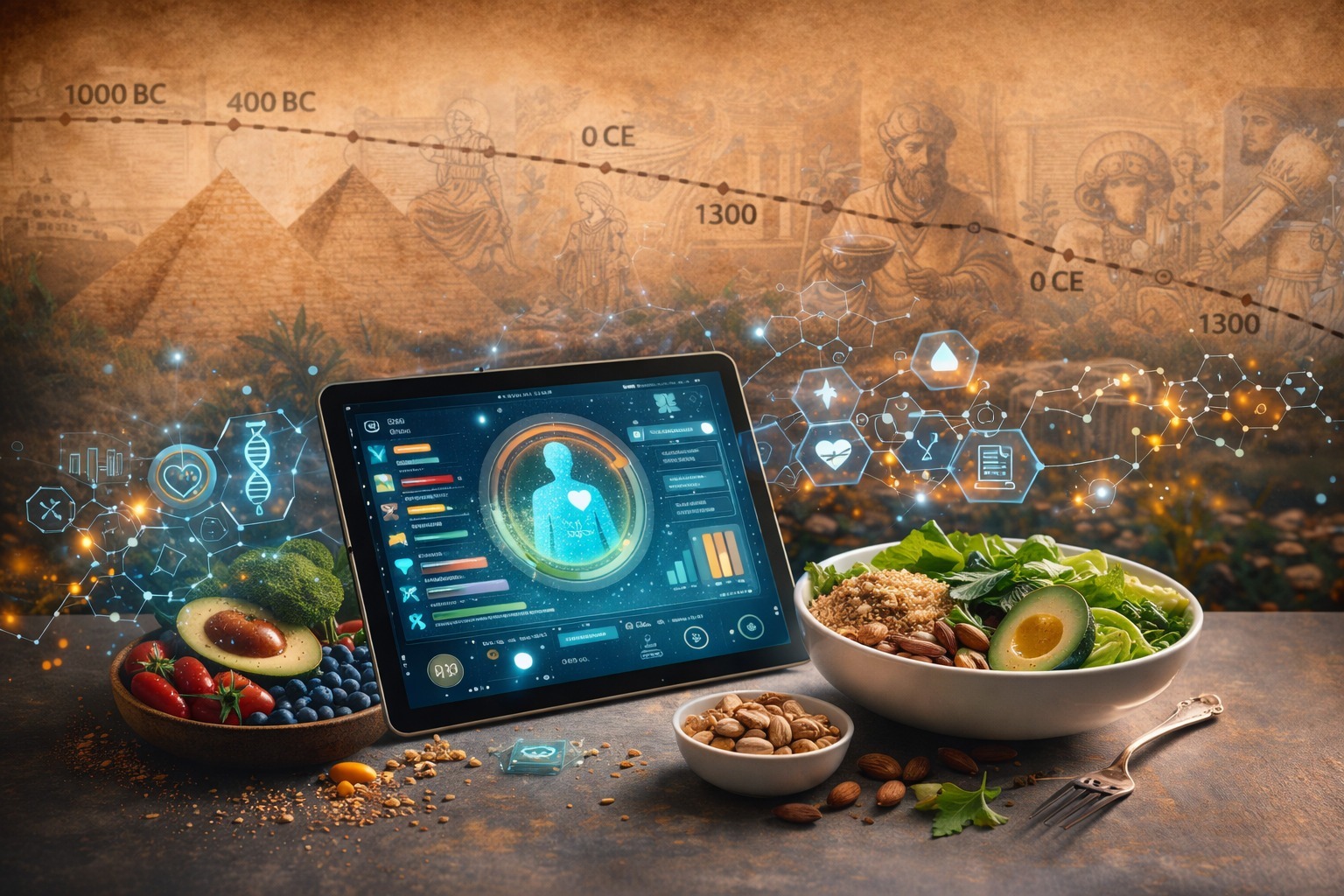
Yet one critical piece is still missing from most modern health conversations: food intelligence.
We track calories, macros, and trends, but rarely ask a more fundamental question—how does food interact with the individual body consuming it? Ancient systems asked that question first. Modern health is only now catching up.
Long before nutrition labels and diet trends, ancient wellness systems viewed food as information. Not just fuel, but signals that influenced digestion, energy, mood, sleep, and long-term resilience.
Food wasn’t classified as “healthy” or “unhealthy” in isolation. It was understood in context:
Who is eating it
When it’s eaten
How it’s prepared
What state the body is already in
This is systems thinking, not mysticism. Ancient intelligence recognized that the same input produces different outcomes in different systems.
As nutrition became more scientific, it also became more generic.
Calories replaced context. Macros replaced metabolism. Dietary guidelines aimed for population averages rather than individual variability. The result is a confusing landscape where one diet is promoted as universally optimal—until the next one replaces it.
If personalized health is the goal, generic food advice is a structural contradiction.
Food intelligence isn’t about rigid rules or moralizing meals. It’s about understanding how food behaves in the body and how the body responds in return.
Two people can eat the same meal and experience completely different outcomes:
One feels energized and clear
The other feels heavy, bloated, or foggy
That difference isn’t willpower. It’s physiology.
True personalization begins when food is treated as a variable, not a constant.
Ayurveda approached this problem thousands of years ago by categorizing both people and foods according to qualities rather than numbers. Foods were understood by how they affect digestion, temperature, moisture, movement, and stability in the body.
This allowed for a flexible framework:
The same food could be supportive for one person and disruptive for another
The same food could be helpful in one season and aggravating in another
Preparation mattered as much as ingredients
What makes this relevant today is not its age, but its logic.
Today’s shift toward personalized medicine, AI-driven health platforms, and metabolic profiling is essentially a return to contextual thinking. We are learning—again—that inputs must be matched to the system receiving them.
Food intelligence sits at the center of this realization.
Knowing what you eat matters.
Knowing how it affects you matters more.
If someone wants to build a true health persona—one that evolves with age, stress, environment, and goals—they must understand food beyond labels and trends.
This doesn’t require extreme restriction or complexity. It requires literacy:
How does warmth vs. cold affect digestion?
How do timing and preparation change outcomes?
Which foods stabilize energy and which disrupt it?
These questions are foundational, not optional.
This is why many people explore structured learning such as Ayurveda courses online by CureNatural, which translate ancient food intelligence into modern, practical frameworks for everyday life—without requiring blind belief or rigid doctrine.
The future of wellness won’t be built on louder advice or stricter rules. It will be built on understanding how systems behave, how inputs interact, and how individuals differ.
Ancient intelligence didn’t compete with modern science. It prefigured it.
Food intelligence is where personalized health stops being theoretical and starts becoming usable.
And that’s not ancient wisdom making a comeback.
That’s intelligence finally catching up to itself.
 Supriyo Khan
 Supriyo Khan
 Supriyo Khan
 Supriyo Khan

Want to add a comment?