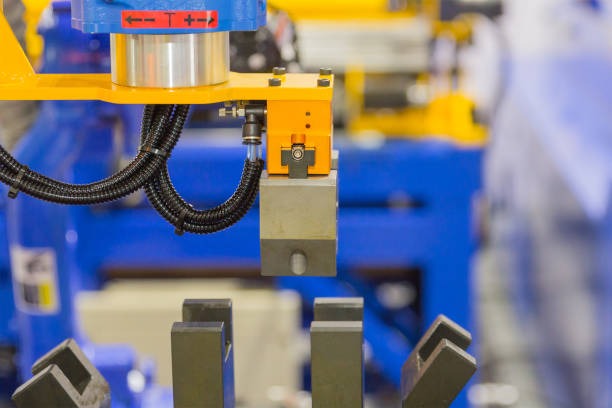
Walk into any modern factory today and you’ll notice something interesting. It’s not just robots moving faster or machines getting smarter. It’s the way automation systems adapt. Parts change, layouts shift, and product designs evolve far more frequently than they used to. In this environment, flexibility is no longer a bonus. It’s a requirement.
That’s exactly where angular grippers step in. While they may look like a small component in a large automation setup, their impact on productivity, space utilisation, and adaptability is far bigger than most people expect. From compact assembly lines to high-speed packaging cells, angular grippers have quietly become a backbone of flexible automation.
Let’s break down why these grippers matter, how they work, and why so many factories are moving away from traditional gripping solutions in favour of angular designs.
Automation used to be rigid. A robot was programmed for one job, one product, and one layout. Any change meant downtime, reprogramming, and often new hardware. Today, that model simply doesn’t work.
Manufacturers now deal with:
Shorter product life cycles
Customised variants
High-mix, low-volume production
Space constraints on shop floors
To keep up, factories need automation systems that can adapt without constant retooling. Grippers, being the direct interface between the robot and the product, play a massive role here. And among the various gripping solutions available, angular grippers offer a unique balance of compactness, reach, and flexibility.
An angular gripper is designed so that its jaws move along an arc rather than straight in and out. Instead of linear motion, the fingers rotate outward or inward around a pivot point. This simple difference in movement geometry unlocks several practical advantages on the factory floor.
Compared to parallel grippers, angular grippers:
Require less space around the workpiece
Allow easier access to confined areas
Enable smoother part insertion and removal
Reduce collision risks in tight setups
This makes them especially valuable in modern automation cells where every millimeter of space matters.
To appreciate why angular grippers are so effective, it helps to understand the angular gripper mechanism itself.
At its core, the mechanism converts linear actuator movement into angular jaw motion. This is typically achieved using internal linkages, cams, or gear systems. When the actuator moves, the jaws rotate around a fixed axis, opening or closing at a defined angle.
The benefits of this mechanism include:
Controlled and repeatable jaw motion
Consistent gripping force throughout the movement
Smooth engagement with parts during pick-and-place
Because the jaws swing away from the part rather than sliding straight back, there’s less risk of scraping or interference. That’s a small detail, but in high-speed automation, small details make a big difference.
The terms angular gripper and radial gripper are often used interchangeably, and while they are closely related, there are subtle differences worth noting.
A radial gripper generally refers to a design where jaws move along a circular path, opening radially from a central point. In practice, many angular grippers function as radial grippers, especially in two-jaw configurations. However, angular grippers may also be designed for asymmetric motion or specific opening angles tailored to an application.
What matters more than terminology is functionality. Both radial grippers and angular grippers excel in applications where:
Parts need side access
Space above or below the part is limited
Linear jaw movement would cause collisions
Understanding this overlap helps engineers choose the right gripper without getting stuck on naming conventions.
Among the different actuation methods available, the pneumatic angular gripper remains the most widely used in industrial automation. And there’s a good reason for that.
Pneumatic systems offer:
Fast response times
High reliability
Simple control logic
Cost-effective implementation
A pneumatic angular gripper uses compressed air to drive the internal mechanism, making it ideal for repetitive, high-speed tasks. These grippers can operate for millions of cycles with minimal maintenance, which is exactly what production environments demand.
They are commonly found in:
Assembly lines
Packaging stations
Sorting and indexing systems
Automotive sub-assembly
When paired with proper air preparation and control valves, pneumatic angular grippers deliver consistent performance day after day.
One of the most practical reasons factories choose angular grippers is space efficiency.
In many automation setups, parts are located close to fixtures, conveyors, or other components. A parallel gripper needs clearance in the opening direction, which isn’t always available. An angular gripper, on the other hand, opens sideways, freeing up vertical and horizontal space.
This allows:
More compact cell designs
Closer placement of tooling
Higher part density on fixtures
In modern factories where floor space is expensive, this compactness directly translates into cost savings and higher productivity per square metre.
Angular grippers shine in tasks that involve inserting or removing parts from housings, nests, or fixtures. The angled jaw motion naturally guides the part into position rather than pushing it straight in.
This is particularly useful for:
Press-fit operations
Loading components into tight cavities
Handling parts with chamfers or grooves
The angular motion reduces side loads on both the part and the robot, improving accuracy and reducing wear over time. For delicate components, this controlled movement can significantly reduce rejection rates.
Another reason angular grippers are essential for flexible automation is their adaptability. With interchangeable fingers and adjustable opening angles, a single gripper can often handle multiple part types.
This is critical in environments where:
Product variants change frequently
Batch sizes are small
Changeover time needs to be minimal
Instead of replacing the entire gripping system, manufacturers can modify jaw geometry or adjust stroke settings. That flexibility keeps production moving without unnecessary downtime.
Modern angular grippers are no longer just mechanical devices. Many are equipped with sensors for:
Jaw position detection
Part presence confirmation
End-of-stroke feedback
This data feeds directly into the robot controller or PLC, enabling smarter decision-making. If a part isn’t gripped correctly, the system knows immediately. That reduces errors and prevents costly downstream issues.
In advanced automation setups, these grippers become part of a larger feedback loop that supports predictive maintenance and quality control.
Factory floors are not gentle places. Dust, vibration, temperature variations, and continuous operation put stress on every component. Angular grippers, especially pneumatic ones, are built to handle these conditions.
Their enclosed mechanisms protect internal parts, while robust materials ensure long service life. This reliability is one reason why experienced automation engineers often prefer angular designs over more complex alternatives.
When discussing high-quality angular grippers, it’s impossible to ignore the role of established automation specialists. Companies like Schunk India have played a key role in advancing gripper technology for industrial use.
With a focus on precision engineering, durability, and application-specific solutions, Schunk India offers angular and radial grippers that integrate seamlessly into modern automation systems. Their experience across industries ensures that these grippers are not just technically sound, but also practical on real factory floors.
As collaborative robots become more common, grippers must be safe as well as efficient. Angular grippers support this shift by offering:
Controlled gripping forces
Predictable motion paths
Reduced pinch points
When designed correctly, they allow robots to operate closer to human workers without compromising safety. This makes them suitable for semi-automated workstations and mixed-production environments.
Looking ahead, angular grippers will continue to evolve alongside automation trends. We’re already seeing:
Lighter designs for faster robot motion
Modular grippers for rapid reconfiguration
Integrated sensing for adaptive gripping
Improved sealing for harsh environments
As factories push towards higher flexibility and smarter systems, the demand for reliable, space-saving gripping solutions will only increase.
Flexible automation isn’t just about smarter robots or faster machines. It’s about choosing components that allow systems to adapt, scale, and evolve without friction. Angular grippers deliver exactly that.
With their compact design, efficient angular gripper mechanism, and proven reliability, they solve many of the challenges modern factories face today. Whether referred to as a radial gripper, a pneumatic angular gripper, or simply a smart gripping solution, their value remains the same.
They make automation more adaptable, more efficient, and far better suited to the realities of modern manufacturing.
 Supriyo Khan
 Supriyo Khan
 Supriyo Khan
 Supriyo Khan
Want to add a comment?