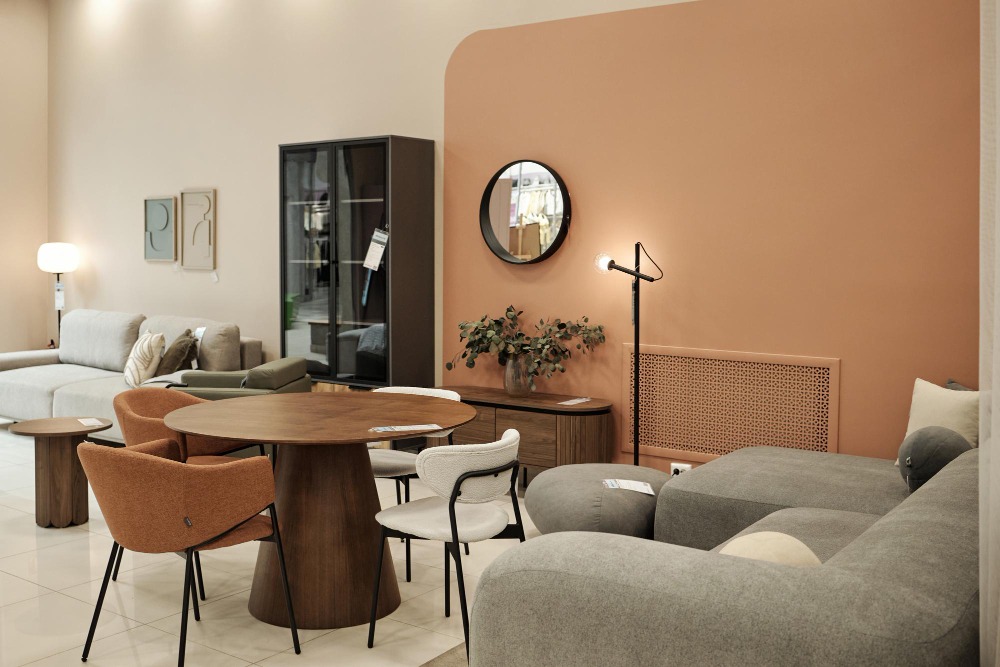
The delivery truck pulls away, and there it is: the centerpiece of a living room. Property owners often spend weeks, maybe months, searching for it. But something is wrong. The color that looked perfect online now clashes with the walls in the afternoon light. The scale feels overwhelming, turning a spacious room into a cramped one. It’s a sinking feeling, and an expensive one.
This disconnect between the showroom and the living room is a common story. A sofa is not just a standalone object; it is a functional piece of architecture within a home. The process of shopping for contemporary furniture denver involves more than just aesthetics or a single fabric swatch. It requires a clear understanding of proportion, light, and the unseen quality of its construction. Without this, purchasers risk a decision that looks good in a photo but fails in reality. This vibrant market is part of the larger Denver-Aurora-Centennial metropolitan area, which in the 3rd quarter of 2025, had 130,744 business establishments and 1,600,146 covered employees, with average weekly wages of $1,719 U.S. Bureau of Labor Statistics.
The financial sting of a bad choice is significant. Beyond the initial cost, return shipping for large items can be complex and expensive. More importantly, a low-quality sofa may only last a few years before the cushions sag and the frame creaks, potentially necessitating costly repairs. For context, skilled tradespeople like shoe and leather workers and repairers in the Denver-Aurora-Lakewood metropolitan area earned a mean annual wage of $41,460 as of May 2020 U.S. Bureau of Labor Statistics, highlighting the investment required for quality craftsmanship and maintenance.
Quick answer: The most common sofa buying mistakes are not about style, but about context. To avoid them, consumers must measure their space for visual weight, not just footprint. Materials should be tested against real-life demands, and specific questions about frame construction and suspension should be asked. A great sofa fits a room and a lifestyle, not just a trend.
What's inside
Mistake #1: Ignoring the Room’s True Scale
Mistake #2: Choosing a Fabric for the Showroom, Not a Lifestyle
Mistake #3: Overlooking the Frame and Suspension
Mistake #4: Forgetting About a Home's Logistics
Mistake #5: Buying for a Trend, Not for a Decade
Frequently Asked Questions
A sofa that is too large or too small for a room disrupts visual balance, impedes traffic flow, and can make the entire space feel uncomfortable and poorly planned.
The most common measurement mistake is focusing only on the floor plan. One might confirm a sofa fits between two windows, but the visual weight, the perceived mass of the object, may not have been accounted for. A low-profile sofa on slender legs can have the same length and depth as a heavy, skirted piece that sits directly on the floor, but it will feel significantly lighter and more open. Conversely, a sofa with a very high back or thick, rolled arms can dominate a room with low ceilings, even if its footprint is modest.
Beyond aesthetics, scale directly impacts how occupants move through and use a space. A sofa that is too deep can turn a comfortable walkway into a narrow channel one has to squeeze through. It can block access to a bookshelf, a window, or even prevent a door from opening fully. This functional friction creates daily annoyance, undermining the room's purpose as a place of relaxation.
❝ A good rule of thumb is to maintain at least 30 to 36 inches for major walkways and about 18 inches between the sofa and the coffee table. Anything less can make a room feel like an obstacle course.
Misjudging scale is an expensive error. It's not just about the hassle of a return. Many retailers charge significant restocking fees for large items, and the cost of return shipping can be substantial. This financial penalty underscores the importance of getting the scale right the first time. Living with the mistake is often worse, as the piece becomes a constant reminder of a poor decision that compromises the entire room's design.
Before committing, map out the sofa's exact dimensions on the floor with painter's tape. This helps visualize the footprint. To understand the volume, stack cardboard boxes or other objects to the height of the sofa's back and arms. Living with this mock-up for a day or two, walking around it and observing its presence when entering the room, provides a much more accurate sense of the piece's presence than any floor plan or augmented reality app can.
One can judge a sofa's hidden quality by investigating its internal structure, specifically the frame material, the joinery, and the suspension system.
The beautiful upholstery observed in a showroom is the last thing to consider. A sofa's longevity is determined by the parts that are not visible. The frame is the skeleton. A high-quality frame is made from kiln-dried hardwood, such as oak, maple, or ash. The kiln-drying process removes moisture, preventing the wood from warping or cracking over time. In contrast, frames made from softer woods like pine or composite materials like particleboard are far more likely to flex, creak, and eventually break under the stress of daily use.
Next, examine the joinery, which is how the frame pieces are connected. The most durable method involves corner blocks, dowels, and screws. Corner blocks are extra pieces of wood reinforcing each corner, providing significant strength. Joints held together only by staples and glue are a clear indicator of a low-cost build that will not withstand years of use.
Finally, the suspension system provides the support for the cushions. There are three common types:
Eight-Way Hand-Tied Springs: This is the traditional gold standard. Each spring is tied by hand to the adjacent springs and the frame in eight different directions. This creates a durable, flexible, and even support system that distributes weight perfectly.
Sinuous Springs: These are "S"-shaped wires that run from the front of the seat to the back. They are a more common and less expensive option that can provide good support if the metal is heavy-gauge and the springs are spaced closely together.
Webbing: This system uses interwoven strips of elasticized fabric stretched across the frame. It is the least expensive option and is most prone to sagging over time, especially in frequently used seats.
❝ Consumers may consider asking a salesperson if a "lift test" can be performed. The test involves lifting one front corner or leg of the sofa about six inches off the floor. If the other front leg lifts with it almost immediately, the frame is tight and strong. If the frame twists or flexes, it is a sign of weak joinery.
Before making a final decision, request a product specification sheet. This document should detail the materials used in the frame, joinery, and suspension. If a salesperson cannot provide these details or is vague, this may be considered a red flag.
Ensuring a fit involves meticulously measuring every inch of the delivery path from the curb to the final room, not just the doorway. This includes comparing those measurements against the sofa's diagonal depth, a dimension that is far more important than its simple length or width.
Many costly mistakes happen between the delivery truck and the living room. Before considering a sofa, documenting its "path of travel" is crucial. This involves measuring the width and height of every opening it must pass through, including exterior doors, interior doorways, hallways, and stairwells. For apartment or condo dwellers, this extends to building entrances, service elevators, and tight corridor turns. A common failure point is a sharp turn in a hallway or a low ceiling on a staircase landing.
The single most critical measurement on the sofa itself is its diagonal depth. To find this, imagine a straight line running from the bottom corner of the back frame to the highest point on the front of the armrest. This diagonal line determines the minimum clearance required to pivot the sofa through a standard doorway. If a door's height is less than the sofa's diagonal depth, it will not fit without being contorted in a way that could damage the frame.
❝ Before finalizing a purchase, it is advisable to ask the retailer a direct question: "What is your exact policy if the piece does not fit upon delivery?" Some companies offer no recourse, potentially leaving the purchaser with a sofa on their sidewalk. Others may have solutions, such as hoisting through a window, but these services can add hundreds or even thousands of dollars to the final cost.
Taking photos and a video of the entire delivery path and sharing them with a salesperson is recommended. A knowledgeable professional can often spot potential issues, like a non-removable handrail or a low-hanging light fixture, that might be overlooked. They can also confirm if the sofa's legs are removable, which can sometimes provide the crucial inch or two of clearance needed. A true "white glove" delivery service will have planned for these obstacles, but the ultimate responsibility for measuring the space rests with the purchaser.
What is the 2/3 rule for sofas? The two-thirds rule is a design guideline suggesting a sofa should take up approximately two-thirds of the length of the wall it is placed against. This helps anchor the piece without overwhelming the wall or looking undersized. Remember to leave some "breathing room" on either side for end tables or floor lamps to create a balanced composition.
What makes a contemporary sofa look dated over time? Specific, loud patterns and overly trendy colors are the fastest way for a sofa to look dated. Bulky, overstuffed silhouettes with large rolled arms or heavily skirted bases can also tie a piece to a specific era. For longevity, focus on clean lines, neutral base fabrics, and high-quality construction, using pillows and throws to incorporate current trends.
What is the difference between down, foam, and fiber-fill cushions? Down-filled cushions offer a soft, luxurious feel but require regular fluffing to maintain their shape. High-density foam provides a firmer, more supportive seat that holds its form well but can feel stiff initially. Fiber-fill is a synthetic, less expensive alternative that mimics the softness of down but can compress and flatten more quickly over time. Many high-quality sofas use a combination, such as a foam core wrapped in down, to balance support and comfort.
Are performance fabrics worth the extra cost? For households with children, pets, or rooms with significant direct sunlight, performance fabrics are often a worthwhile investment. These textiles are engineered to resist stains, moisture, and fading far better than standard upholstery like cotton or linen. While the upfront cost is higher, it can prevent the much greater expense of professional cleaning or reupholstering down the line.
What is the "2-2-1" rule for living room seating? This is a classic formula for arranging a conversational seating area, typically consisting of one three-seat sofa, one two-seat loveseat, and one accent chair. The numbers can vary (e.g., a sofa and two chairs), but the principle is to create a balanced grouping that encourages interaction. It provides flexible seating options and is more visually interesting than a single, massive sectional.
Ultimately, selecting a sofa involves both aesthetic appreciation and rigorous practical evaluation. Beyond visual appeal, understanding the hidden construction and ensuring physical compatibility with one's living space are crucial for a successful purchase. Diligent measurement, structural assessment, and logistical planning are therefore essential tools for any consumer seeking a lasting and functional addition to their home.
Robert Zimmerman and Mike Mordeson are the co-founders of Element Home, a Denver-based showroom specializing in contemporary furniture and fine art since 2003. Their work involves curating collections from American, European, and Canadian designers and representing more than thirty nationally-recognized artists. Through their integrated interior design services, they guide clients from initial space planning and selection through to final white glove installation, focusing on quality craftsmanship and cohesive home environments.
 Supriyo Khan
 Supriyo Khan
 Supriyo Khan
 Supriyo Khan

Want to add a comment?