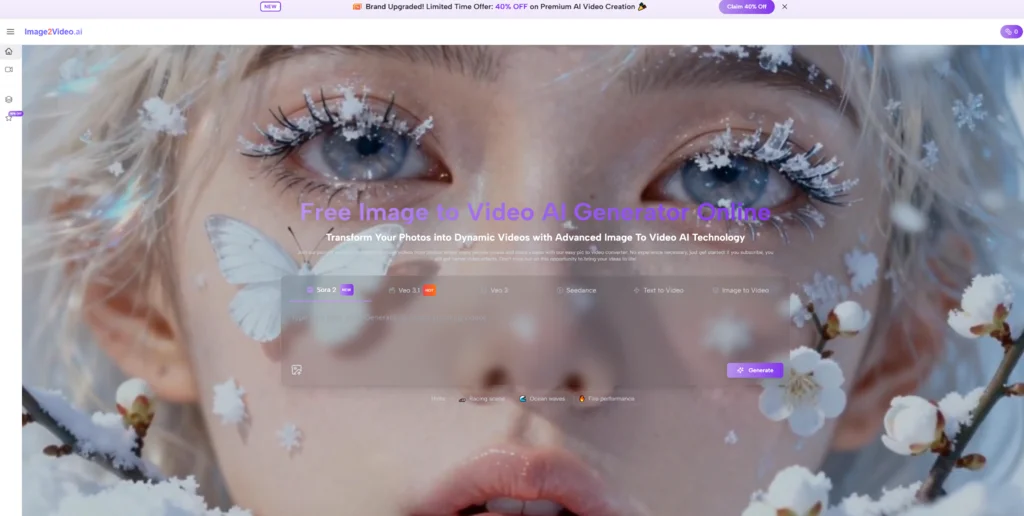
For centuries, visual art has been defined by boundaries. A painting stops at the frame. A photograph stops at the shutter click. We have mastered the art of composition, color, and light, but we have always been limited to two dimensions. We capture a slice of reality, pin it like a butterfly under glass, and call it finished. But the human brain doesn't think in stills. We think in flow. When you imagine a forest, you don't just see the trees; you hear the rustle of leaves and feel the shifting shadows. The friction lies here: There is a gap between the dynamic world inside our heads and the static world on our screens. We are now witnessing the dissolution of that boundary. We are moving from an era of capturing moments to extrapolating them. Image to Video AI, we are no longer just editing images; we are unlocking the fourth dimension—Time—and inviting it into our creative process. To understand the shift, I recently conducted a creative experiment. I took a piece of digital concept art—a surrealist image of a floating house tethered to a cliff. In a static format, it was intriguing but silent. I fed this image into the platform, leveraging the new Sora 2 integration. I didn't ask for a movie; I asked for life. The transformation was subtle but profound. The ropes tethering the house began to strain and slacken with an invisible wind. The clouds in the background didn't just scroll; they morphed, accumulating and dissipating as real vapor does. It felt less like I had "animated" a picture and more like I had cast a spell. The AI acted as a "Motion Brush," painting physics onto a canvas that previously knew only geometry. The reason this feels different from the "GIFs" or "Cinemagraphs" of the past decade is the underlying intelligence of the models now available. Sora 2 (The Physicist): In my testing, this model displays an uncanny understanding of material properties. It knows that silk moves differently than denim, and that smoke behaves differently than steam. It simulates the weight of the world within the image. Veo 3.1 (The Cinematographer): This model seems to understand the language of the lens. It introduces depth of field and focus pulls that guide the viewer’s eye, turning a flat image into a volumetric space. Why does this matter? Because it changes the relationship between the creator and the viewer. It turns passive observation into active immersion. Below is a breakdown of how adding the dimension of time alters the viewer's experience. Imagine a portfolio for a fashion designer. Old Way: A photo of a dress. The viewer has to guess how the fabric hangs. New Way: A generated video where the model turns slightly, the fabric ripples, and the light catches the sequins. The viewer instantly understands the drape and flow of the material without a physical runway show. As with any powerful tool, there is a learning curve. The AI is not a mind reader; it is a pattern matcher. 1. The "Dream Logic" Factor In my observations, the AI sometimes leans into surrealism. If you upload an abstract image, the AI might interpret a shadow as a hole and try to move objects into it. The Takeaway: This is not a bug; it's a feature for artists. Sometimes the AI's "mistakes" offer a creative direction you hadn't considered. It acts as a digital muse, suggesting, "What if the shadow was a portal?" 2. The Stability vs. Dynamism Scale There is a trade-off I’ve noticed: High Dynamism: Asking for "explosive movement" often degrades the details of the original image. High Stability: Asking for "ambient motion" preserves the original art perfectly but offers less drama. The Strategy: Use Veo 3.1 when you need to preserve the pristine details of a face or product. Use Sora 2 when you want to experiment with complex environmental physics. This technology is not just for social media; it is reshaping how we visualize concepts in professional fields. Game developers and novelists can use this to "stress test" their worlds. Does this cyberpunk city look right when the neon lights are flickering? Does this alien landscape feel hostile when the fog rolls in? It allows for rapid prototyping of mood. Instead of spending days rendering a fly-through, an architect can take a single render and generate a 5-second clip of sunlight tracking across the lobby. It sells the feeling of the space, which is often what sells the project. History teachers can take a painting of the signing of the Declaration of Independence and add subtle movement—shuffling papers, murmuring crowds. Suddenly, a dusty historical date becomes a living scene. As we embrace this "Motion Brush," we must also respect the medium. There is a seduction in making everything move, but not everything needs to move. The power of this technology lies in intent. It is about enhancing the story, not distracting from it. When we use AI to animate a photo, we are creating a derivative work—a collaboration between human intent and machine imagination. It is a new form of digital art that sits somewhere between photography and cinema. We are standing at the threshold of a new artistic era. The definition of an "image" is expanding. For the first time in history, the moment you capture a photo is not the end of the creative journey. It is merely the first frame. With tools like Image to Video AI harnessing the power of Sora 2 and Veo 3.1, you are no longer just a photographer or an illustrator. You are a director of time. The question is no longer "How do I capture this?" The question is now: "Where does this moment go next?"The "Motion Brush": A New Creative Paradigm
The Engine of Imagination: Sora 2 and Veo 3.1
Visualizing the Shift: The Sensory Upgrade
The "Living Portfolio"
Navigating the Hallucinations: A Creative Reality Check
Strategic Applications: Beyond the Screen
1. Concept Art and World Building
2. Architectural Visualization
3. Educational Engagement
The Ethics of the "Synthetic Real"
The Canvas is No Longer Fixed
 Supriyo Khan
 Supriyo Khan
 Supriyo Khan
 Supriyo Khan
Want to add a comment?