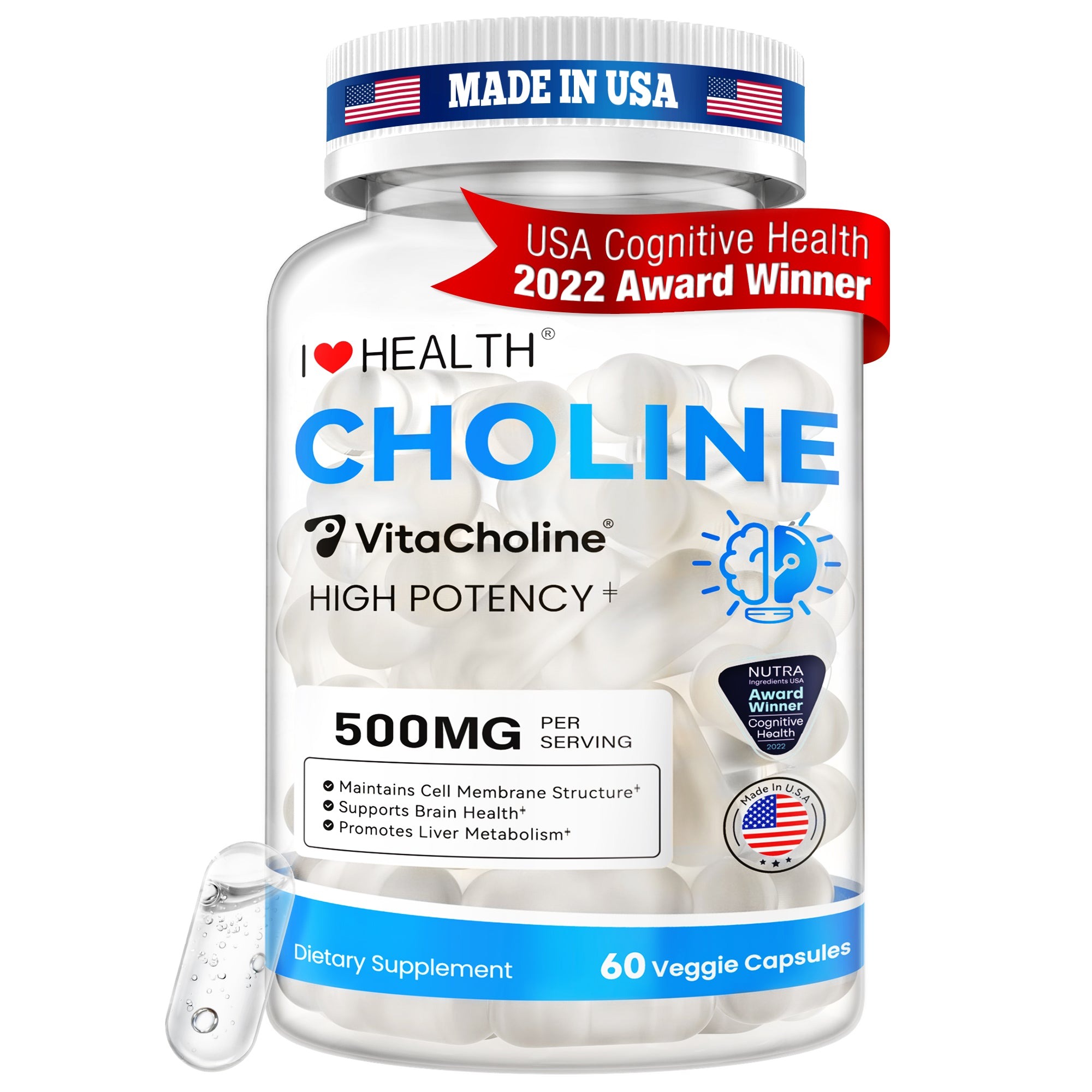
Fatigue that doesn't improve with rest. Brain fog that lingers through the afternoon. Muscle aches without obvious cause. These are symptoms many people chalk up to stress or poor sleep — but they can also be signs that the body is running low on a nutrient it can't function properly without. Choline is classified as an essential nutrient, meaning the body cannot produce sufficient amounts on its own and must obtain it from food or supplements. Yet it remains one of the most commonly deficient nutrients in the modern diet, overlooked in part because it doesn't carry the name recognition of vitamins C or D.
Choline is involved in processes that span virtually every major system in the body. It builds and maintains cell membranes, drives the production of the neurotransmitter acetylcholine, enables the liver to process and export dietary fats, and plays a foundational role in methylation — a biochemical process that influences gene expression, detoxification, and cardiovascular health. The consequences of chronic low intake range from subtle cognitive sluggishness to more serious conditions like liver disease and neurological decline. This guide walks through the key signs of choline insufficiency, the populations at greatest risk, and how supplementation can effectively close the gap.
Because choline is involved in so many biological functions, its deficiency can show up in diverse ways that don't immediately point to a single cause. Knowing what to look for helps make the connection between lifestyle symptoms and nutritional status.
Memory lapses, difficulty concentrating, and reduced mental sharpness are among the most commonly reported symptoms associated with low choline intake. Acetylcholine — the neurotransmitter synthesized from choline — is critical for encoding new memories and sustaining focused attention. When choline availability drops, acetylcholine production can be compromised, leaving the brain less equipped for tasks that require working memory and cognitive flexibility. Many people describe this as a "foggy" quality to their thinking, where information that should be readily accessible feels just out of reach. These effects are subtle in mild deficiency but become more pronounced over time.
Acetylcholine also governs neuromuscular signaling — the communication between nerves and muscle fibers that drives voluntary movement. Insufficient choline can impair this signaling pathway, contributing to unexplained muscle weakness and exercise intolerance. Some people with low choline intake report that their muscles feel unusually heavy or that they fatigue faster than expected during physical activity. These symptoms are distinct from the kind of fatigue caused by iron deficiency or thyroid dysfunction but are often overlooked as a possible nutritional cause.
The liver depends on choline to produce phosphatidylcholine, which is essential for packaging and exporting dietary fat. Without it, fat accumulates in liver cells. In clinical settings, choline-deficient diets have been shown to elevate liver enzymes (ALT and AST) and cause measurable increases in liver fat within weeks. People with non-alcoholic fatty liver disease, elevated liver enzymes on blood tests, or a history of heavy alcohol use are particularly likely to have insufficient choline and may benefit significantly from a choline supplement.
Certain groups face a substantially higher risk of inadequate choline intake due to dietary patterns, physiological demand, or genetic factors. Identifying your risk profile is a useful first step before deciding whether supplementation makes sense.
Pregnant and breastfeeding women have dramatically elevated choline requirements — the adequate intake during pregnancy rises to 450 mg per day, and during lactation to 550 mg per day. These higher demands reflect choline's critical role in fetal neural tube closure, hippocampal development, and the long-term programming of the child's cognitive and stress response systems. Many prenatal vitamins contain little or no choline, leaving a significant gap that food alone may not fill for many pregnant women.
People following plant-based or vegan diets face a structural challenge because the most bioavailable and abundant dietary sources of choline — eggs, beef liver, and fish — are excluded. While some plant foods like soybeans, Brussels sprouts, and quinoa contain choline, the amounts are considerably lower and the bioavailability differs from animal-source choline. Careful dietary planning and supplementation become more important for maintaining adequate choline status on these diets.
Individuals with variants in the PEMT gene or the MTHFR pathway have genetically increased choline requirements. PEMT (phosphatidylethanolamine N-methyltransferase) is the enzyme the body uses to synthesize some choline internally. People with reduced PEMT activity rely more heavily on dietary and supplemental choline to meet their needs, and they may experience deficiency symptoms even when their intake appears adequate by population standards. Genetic testing can identify these variants, and iLoveHealth's choline formulations provide a reliable way to address elevated individual requirements.
Not all choline supplements are interchangeable — the form determines how efficiently choline is absorbed, how well it crosses into the brain, and what downstream effects are most prominent. Selecting the right form for your goals makes a meaningful difference in outcomes.
Alpha-GPC is the form with the most robust clinical evidence for cognitive effects. It crosses the blood-brain barrier efficiently and raises acetylcholine levels in the hippocampus and prefrontal cortex — the regions most involved in memory and executive function. Clinical trials using alpha-GPC have shown improvements in memory retrieval speed, attention, and processing speed in both healthy adults and people with mild cognitive impairment. It is the preferred form for anyone whose primary goal is brain health and mental performance.
Citicoline (CDP-choline) is another highly regarded form that raises both choline and uridine levels, supporting neuronal membrane integrity in addition to acetylcholine synthesis. It has been studied extensively in the context of stroke recovery, Alzheimer's disease, and attention disorders. For people concerned about neuroprotection and long-term brain resilience, citicoline is an excellent option.
For liver support and general choline adequacy, choline bitartrate and phosphatidylcholine are effective and economical choices. Phosphatidylcholine — the form found naturally in food — integrates directly into cell membranes and is particularly relevant for liver health applications. Doses typically range from 300 to 600 mg per day depending on the form and individual need, with higher doses recommended during pregnancy under medical supervision.
Choline deficiency is common, underdiagnosed, and consequential. The symptoms it produces — cognitive fog, muscle weakness, liver stress, and fatigue — are easily attributed to other causes, allowing the underlying nutritional gap to go unaddressed for years. For the populations most at risk, including pregnant women, plant-based eaters, and those with relevant genetic variants, targeted supplementation is not just a wellness option but a genuine health priority. Matching the choline form to your specific goals, whether that is sharper cognition, liver protection, or meeting elevated pregnancy requirements, ensures you get the most from supplementation. A consistent daily habit is far more valuable than occasional high doses, and the benefits of restoring adequate choline levels extend across virtually every system in the body.
 Supriyo Khan
 Supriyo Khan
 Supriyo Khan
 Supriyo Khan

Want to add a comment?