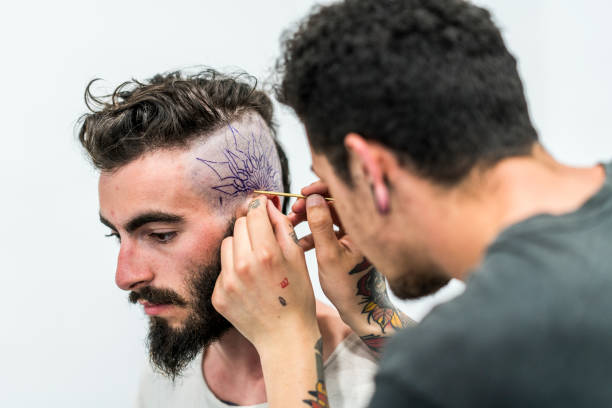
A hair tattoo can address thinning hair by replicating the look of natural follicles to increase visual density, restore hairlines, and conceal scarring. The procedure is nonsurgical, and a practitioner customizes it to match the client's skin tones and hair types. Here are a few reasons why hair tattoos are a creative solution for thinning hair: Artists offer hairline recreation through sculpt micropigmentation, rebuilding a receding hairline, and creating a more defined look. They work with clients to design straight, round, and slightly receded hairline styles. The process utilizes a hair tattoo to give the appearance of a more defined and denser hairline. Practitioners customize pigment shades to match a client’s hair color and skin tone. They use micro-fine needles to deposit specialized pigment into the scalp and fill in sparse areas. By placing pigment between thinning strands, the treatment reduces contrast between the scalp and hair, making the head appear fuller. The treatment provides a durable solution, maintaining its appearance for years before needing a touch-up. Scar camouflage blends damaged or bare areas of the scalp with the existing hair to restore a uniform appearance. It addresses the visual challenges of thinning hair through the following: Follicle replication within scar tissue Eliminating dark contrast Blending out scar visibility Addressing disruption in growth Follicle Replication within scar tissue fills in gaps where hair no longer grows. The treatment reduces the visual contrast between the light color of a scar and the darker surrounding hair. Artists apply pigment to the car and the surrounding healthy skin to blend out the edges. Corrective pigment camouflage restores a uniform appearance in areas where injuries or surgical procedures have permanently stopped natural hair growth. Practitioners use specialized inks specifically formulated for the sculp that resist fading or discoloration over time. Scalp micro pigmentation addresses the loss of visual hair thickness. By depositing pigments between existing strands, an artist fills in the scalp to eliminate the appearance of diffuse thinning. Darkening the scalp to match the hair color creates the illusion of a fuller head of hair. The service is effective for specific thinning regions, such as widening part lines in women or thinning at the crown in men. Practitioners use a gray-scale pigment system that can be diluted to match any hair color, including gray or lighter shades. Custom dilution using the gray scale might make the added density look entirely natural. By adding a matte pigment to the skin, this service helps disguise scalp glare or shine. Artists perform density enhancement in layers across multiple sessions. The first session lays a follicle replication foundation, while the subsequent sessions increase visual density and eliminate signs of thinning. SMP correction provides a way to restore natural appearance for those who might have had unsuccessful prior treatments. Correction services refine areas with oversized dots or unnatural colors. If a previous hair tattoo has faded into an unnatural blue or green hue, practitioners neutralize or adjust the pigment. The correction procedure helps reshape hairlines that were placed too low or too straight to properly frame the face. In cases where too much pigment was applied, artists break up the pigment to recreate the appearance of individual follicles. By correcting poor work, practitioners may then add the proper depth and layering needed to thicken the look of thinning hair. Scalp micropigmentation helps resolve thinning caused by traction alopecia by filling patchy areas. For localized thinning, practitioners deposit pigment to camouflage the bare scalp and make the hair appear thicker. They use a layering process to build a realistic three-dimensional effect that mimics natural hair depth. The procedure uses a pointillism technique, where tiny micro-needles create individual dots rather than lines. Using this technique improves effectiveness in traction alopecia correction by allowing the artist to fill irregular patches more naturally. Before treatment, practitioners provide a consultation to assess the scalp. They check the skin’s health state for pigment retention and address other issues. Scalp tattoos provide a semi-permanent cosmetic solution, and you may touch up the pigment after several years. Touch-ups allow the treatment to adapt as your natural hair continues to thin or change color with age. Contact a reputable tattoo artist to learn more about their services.Hairline Recreation
Corrective Pigment Camouflage
Density Enhancement
SMP Correction
Traction Alopecia Correction
Explore Hair Tattoo Procedures
 Supriyo Khan
 Supriyo Khan
 Supriyo Khan
 Supriyo Khan
Want to add a comment?