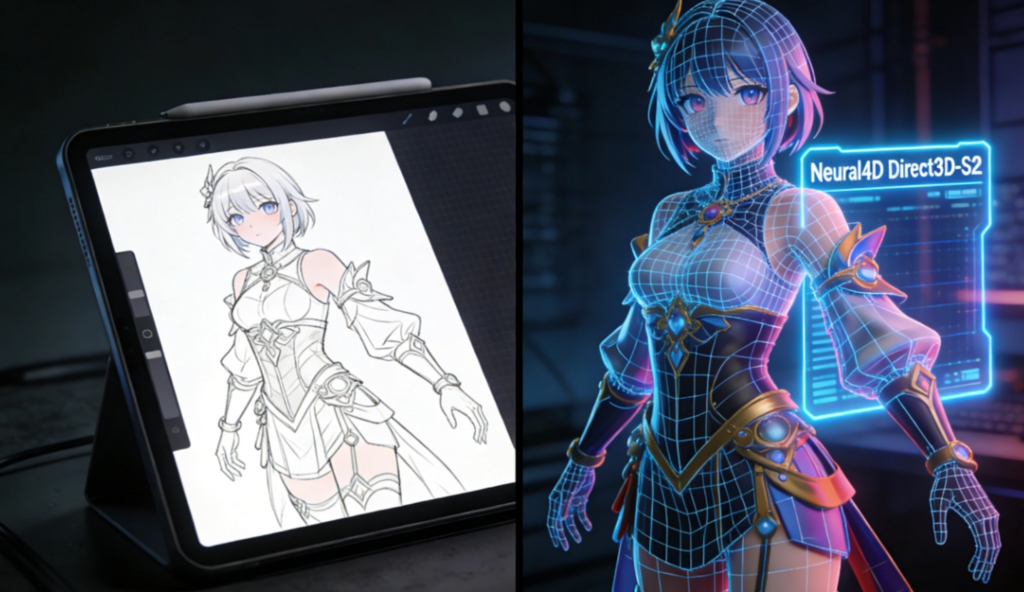
The leap from 2D illustration to 3D production has historically been a walled garden, guarded by steep learning curves and expensive software licenses. For webtoon artists and indie developers, the bottleneck isn't the imagination—it's the hundreds of hours required for manual vertex pushing. However, in 2026, the emergence of an automated 2D to 3D anime workflow is dismantling these barriers, allowing creators to transform flat sketches into depth-rich, volumetric assets in seconds.
Traditional 2D workflows often suffer from production fatigue when artists are forced to draw repetitive backgrounds or complex character rotations from scratch. By leveraging AI-driven generation, creators can now bypass the "blank canvas" struggle and focus on storytelling.
Instant Volumetric Logic: Neural4D uses Direct3D-S2 architecture to interpret 2D input and reconstruct accurate volume, ensuring models aren't just "flat planes" but true 3D structures.
Native Anime Optimization: The AI Anime module is specifically tuned for cel-shaded aesthetics, preserving the sharp lines and vibrant palettes unique to the genre.
Speed as a Creative Asset: With inference speeds up to 12 times faster than previous industry standards, artists can iterate on character designs in real-time without breaking their creative flow.
A 3D model is functionally useless if it creates more work for the rigger or animator. Many generic AI tools output "triangle soup", a chaotic mess of polygons that is impossible to animate. Neural4D prioritizes Clean Topology, providing a solid foundation for professional pipelines.
Quad-Dominant Geometry: The system generates quad-dominant meshes, which are essential for smooth deformations and clean edge flow during animation.
Engine-Ready Exports: Assets are exported in industry-standard formats like .vrm, .fbx, and .glb, allowing for direct imports into Unity, Unreal Engine, or VSeeFace for virtual YouTubing.
Conversational Refinement: Through the Neural4D-2.5 multi-modal model, creators can use natural language to fine-tune specific details, such as adjusting a character's proportions or refining garment folds, without manual sculpting.
The shift toward automated pipelines isn't about replacing the artist; it's about eliminating "digital brick-laying". By automating the reconstruction of standard props, buildings, and background characters, solo developers can achieve production values previously reserved for large studios.
Watertight Integrity: Every generated asset features watertight mesh logic, ensuring there are no hidden holes that could break lighting or physics simulations within a game engine.
PBR Texture Support: Even for anime styles, the inclusion of PBR textures ensures that models react realistically to dynamic lighting environments.
Cost-Efficient Iteration: Instead of paying per-vertex, creators utilize a credit-based system that allows for rapid prototyping and constant refinement.
In 2026, the most successful creators are those who treat AI as a high-speed scaffolding. By integrating Neural4D into your production, you aren't just generating geometry; you are reclaiming your time. The transition from a 2D sketch to an engine-ready 3D asset is no longer a multi-day ordeal—it is a three-second interaction. Stop fighting the software and start realizing your vision.
 Supriyo Khan
 Supriyo Khan
 Supriyo Khan
 Supriyo Khan

Want to add a comment?